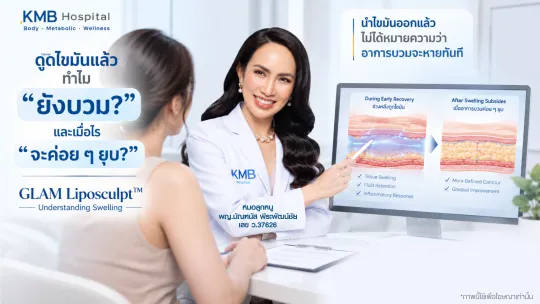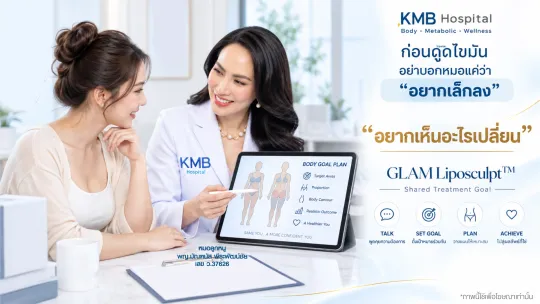
After the GLAM Liposculpt™ procedure, why is it necessary to return for a follow-up with the doctor?

Why You Must Return for Follow-ups with Your Doctor After the GLAM Liposculpt™ Program
After the GLAM Liposculpt™ program, returning for follow-ups is crucial because even if you feel better or have returned to your daily routine, your tissues are still in the recovery process. Doctors need to evaluate swelling, hardening or lumps, incision changes, the progression of your Body Contour, and your body's readiness for each recovery stage.
Article Code: GL-F-K05 | Reading time: ~8 minutes Category: Post-Liposuction Care and Results First Published: October 2, 2026 Last Updated: October 5, 2026
After the GLAM Liposculpt™ program, returning for follow-ups is crucial because even if you feel better or have returned to your daily routine, your tissues are still in the recovery process. Doctors need to evaluate swelling, hardening or lumps, incision changes, the progression of your Body Contour, and your body's readiness for each recovery stage.
A follow-up is not just about "checking the incision"; it is an essential part of post-liposuction care. It allows your doctor to see how your body is recovering and to determine how to adjust recommendations for each specific individual.
"I feel better, why do I still need to see the doctor?"
This is a very understandable question.
After a liposuction program, once the soreness subsides, you can move around easily, return to work, and the external incisions are healing well, many people may feel:
But what we see or feel on the surface is only one part of recovery. Underlying tissues can continue to undergo changes, swelling may not have completely subsided, some areas may become firm or develop lumps, and your Body Contour can continue to evolve.
Follow-ups are more than just checking incisions
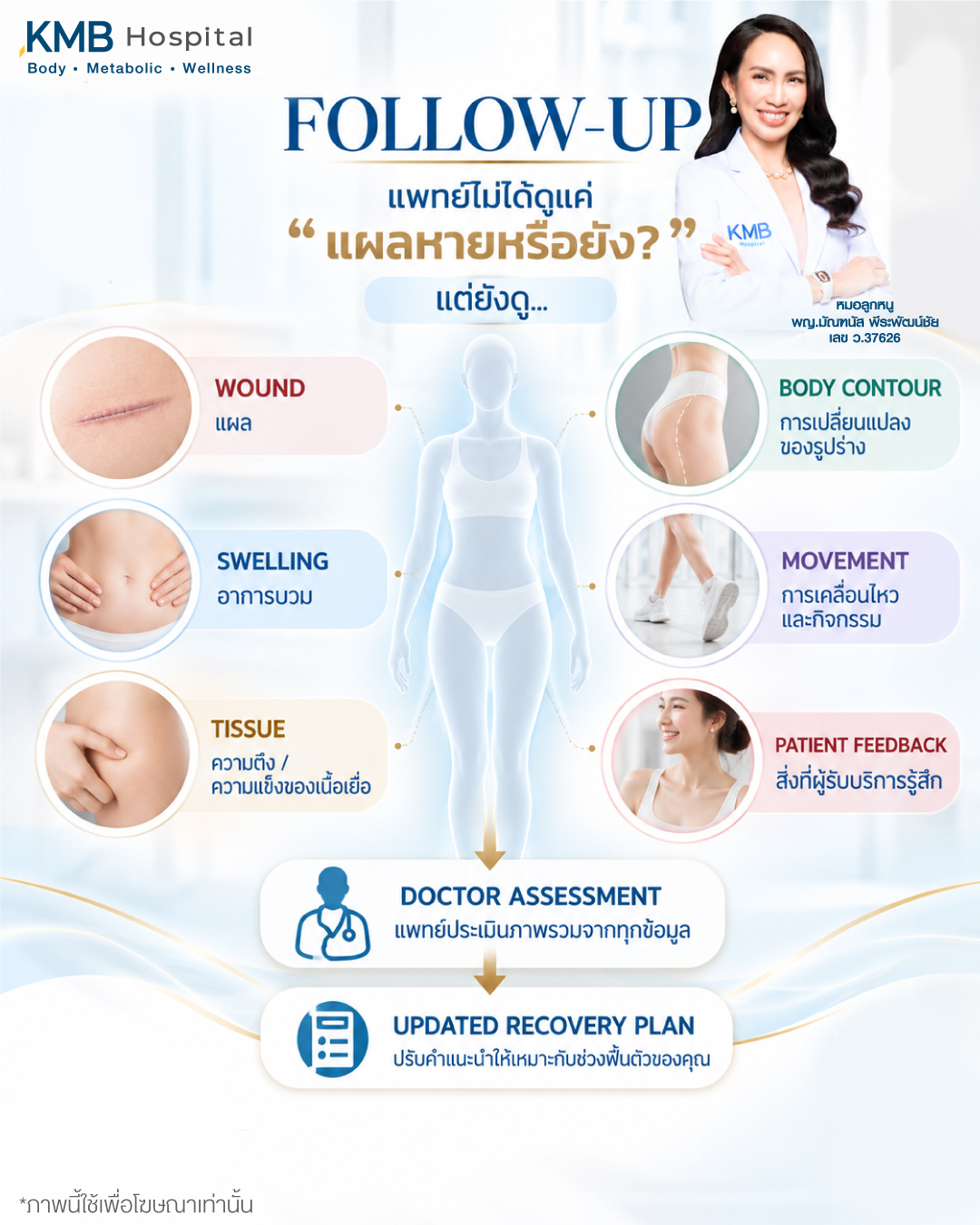
Initially, incisions are the biggest concern because they are visible. But as they heal, there are many other factors the doctor needs to monitor, such as:
Therefore, a follow-up isn't just about "is the incision okay?", but rather:
Care must evolve with your Recovery Stage
Advice appropriate for the early stages post-liposuction may not be the same for later stages. One phase may focus on incision care and basic movement, while the next might require evaluating swelling, tissue firmness, or activity levels. In some cases, doctors may consider additional care based on your actual recovery. Follow-ups help answer:
This is why aftercare should not be a static set of instructions from start to finish.
Follow-ups help identify "trends," not just snapshots
In our topic on swelling, we mention the principle that:
The same principle applies to follow-ups. Seeing your shape on a single day provides only partial information. By tracking your progress over several stages, doctors can see:
Looking at the "path" of change is more useful than making judgments based on a single visit.
Patient input during follow-ups is vital
Follow-ups are not just about the doctor checking you. Observations you make at home are critical information, such as:
These details help doctors understand your recovery journey in more detail. Please share these honestly with your medical team; don't wait until the symptoms are severe or very obvious.
Follow-ups allow doctors to tailor advice to your body's reality
Before going home, you receive advice based on the treatment scope and planned strategy. However, as time passes, your body provides additional feedback. Some people recover faster in certain areas, others have more swelling, some have firm spots that need monitoring, and some are ready for activity sooner or later than others. Follow-ups allow doctors to adjust advice from:
This is Personalized Recovery.
Why GLAM Liposculpt™ prioritizes follow-ups
Because GLAM does not view liposuction as:
It is a treatment journey comprising:
In each phase, the information the doctor needs to track differs. Therefore, follow-ups act as "connection points" between each recovery stage to observe how your body is progressing and what steps to take next.
Follow-up does not mean more treatment every time
This is very important. Some may think returning for a follow-up means having more treatment every time. That is not necessary. Follow-ups can simply be:
If the doctor sees that your body is recovering according to plan, nothing else may be needed. The goal of a follow-up is not to "find more things to do," but:
Don't wait for problems to occur before seeing your doctor
Effective follow-ups are not just for when complications occur. If you wait until a problem arises, you lose the opportunity to witness the changes along the way. Planning your follow-ups helps the medical team understand your recovery journey from stages where no obvious problems exist. If there are areas that need careful monitoring, they can be tracked appropriately. Thus, view follow-ups as an essential part of treatment, not as a visit reserved only for when "something goes wrong."
Follow-up is part of Personalized Recovery
If we were to summarize this chapter in one sentence, we want you to remember:
or
Because before the liposuction program, we planned based on pre-procedure information. After the program, we must use new information from your actual recovery. This is why GLAM Liposculpt™ care doesn't end on the day of the procedure; it continues through monitoring your recovery and evaluating results at appropriate intervals.
Key Takeaways
- Post-liposuction follow-ups are not just for incision checks; they assess tissue recovery and Body Contour.
- Even if you feel better or have returned to work, internal recovery is still ongoing.
- Follow-ups help doctors observe trends in swelling, firmness, lumps, and shape changes over time.
- Post-liposuction advice can change based on your Recovery Stage and clinical findings.
- Returning for a follow-up does not mean you must have extra treatments every time.
- GLAM Liposculpt™ views follow-ups as a part of Personalized Recovery, not an optional step after treatment.
"I feel normal," but what else does the doctor need to check?
Imagine a patient returns for a follow-up and says:
This is great news. However, the doctor still needs to check several things: where swelling remains, which areas are still tight or firm, if the recovery is symmetrical, how the incisions are, what direction the Body Contour is heading, and whether the body is ready for the next Recovery Stage. What you feel in daily life and what the doctor assesses from the tissues are different data points that must be combined.
What does the doctor examine during a follow-up?
Every examination may differ depending on the treated area and time since liposuction, but in general, doctors evaluate several things together, such as:
Check incision healing, skin color, and changes around the area.
Check if swelling is decreasing, shifting, or its overall appearance.
Evaluate how firmness relates to your Recovery Stage and whether it requires further monitoring.
Monitor the shape trend from front, side, and back views.
Evaluate if you are ready to increase your activity levels.
Listen to your observations from home and integrate them with the examination findings.
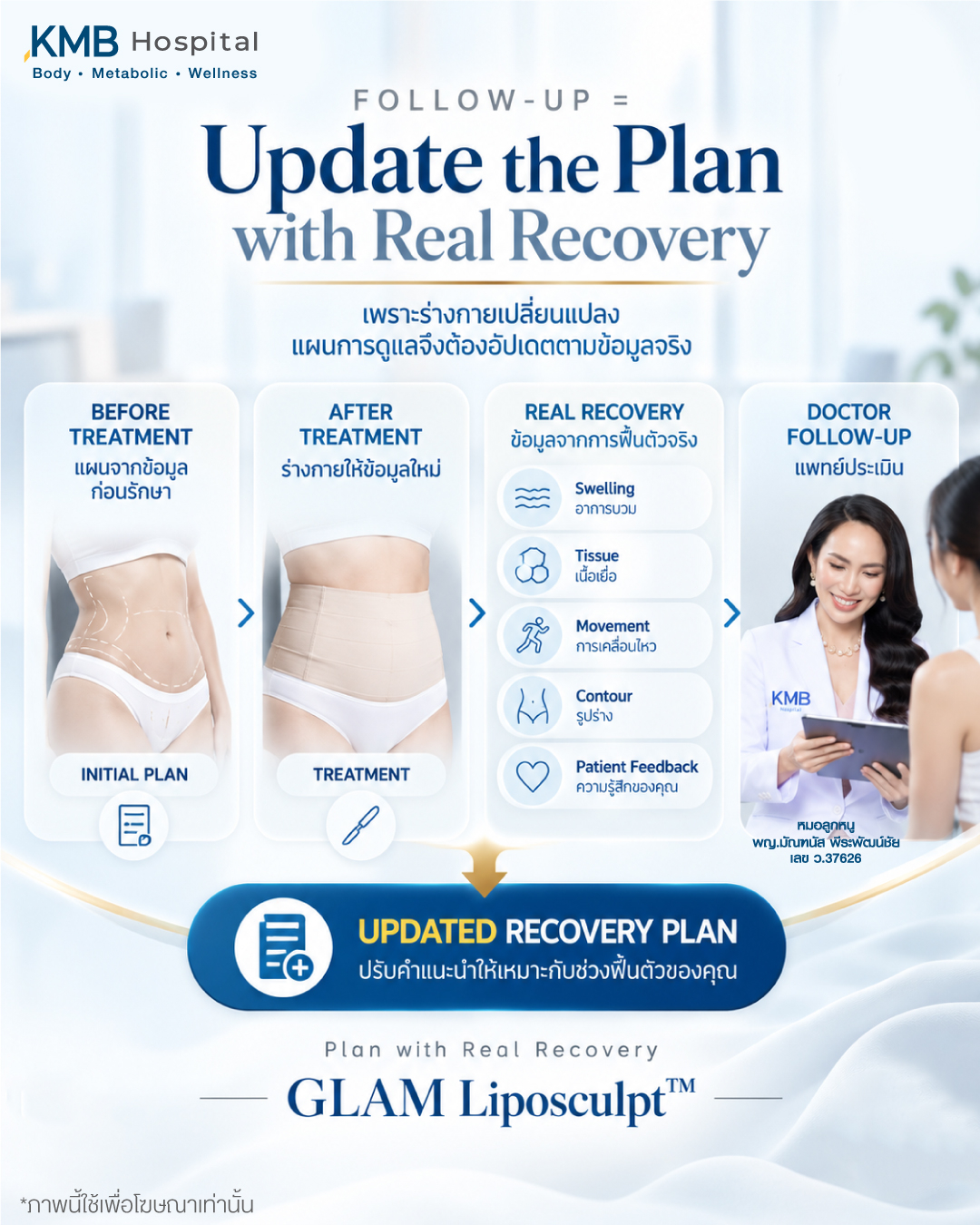
Therefore, a follow-up combines information from:
together.
Follow-up photos are useful because they help observe "changes over time."
Mirror-checking your shape daily can make you hyper-focused on minor variations, causing unnecessary worry. However, tracking photos from similar angles over time helps you see Body Contour trends more clearly than relying on your own memory. Nevertheless, photos are just one piece of information; the doctor must still integrate them with physical exams and your Recovery Stage. Therefore, follow-up photos are not just for "Before-After" comparisons, but are an integral part of tracking change.
Follow-ups are still useful even if recovery is going well
Some may think:
But actually, follow-ups when everything is going well are extremely useful. They allow the doctor to confirm that recovery is proceeding in the right direction and help determine:
A follow-up doesn't just have the duty of "finding problems," but also of confirming that your body is recovering as expected.
Follow-ups help reduce unnecessary care
Another important point is that when patients worry about swelling, lumps, or unevenness, they may feel an urge to rush into more treatments. If the doctor evaluates and sees that tissues are changing according to the Recovery Stage and no further intervention is needed, the follow-up prevents over-treatment. This aligns with the principle in the previous chapter:
Rather than See a change → Rush for Treatment.
Because sometimes, the most appropriate care is just to monitor and give the tissues time to recover.
Follow-ups help connect "Recovery" to "Results"
Initially, the goal of follow-ups is to see how tissues are recovering. As time passes, the role of follow-up shifts from:
This is why we shouldn't use the question "Is it showing results yet?" as the only question from day one post-liposuction, because in each phase, the doctor is evaluating different things.
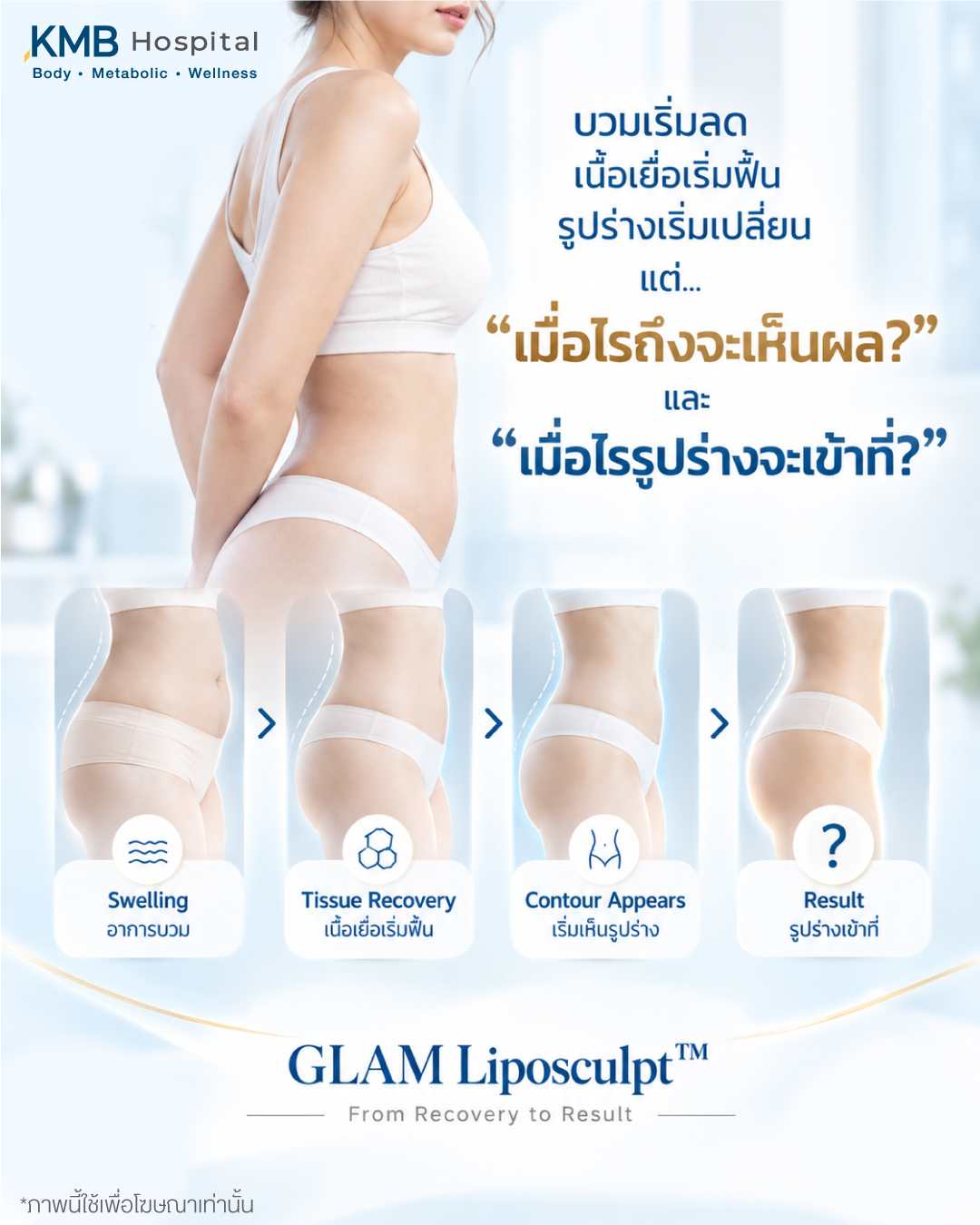
What is checked in each follow-up stage?
Frequently Asked Questions
Why return for follow-ups after GLAM Liposculpt™ even if I feel good?
Because feeling better only reflects a part of recovery. Even if you can walk, work, or feel little pain, tissues can still have swelling, firmness, or Body Contour changes. Follow-ups help doctors evaluate these and tailor advice to your current Recovery Stage.
What will the doctor examine at a follow-up after GLAM Liposculpt™?
It depends on your Recovery Stage and treated area. They may check incisions, swelling, firmness/lumps, symmetry, Body Contour, movement, and observations you have from home. The goal is a comprehensive view of your recovery progress, not just checking the incisions.
If I have no problems after GLAM Liposculpt™, do I still need to follow up?
Yes, you should follow the plan provided by your medical team. Follow-ups are beneficial even when recovery is smooth; doctors use them to confirm progress, adjust activity or advice, and set appropriate intervals for future evaluations.
Does follow-up after GLAM Liposculpt™ mean more treatment every time?
Not necessarily. Follow-ups might simply involve exams, discussions, and adjusting advice based on your Recovery Stage. If the doctor sees you are recovering well, no extra treatment may be needed.
How are follow-up photos after GLAM Liposculpt™ useful?
Photos from similar angles help visualize shape trends over time, especially as changes occur gradually.
However, photos cannot replace a physical examination. The doctor still needs to integrate them with clinical signs, tissue palpation, and your Recovery Stage.
How do follow-ups after GLAM Liposculpt™ help with results?
Follow-ups allow the doctor to observe how recovery progresses. As time passes, the consistent monitoring of Body Contour changes helps distinguish which phase you are in—recovery assessment versus evaluating the final result—preventing hasty judgments made too early.
Summary
After a GLAM Liposculpt™ liposuction program, follow-ups are not just for incision checks; they involve tracking:
Follow-ups allow the doctor to use real physiological data to update original plans. The core concept of this article is:
Or "Follow up to let the care plan progress based on your actual physical state." As recovery progresses, the role of follow-ups shifts from assessing recovery to evaluating Body Contour and final results. This leads to the next important question:
Read more from DoctorLooknuu.com
About this article
This article explains the role of follow-ups after the GLAM Liposculpt™ program, covering incision assessment, swelling, tissue hardening, recovery, Body Contour changes, and adjusting advice per Recovery Stage.
Follow-ups are part of Personalized Recovery and do not mean you require extra treatments every time. Appropriate care should be based on clinical examination and individual variations.
The information provided is for educational purposes and cannot replace medical diagnosis or personalized advice from a physician.
Review Information
First Published: October 2, 2026 Last Updated: October 5, 2026
Medical References
The original source did not provide additional medical references; therefore, no references were added.
Individualized Understanding and Care
The information provided is for educational purposes and cannot replace medical diagnosis or personalized advice from a physician. Post-liposuction follow-ups and advice should be considered based on your Recovery Stage, clinical findings, and individual progress.
Do you have a follow-up or concerns during recovery?
Follow-ups are part of Personalized Recovery. If you have concerns about incisions, swelling, firmness, movement, or Body Contour, please contact your medical team and return for your scheduled follow-ups.