
After undergoing liposuction under IV sedation or general anesthesia, what recovery steps and symptoms should be monitored?

What recovery and symptoms should be monitored after IV sedation or general anesthesia for liposuction?
After a liposuction procedure, patients who have received IV sedation or general anesthesia still require a recovery period to ensure that consciousness, breathing, oxygen levels, pulse, blood pressure, nausea, pain, and bodily responses have returned to an appropriate state. Discharge is not decided solely by whether the patient is "awake" or by a specific time elapsed, but by the overall readiness according to the care team's criteria.
ASA guidelines on post-anesthetic care emphasize evaluating the respiratory system, circulatory system, level of consciousness, temperature, pain, nausea and vomiting, and other relevant information before considering discharge from the recovery area.
Table of Contents
- Why can't you go home immediately after liposuction?
- What does the team monitor during the recovery period?
- What is the difference between "awake" and "ready to go home"?
- How many hours do you need to recover before going home?
- Do IV sedation and general anesthesia recover the same way?
- Why is it necessary to have someone take you home?
- Recovery from anesthesia vs. Recovery from liposuction
- When should you contact the hospital?
- Symptoms that require urgent evaluation
- Criteria for readiness before going home
- Frequently asked questions
- Medical references
Key points to know before continuing
- Finishing a liposuction program does not mean the effects of IV sedation or general anesthesia end immediately.
- "Being awake" does not always mean "being ready to go home."
- During recovery, you still need to monitor breathing, oxygen, pulse, blood pressure, and level of consciousness.
- Symptoms such as drowsiness, nausea, chills, or dizziness can be encountered during recovery from anesthesia.
- Recovery time should not be set by a single number for everyone.
- Patients who have received sedation or general anesthesia should not drive home by themselves.
- After returning home, decisions regarding driving, working, drinking alcohol, or activities requiring focus must follow specific advice from the care team.
- Recovery from anesthesia and recovery from a liposuction program are two different layers of recovery.
Why can't you go home immediately after liposuction?
Because once the procedure is finished and "the medication is stopped," it does not mean
After IV sedation or general anesthesia, the body needs time to recover from the effects of the medication.
Some patients may regain consciousness quickly, while others may remain drowsy, dizzy, nauseous, or feel chilly.
After general anesthesia, patients are usually moved to a recovery area so the team can continue to monitor their breathing, heart function, and recovery from anesthesia. Symptoms like drowsiness, nausea, chills, vomiting, or throat irritation can be encountered during this phase.
Therefore
↓
↓
↓
What does the team monitor during the recovery period?
Consciousness
Has the patient woken up and are they responding appropriately?
Breathing
Is breathing appropriate, and is further assistance required?
Oxygen
Are oxygen levels appropriate?
Pulse and Blood Pressure
How is the circulatory system recovering and stabilizing?
Pain
Evaluate pain or discomfort as medication effects wear off.
Nausea/Vomiting
Evaluate and provide care as appropriate before discharge.
Temperature/Chills
Monitor temperature and symptoms during recovery.
It's not just about, "Has the patient opened their eyes yet?" but evaluating several aspects together.
Consciousness
How are they upon waking, and are they responding appropriately?
Breathing
Is breathing appropriate, and is there anything that requires additional assistance?
Oxygen levels
Are oxygen levels appropriate?
Pulse and blood pressure
How is the circulatory system recovering and stabilizing?
Pain
As the effects of anesthesia wear off, pain or discomfort may become more apparent and must be evaluated accordingly.
Nausea or vomiting
This is a common symptom after anesthesia and may require care before discharge.
Temperature and shivering
Some individuals may feel cold or shiver during recovery.
Post-anesthetic care guidelines cover the assessment of the respiratory system, cardiovascular system, mental state or level of consciousness, temperature, pain, nausea, vomiting, fluids, and other relevant information.
Therefore, the term "recovery" does not mean "lying down until the time is up," but rather "observing how the body is recovering."

What is the difference between "awake" and "ready to go home"?
There is a difference. A patient may be able to open their eyes or talk, but they may still be:
- Very drowsy
- Dizzy
- Nauseous
- Reacting slower than normal
- Still needing monitoring of breathing or circulatory systems
- Or still needing evaluation of other symptoms from the procedure
Therefore
It is recommended to observe the patient until they have passed the period of increased risk of cardiac and respiratory depression. We do not support setting a "fixed minimum recovery time" as the answer for everyone, but rather using discharge readiness criteria as the primary guideline.
This is why some people recover faster than others, even if they have the procedure on the same day.
How many hours do you need to recover before going home?
There is no single number for everyone. The duration depends on several factors, such as:
- The level of IV sedation or general anesthesia
- Medication received
- Patient's health
- Response to medication
- Details of the liposuction program
- Symptoms during recovery
- Facility criteria and protocols
After anesthesia, patients may be in recovery for several hours before going home or moving to a private room, depending on the type of procedure, anesthesia, and recovery process.
Therefore, one should not use terms like "everyone can go home in 1 hour" or "after 2 hours, you can definitely go home" as a hard rule because "time" is just one piece of information, but
is more important.
Do IV sedation and general anesthesia recover the same way?
Not necessarily.
Because the levels of sedation are different. IV sedation itself does not have a single level. Some people receive sedation at a level where they remain responsive, while others may become more drowsy. General anesthesia is a state of total unconsciousness and involves different forms of airway management and recovery patterns.
After conscious/moderate sedation, patients may be drowsy, have a headache, or be nauseous and still need monitoring of oxygen and blood pressure during recovery.
After general anesthesia, symptoms may include
- Drowsiness
- Dizziness
- Nausea or vomiting
- Dry mouth
- Cold or shivering
- Throat irritation in cases where airway devices were used
Therefore, instead of asking, "Which method recovers faster?" you should ask, "Which method will be used for my case, and how will the team evaluate readiness?" This is more accurate.
Is being drowsy after IV sedation abnormal?
Not necessarily abnormal. Medications used for sedation can cause
- Drowsiness
- Feeling slower
- Vague memory of certain events
- Body coordination and decision-making not returning to normal immediately
Even if a patient feels, "I am okay now," it does not mean that reflexes and decision-making have returned to their full capacity. Many sources on sedation advise avoiding driving, operating machinery, consuming alcohol, and making important decisions during the period after sedation, as determined by the team.
Therefore, after returning home, "feeling good" does not mean "being able to do everything like before immediately."
After general anesthesia, why is someone still drowsy even though they are awake?
Because regaining consciousness is a process. Patients may be awake and able to talk, but medication can still affect
- Drowsiness
- Reflexes
- Coordination
- Decision-making
for a while. The effects of general anesthetic can last for about 24 hours, even if the patient starts to regain consciousness shortly after the medication is stopped. The duration for full recovery depends on the type of procedure and the individual. Therefore, waking up is not an "on-off switch," but a gradual recovery.
Can nausea occur after general anesthesia?
Yes, it can. Nausea and vomiting are side effects that may occur during the recovery period after general anesthesia, and the team can evaluate and provide care accordingly. The important thing is not to assume that
"a little bit of nausea = definitely a complication."
However, if the symptoms are severe, persistent, or accompanied by other symptoms, you should inform the care team so they can assess the overall picture.
Is pain increasing when the medication wears off the same thing as anesthesia effects?
They are related, but they are not the same thing. In the initial period after the procedure, the effects of medication and anesthesia may still help reduce some pain perception. As the effects wear off, patients may begin to feel
- Tightness
- Soreness
- Pain
- Discomfort in the treated area
more clearly. Therefore, recovery must evaluate both "how is recovery from anesthesia?" and "what are the symptoms from the procedure?" side by side. Pain evaluation and management are part of post-anesthetic care.
Why is it necessary to have someone take you home?
Because after sedation or general anesthesia, even if the patient can walk and talk, their reflexes, balance, or decision-making may still be affected by the medication.
It is recommended that patients returning home after anesthesia have a responsible person to take them, and post-anesthetic care guidelines include having a responsible person accompany the patient home as part of the discharge plan.
Therefore, "can go home" does not mean "can go home alone."
For liposuction, there is also the matter of pain, tightness, movement, and post-procedure care involved as well.
After returning home, when can I drive?
Do not use the feeling of "not feeling sleepy anymore" as the only criterion. Both sedation and general anesthesia can affect decision-making, coordination, and reactions after the procedure.
Advice from many institutions usually specifies avoiding driving for at least the first day after anesthesia or sedation, but details may differ depending on the method, medication received, procedure, symptoms, and the care team's requirements.
For KMB patients:
You should not drive yourself just because you feel "awake and alert enough."
Can I drink alcohol after IV sedation or general anesthesia?
You should avoid it for the period recommended by the medical team.
Because alcohol can increase sedative effects and affect decision-making or coordination while the body is still recovering from medication.
Advice after sedation and general anesthesia generally includes avoiding alcohol during the post-procedure period as specified by the facility.
And do not take sleeping pills, sedatives, or certain other medications on your own without knowing the team's advice.
When can I return to work?
This must be divided into two matters:
Effects of anesthesia
During the first period, reflexes and concentration may not have fully returned.
Effects of the liposuction program
There may still be swelling, bruising, tightness, or soreness, and the nature of work for each person is different.
The American Society of Plastic Surgeons states that the time to return to work and various activities after liposuction depends on the details of each case, and activities should increase according to recovery progress and the surgeon's advice.
Therefore, do not answer based on "general anesthesia or not" alone.
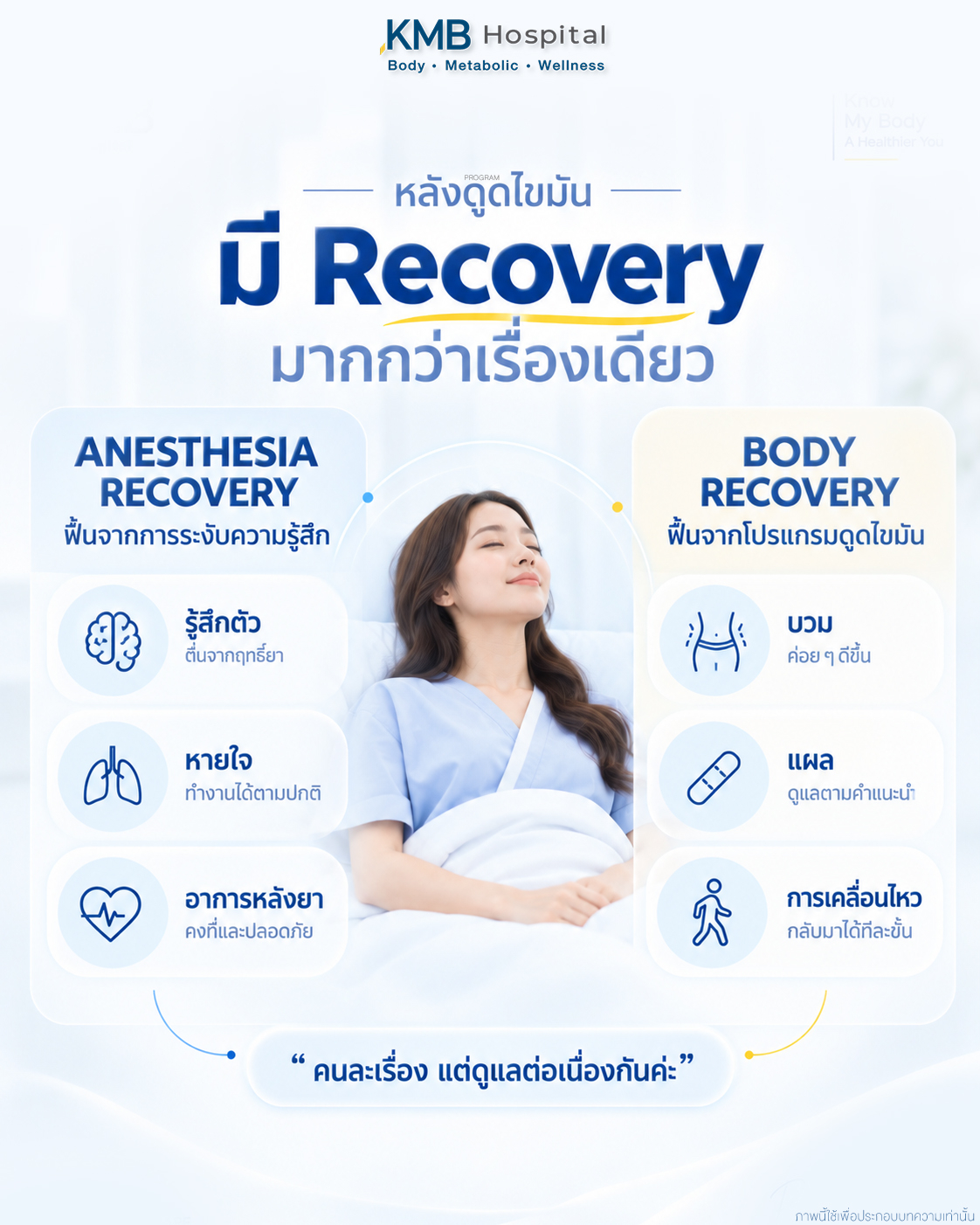
Are recovery from anesthesia and recovery from liposuction the same thing?
Not the same. This is a very important point in this chapter.
ANESTHESIA RECOVERY is recovery from IV sedation / general anesthesia. The team is checking:
- Are they fully awake?
- Are they breathing well?
- Is oxygen appropriate?
- How are pulse and blood pressure?
- Is there nausea?
- How much do medication effects linger?
Whereas LIPOSUCTION RECOVERY is recovery from the liposuction procedure itself, which may involve
- Swelling
- Bruising
- Tightness
- Soreness
- Wounds
- Compression garments
- Movement
- Caring for the treated area
- Follow-up appointments
Swelling, bruising, and discomfort are part of the recovery period after liposuction, and patients should receive specific advice regarding wounds, medication, garments, activities, and follow-ups. Therefore, waking from anesthesia does not mean the body has recovered from the liposuction program.
Is swelling and bruising after liposuction abnormal?
Swelling and bruising are common during the recovery period after liposuction. However, this chapter does not want patients to interpret that "everything is just normal," because the important thing is "the trend of symptoms" and "whether other symptoms are present."
If symptoms become severe and differ from the advice given, or if you feel that "this is not what the team said," you should contact the hospital.
When should you contact the hospital?
Specific advice must adhere to the discharge instructions for each case. Generally, if after liposuction you have:
- Severe pain or pain that differs from the advice given
- Excessive bleeding or abnormal symptoms from the wound
- Swelling, redness, heat, or suspicious discharge
- General symptoms that worsen or are clearly abnormal
You should contact the care team for evaluation. It is recommended that those with severe pain or unexpected symptoms after liposuction contact the facility where the procedure was performed as soon as possible.
Which symptoms should be considered urgent?
If you have symptoms such as:
You should receive urgent medical evaluation. Do not wait for a normal follow-up appointment.
It is advised that after surgery, if you have difficulty breathing, chest pain, or an irregular heartbeat, you should seek medical help immediately. Liposuction itself carries risks related to heart, lung, and blood clot complications, even if they do not happen to most people.
The simplest rule is:
Seek medical evaluation immediately.
If there are no abnormal symptoms, do I still need follow-up?
Yes. Having no urgent symptoms on the first day does not mean there is no need for further follow-up. After liposuction, there is still a recovery period for:
- Wounds
- Swelling
- Bruising
- Shape
- Skin
- Movement
- And returning to various activities
It is recommended that patients receive specific advice regarding wound care, medication, compression garments, things to monitor, and follow-up appointments.
Therefore, the appropriate path is:
↓
↓
↓
Not
↓
How does FAT Mapping™ relate to recovery?
FAT Mapping™ is not a tool used to monitor recovery from anesthesia. Its primary role is before the procedure, to help the doctor understand:
- Fat location
- Shape
- Relationships between different areas
- And data to be used in planning
When the procedure plan is clearer, the team has information about the scope and details of the procedure before performing it. However,
and it is not used to decide if the patient is "awake enough" or "ready to go home."
Where does GLAM Liposculpt™ come in?
GLAM is part of the procedure plan, or the plan for the liposuction program, which has an impact on the overall recovery after the procedure, such as:
- Treated areas
- Scope of the plan
- Recovery characteristics of each area
- Post-procedure care guidelines
But recovery from IV sedation or general anesthesia is another part that the anesthesia and recovery team must evaluate.
Therefore, it can be viewed as two paths that walk together:
Recovering from sedation/anesthesia
Recovering from the liposuction program
Before going home, the team doesn't just check if you are "awake yet."
To keep it simple, before going home, the team is checking:
Appropriate consciousness
↓
Appropriate breathing and oxygen
↓
Appropriate pulse and blood pressure
↓
Pain, nausea, and other symptoms managed
↓
Clear discharge plan and post-procedure advice. Therefore
Discharge should not happen just because "the patient has opened their eyes" or "the time is up," but should occur when "the overall state is recovered appropriately for the next step" according to the team's assessment.
Frequently asked questions
1. Is recovery required after IV sedation?
Yes. Although IV sedation may recover faster than general anesthesia in some situations, it still requires assessment of consciousness, breathing, oxygen, pulse, blood pressure, and other symptoms according to the sedation level and individual response.
2. Can I go home immediately after waking up?
Not necessarily. Waking up is just one part of the assessment. The respiratory system, circulatory system, side effects, and overall readiness must still be checked before discharge. ASA emphasizes using readiness criteria, not just a fixed time.
3. Are nausea or shivering common after general anesthesia?
Yes. Nausea, vomiting, shivering, drowsiness, or throat irritation can occur during recovery from general anesthesia, and the team will evaluate and provide care based on symptoms.
4. Can I drive home myself after IV sedation or general anesthesia?
No. Patients who have received sedation or general anesthesia should have someone take them home and follow specific team advice regarding the period when they should avoid driving, as reflexes and decision-making may still be affected even if you feel alert.
5. Does someone need to be with me after returning home?
Generally, outpatient surgery and receipt of sedation or general anesthesia come with advice to have a responsible adult help take you home and stay to help during the initial period after the procedure. However, for the appropriate duration, follow the advice of the medical facility and the care team.
What symptoms after liposuction should not be waited on?
If you have symptoms of difficulty breathing, chest pain, or a clearly irregular heartbeat, you should seek medical help immediately. For severe pain or other unexpected symptoms after liposuction, you should contact the medical facility providing care for evaluation as soon as possible.

Things KMB wants you to remember from this chapter
If you can remember only one thing about recovery, I want you to remember that "being awake does not mean being fully recovered." Because after IV sedation or general anesthesia, the team still needs to check:
How is their consciousness?
How is their breathing?
How is their oxygen?
How are their pulse and blood pressure?
Are they nauseous?
How much pain are they in?
Are they ready for discharge or the next step?
After that, even after recovering from anesthesia, the body still undergoes
as well. Therefore, the whole path is:
↓
↓
↓
↓
Because "procedure finished" is not "care finished."
Medical references
This article is compiled based on principles of post-anesthetic care, recovery after sedation/general anesthesia, and liposuction recovery from relevant sources, including:
- American Society of Anesthesiologists — Practice Guidelines for Postanesthetic Care
- American Society of Anesthesiologists — Anesthesia Recovery / Post-Procedure
- American Society of Anesthesiologists — Role of the Physician Anesthesiologist
- MedlinePlus — Conscious Sedation for Surgical Procedures
- MedlinePlus — General Anesthesia
- American Society of Plastic Surgeons — Liposuction Recovery
- American Society of Plastic Surgeons — Liposuction Risks and Safety
- NHS — General Anaesthetic / Liposuction
Medical disclaimer
This article is prepared to provide general information about recovery after IV sedation or general anesthesia for liposuction and cannot replace personalized advice from a doctor, anesthesiologist, or the care team.
Recovery time, discharge criteria, driving, returning to work, eating, medication use, and post-procedure activities may differ depending on the anesthesia method, medication received, patient health, details of the liposuction program, and facility protocols.
If you have severe symptoms or emergency symptoms such as difficulty breathing or chest pain, you should receive immediate medical evaluation and should not wait for a response through online channels.
Article review history
First published: October 26, 2026
Last updated: October 26, 2026
Last medical review: October 26, 2026
Medically reviewed by: Dr. Mantanus Peeraphatchai (Dr. Looknu) License 37626
Before going home after liposuction, try to ask the team everything
Am I recovered enough from the anesthesia?
Does someone need to be with me after returning home?
When should I avoid driving or doing activities that require focus?
What symptoms are common in the beginning?
What symptoms require calling the hospital back?
What symptoms require seeing a doctor immediately?
Because what is important after IV sedation or general anesthesia is not just "are you awake?" but
Do you have questions about recovery or anesthesia before doing liposuction?
You can bring your questions and concerns about health information to talk with the KMB team to receive information to help with assessment and advice that is suitable for each individual.