
FAT Mapping Outer Thigh and Hip. How does FAT Mapping™ Outer Thigh and Hip help plan liposuction to match the overall body shape?
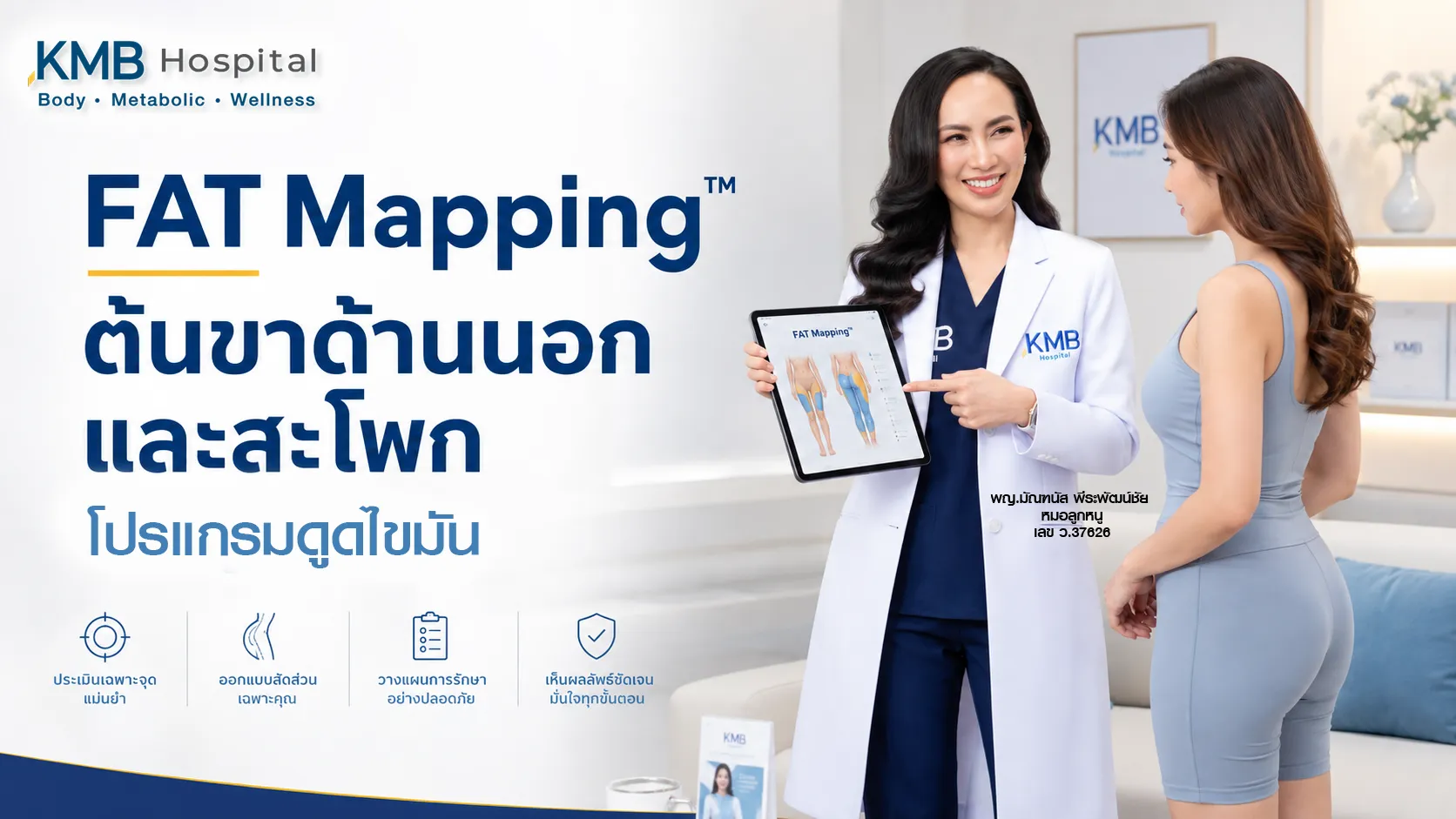
KMB KNOWLEDGE BLUEPRINT™
DOMAIN D — REGIONAL FAT MAPPING™ | Article Code: FM-D-K03
Category: FAT Mapping™ | Science of Fat | Pre-Liposuction Program Assessment
How FAT Mapping™ of the Outer Thighs and Hips Helps Plan Liposuction Programs to Match Overall Body Shape
First Published: August 15, 2026 | Last Updated: August 15, 2026 | Reading Time: 7 minutes
Author: Medical Content Team, KMB Hospital
Medically Reviewed by: Dr. Mandanus Pyrapathanaichai (Dr. Luknu) License No. W.37626
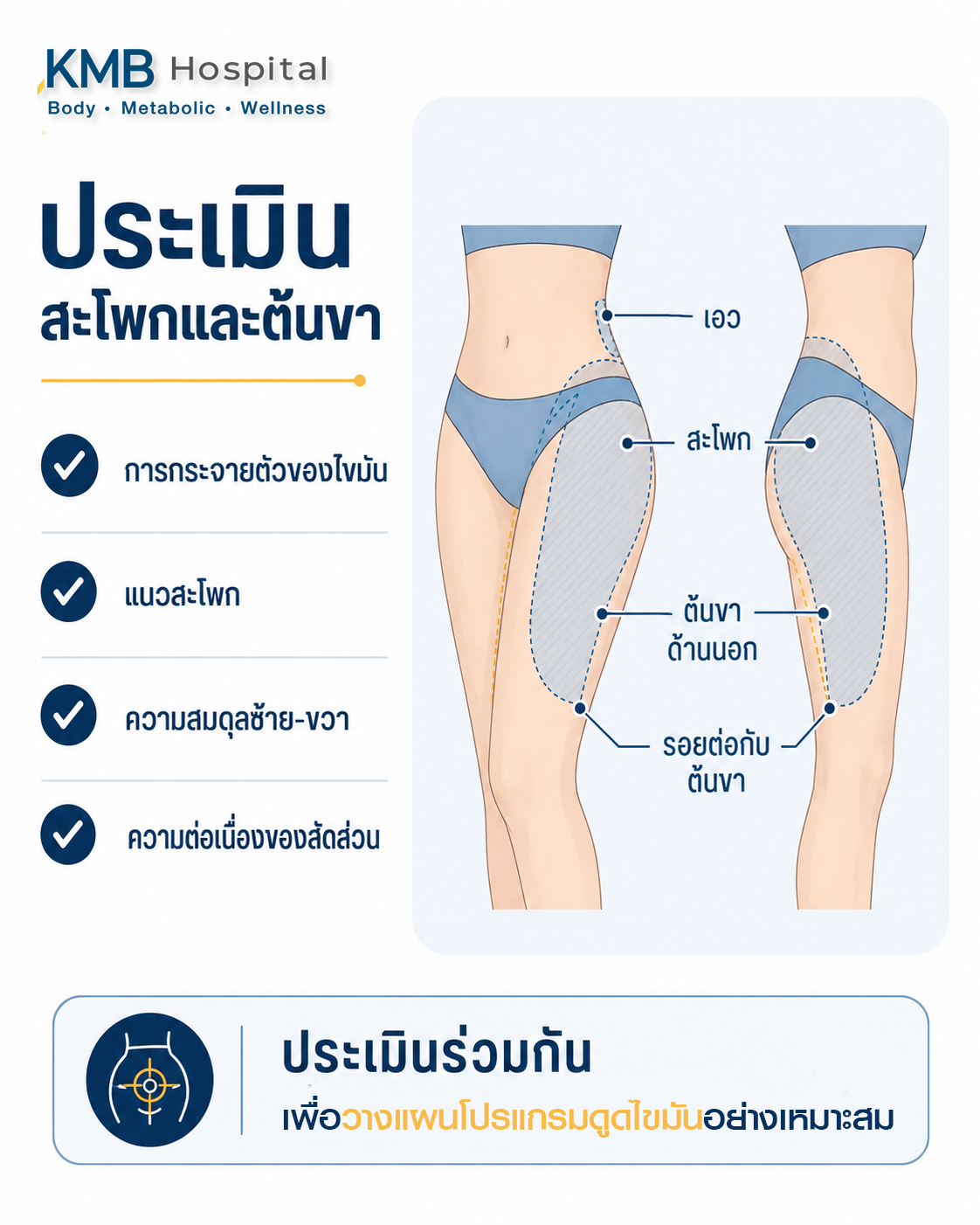
FAT Mapping™ of the outer thighs and hips enables doctors to evaluate fat distribution, hip line continuity, lower body proportions, and the relationship between the hips, thighs, and waist before planning a liposuction program.
Evaluation of this area is not focused solely on the most prominent spots, but helps doctors understand the overall shape of the lower body to choose the appropriate liposuction program direction for each client.
Why Outer Thighs and Hips Must Be Assessed Together
The outer thighs and hips are areas that are directly connected.
When clients feel their hips are wide, or outer thighs are bulging, many often view this as caused by localized fat.
However, in reality, the shape of this area is influenced by multiple factors, including fat distribution, pelvic bone alignment, muscle mass, and lower body proportion continuity.
What Does FAT Mapping™ of the Outer Thigh and Hips Assess?
FAT Mapping™ in the outer thigh and hip areas helps gather multiple aspects of data before being considered alongside patient history and physical examination
| Assessed Information | What Helps the Physician Understand |
|---|---|
| Fat Distribution | Where fat accumulates prominently on the hips, outer thighs, or how it spreads continuously between different areas |
| Continuity Between Waist, Hips, and Thighs | How the lower body proportion lines connect and which areas affect the overall picture |
| Left and Right Balance | Whether there are differences or imbalances between both sides that should be considered |
| Curves of Hips and Thighs | How the lower body curves relate to the waist, hips, leg line, and overall shape |
| Supporting Physical Examination Data | Data from FAT Mapping™ must be used together with a physical examination, health history, and the patient's goals |
These data help physicians assess the lower body shape more precisely and select a liposuction program planning approach suitable for each individual
Why Patients with Similar Hip Shapes May Receive Different Liposuction Program Plans
Even if the shapes of the hips and outer thighs look similar, assessment results may vary
Therefore, physicians use FAT Mapping™ along with physical examination to assess the overall body shape before planning the liposuction program, rather than comparing with other patients
How does FAT Mapping™ make the planning of outer thigh liposuction programs more systematic?
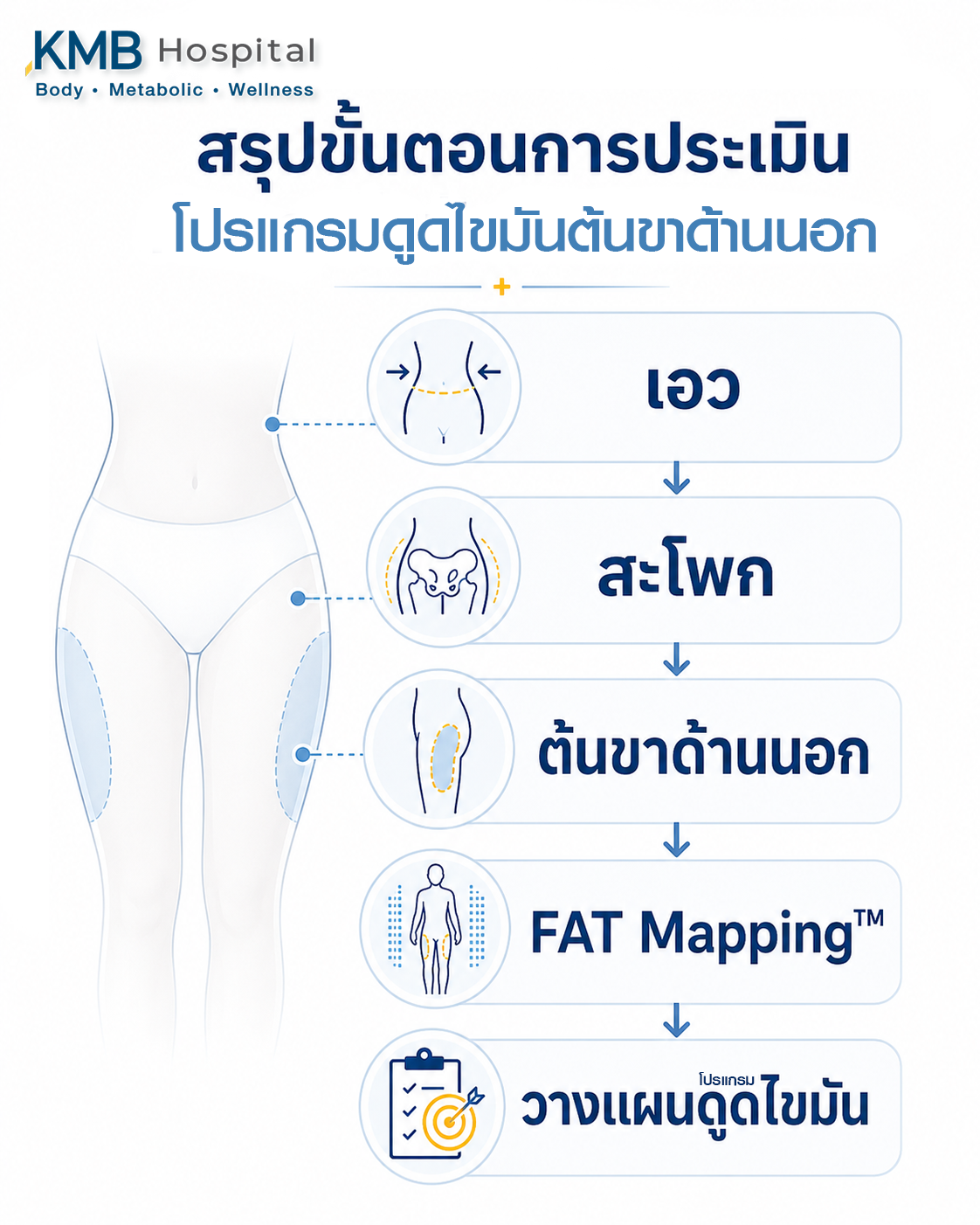
FAT Mapping™ allows doctors to understand the relationship between the waist, hips, and outer thighs more clearly.
When used together with history taking and physical examination, such data helps plan liposuction programs based on each client’s information and helps explain treatment rationale systematically.
Listen to Goals
Understand what the client is concerned about and the shape they want to change.
Evaluate Lower Body Proportions
Consider waist, hips, outer thighs, leg lines, and left–right balance together.
Connect Information
Bring together information from FAT Mapping™, physical examination, structure, and skin quality for consideration.
Explain and Plan Together
Explain possibilities, limitations, and approaches suitable for each individual’s body shape.
Key Points to Know
Outer thighs and hips must consider lower body proportion relationships; they should not be separated.
FAT Mapping™ helps gather information of thighs, hips, waist, and leg lines before planning.
The goal of planning is overall body shape balance and continuity.
Clients worried about the same area may receive different plans because structure and assessment data differ.
Suitable approaches should consider effects on hips, leg lines, and the entire lower body shape.
Evaluation Must Look at Overall Lower Body Proportions
When doctors evaluate the outer thighs, they don’t look just at the thighs but are considering hips, waist, leg lines, and overall body shape balance.
Balanced shape does not mean making any one area the smallest, but means considering how all parts connect.
Article Summary
FAT Mapping™ of the outer thighs and hips helps doctors assess fat distribution, hip line, left-right balance, and the continuity of the waist, hips, and thighs before planning liposuction programs.
Evaluation does not focus solely on the most protruding areas but considers how changes in the outer thighs affect the hips, leg lines, and overall shape.
When used in conjunction with medical history taking and physical examination, data from FAT Mapping™ enables systematic planning, clear justification, and alignment with each client's body shape.
Frequently Asked Questions
1. How does FAT Mapping™ help plan outer thigh and hip liposuction programs?
FAT Mapping™ allows doctors to visualize fat distribution and the relationship between the outer thighs, hips, waist, and leg lines. This data ensures planning does not focus solely on areas of concern for the client but considers the impact on the overall shape before making treatment decisions.
2. Why do doctors evaluate the hips along with the outer thighs before a liposuction program?
Because the outer thighs and hips significantly affect lower body proportions. If evaluated separately, the continuity of the shape might be overlooked. Therefore, doctors use FAT Mapping™ alongside physical examinations to plan for appropriate coordination between both areas.
3. Will clients with similar outer thigh issues use the same plan?
Not necessarily. Even if concerned about the same area, results from FAT Mapping™, bone structure, fat distribution, skin quality, and individual proportions differ. Therefore, care plans should be assessed individually.
4. What do doctors prioritize most before planning the outer thigh area?
Doctors prioritize the overall balance of the lower body shape by evaluating how changes in the outer thighs will affect the hips, leg lines, and overall proportions. Data from FAT Mapping™ makes the rationale for planning clearer.
5. Why might performing an outer thigh liposuction program alone not suit some individuals?
In some cases, body shape issues do not stem solely from the outer thighs. FAT Mapping™ may reveal that the relationship of the hips, waist, or other areas affects overall proportions. Thus, doctors may propose approaches that cover the relationships of relevant areas more comprehensively.
The goal is not to reduce fat in specific areas the most, but to design a shape with balance using information for individualized planning.
Related Articles at KMB Hospital

Read More from DoctorLooknuu.com
Medical Sources
- American Society of Plastic Surgeons. Liposuction Consultation. Information regarding target assessment, health, treatment history, risk factors, alternatives, expected outcomes, and limitations before treatment planning
- Chia CT, Neinstein RM, Theodorou SJ. Evidence-Based Medicine: Liposuction. Plast Reconstr Surg. 2017;139(1):267e–274e. doi:10.1097/PRS.0000000000002859.
About KMB Hospital
KMB Hospital emphasizes systematic pre-treatment assessments, utilizing information from medical history inquiries, physical examinations, FAT Mapping™, and patient goals collectively to support planning suitable for each individual's shape, health, limitations, and expectations
Article Author Information
Baby Doctor
Medical Practice License No. W.37626
Evaluate Lower Body Proportions Before Planning
If you are unsure how the bulge of the outer thigh relates to your hips, waist, leg alignment, or body structure, a physician's assessment provides clearer understanding of the information, limitations, and appropriate guidance for each individual.