How are fat and skin related? Assess before Liposuction Program | KMB Hospital
KMB KNOWLEDGE BLUEPRINT™
DOMAIN B | Article Code: FM-B-K23
Category: FAT Mapping™ | Skin and Fat | Pre-Liposuction Program Assessment
How are fat and skin related? Why must doctors evaluate both parts before a liposuction program?
First Published: August 3, 2026
Last Updated: August 31, 2026
Reading Time: Approximately 8 minutes
Author: Medical Content Team, KMB Hospital
Medically Reviewed By: Dr. Mantanun Pirapatsakay (Look-noo) License No. W.37626
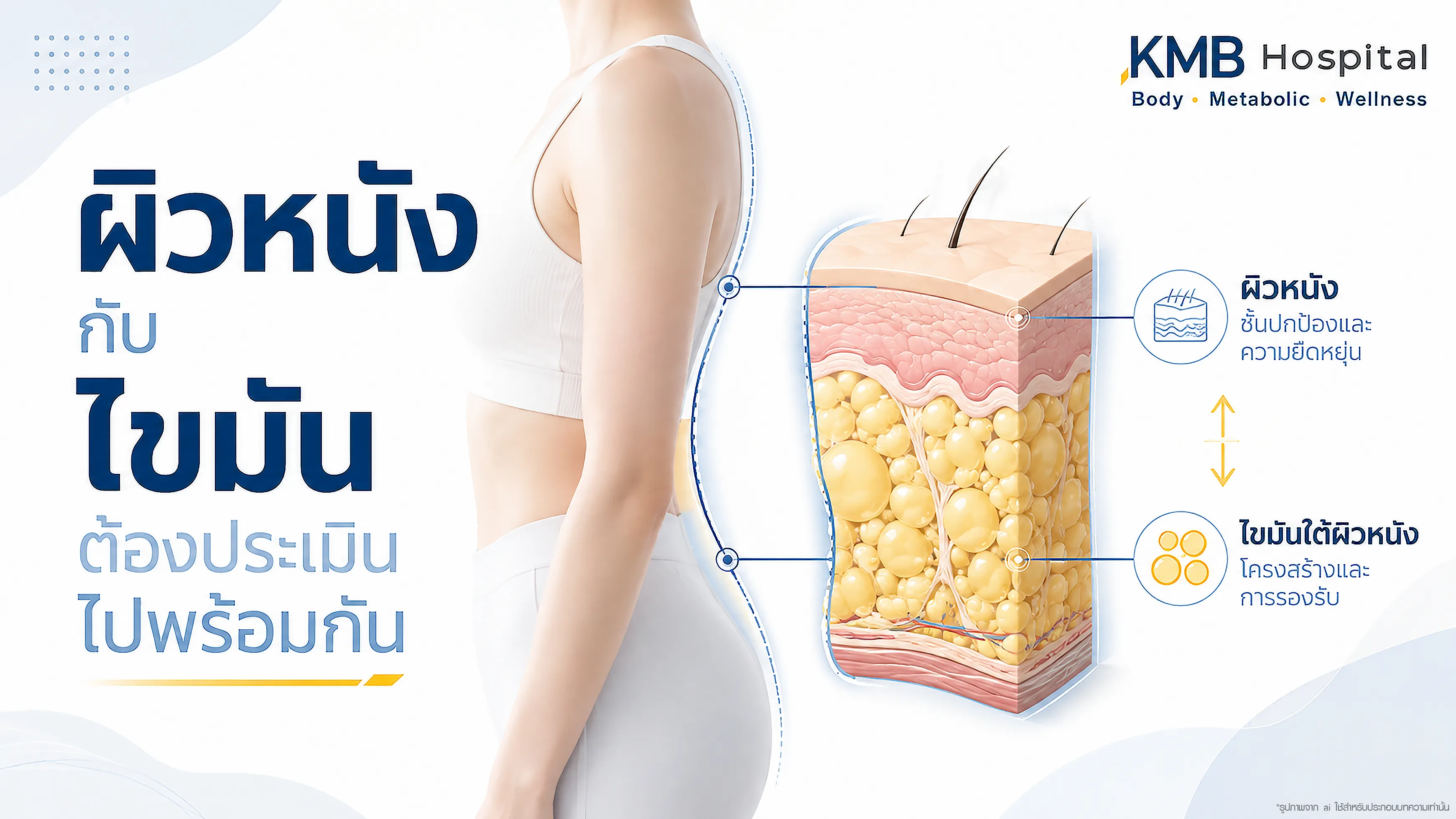
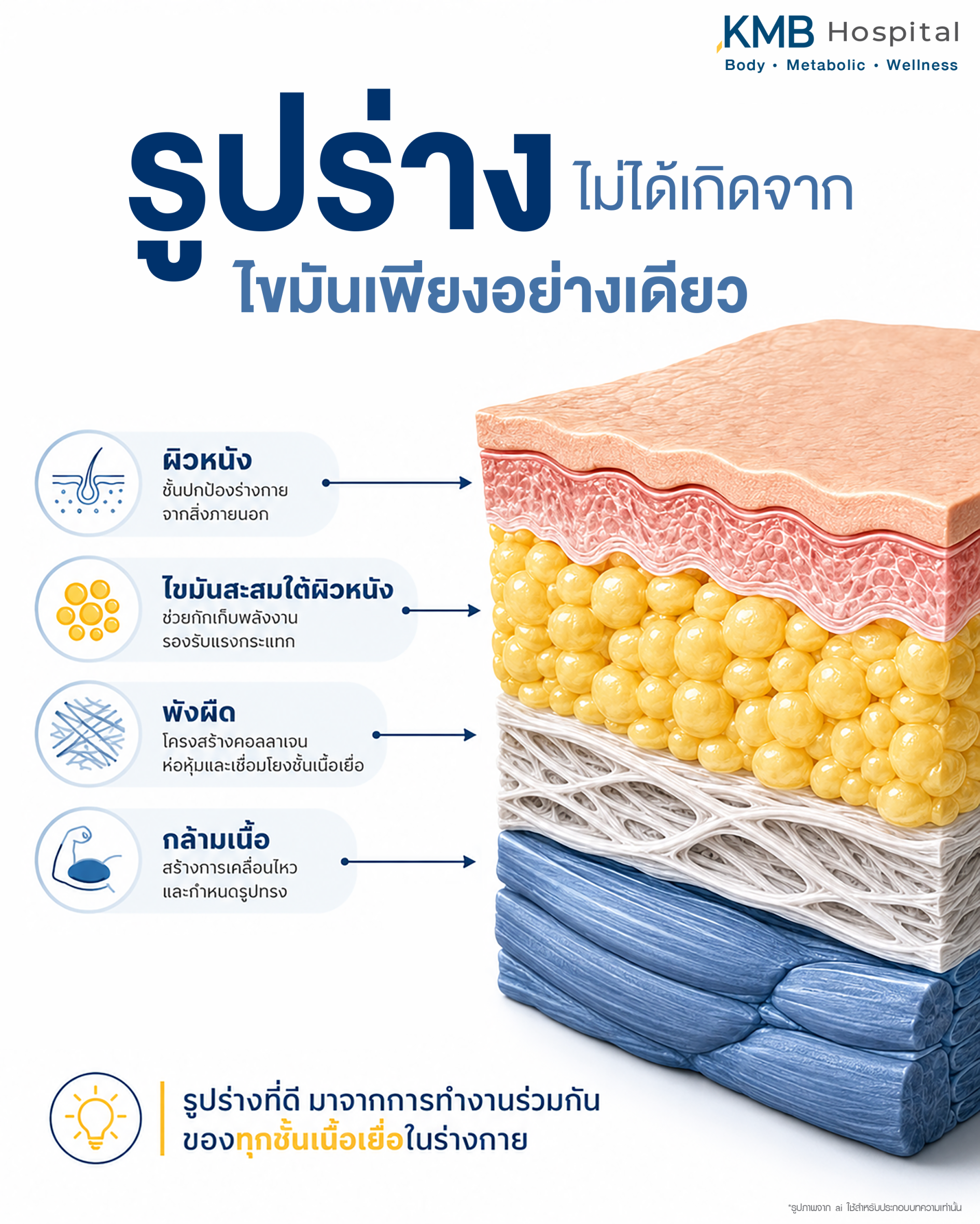
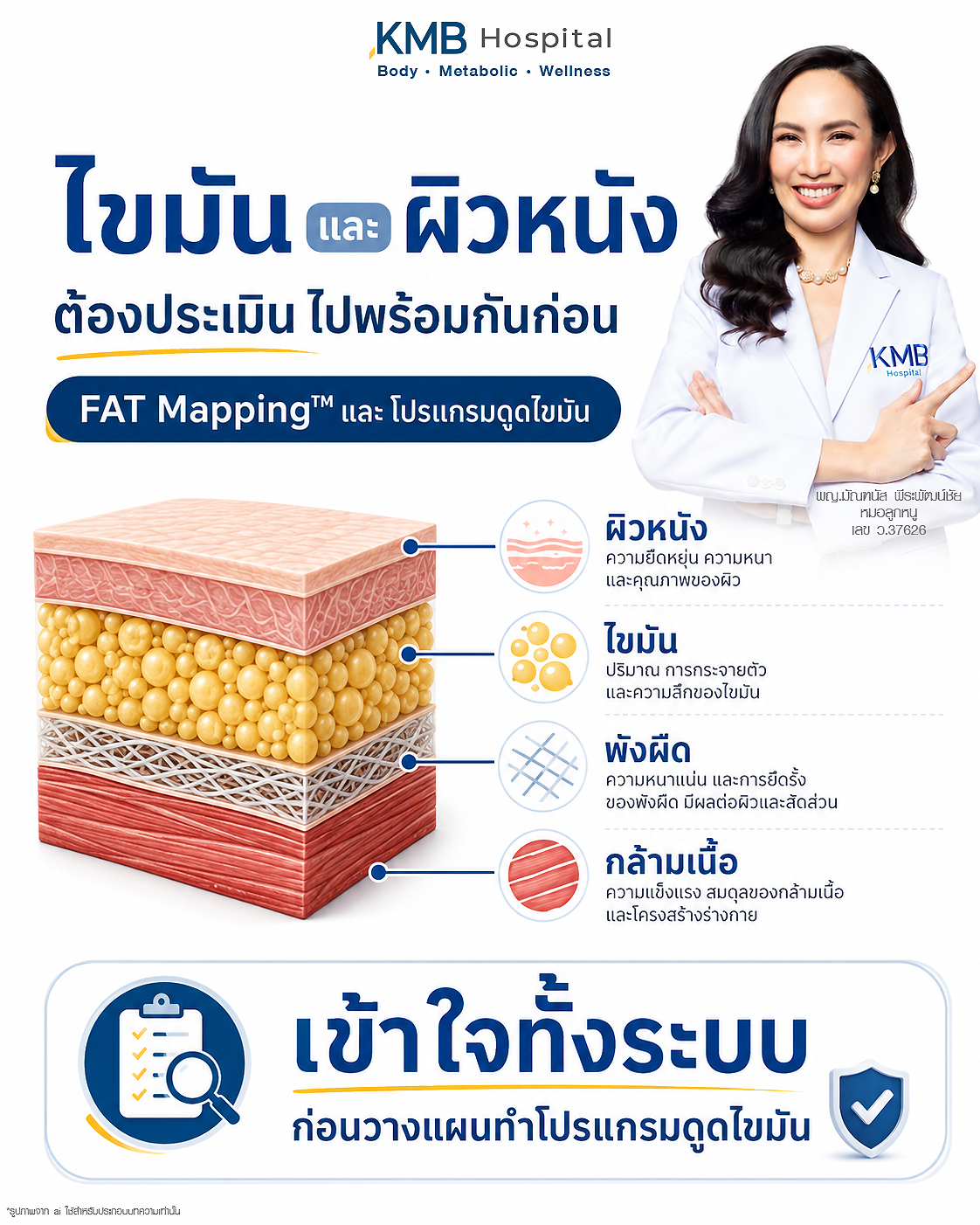
External shape does not come from fat alone, but arises from the relationship between the skin, subcutaneous fat, fascia, and underlying structures. If any component changes, the visible shape may change accordingly.
Before conducting FAT Mapping™ and planning a liposuction program, doctors must evaluate both fat volume and skin quality together to help ensure plans suit each client and explain expected results consistent with body structure.
How do skin and fat work together?
Many view the skin merely as a layer wrapping the body, while fat is something located below and separate.
In reality, both parts are connected through many fascia and connective tissues, allowing the skin to move, be flexible, and adapt to the shape of the underlying tissue.
When fat volume changes, the skin responds according to each individual's ability to stretch and retract.
What happens to the skin when fat increases?
As subcutaneous fat accumulates more, the skin gradually expands to accommodate the increased volume of tissue.
If changes occur slowly, many people's skin adapts well, but if weight increases rapidly or there is significant body change, such as pregnancy, the skin may stretch beyond its recovery capacity, causing laxity or stretch marks in some cases.
Furthermore, skin adaptability varies per individual, depending on age, genetics, quality of collagen and elastin fibers, as well as other health factors.
Does the skin always retract when fat decreases?
Not always. Although the fat quantity decreases, skin retraction ability varies per person.
Age
Skin Elasticity
Duration of Fat Accumulation
History of Weight Changes
Genetics
Quality of Collagen and Elastin
Thus, individuals losing the same weight may show different post-weight loss skin characteristics.
Why must a physician assess both skin and fat before the liposuction procedure?
The liposuction procedure reduces subcutaneous fat volume. After fat volume changes, the skin must adapt to the new shape.
Therefore, physicians must assess the following components together.
| Assessment Components | Importance for Planning |
|---|---|
| Fat Volume | Helps understand the volume and location of subcutaneous fat |
| Skin Quality | Helps evaluate skin adaptation when fat volume changes |
| Elasticity | Relates to the skin's ability to stretch and rebound |
| Laxity | Helps identify limits of excess skin or skin with limited adaptability |
| Fibrous Tissue | Affects tissue adhesion and movement |
| Body Structure | Ensures assessment does not rely solely on fat volume |
Assessing both parts helps physicians explain treatment guidelines and set appropriate expectations for each client.
Why do people with the same amount of fat have different skin?
Even if two clients have similar amounts of subcutaneous fat, the skin characteristics may differ significantly. Some have relatively firm skin, some have thin skin, some have sagging skin, or even stretch marks.
These differences arise from multiple factors, such as:
Age
Genetics
Quality of Collagen and Elastin
Weight Changes
Pregnancy
Sun Exposure
Lifestyle Habits
Therefore, the amount of fat alone cannot fully explain external appearance.
How does skin affect the results after a liposuction program?
When subcutaneous fat decreases, skin must adapt to the new shape. If the skin still has good elasticity, it may adapt better.
Conversely, if the skin is sagging or has lost much elasticity, the change in body shape may differ from those with good skin quality.
However, skin response varies in each individual and cannot be predicted solely from age or body shape. Therefore, doctors must evaluate skin along with other information before planning a liposuction program.
What is skin elasticity?
Skin elasticity is the ability of the skin to stretch and return to its original state.
This property relates to the structure of collagen, elastin, connective tissue, moisture content in the skin, age, and overall health.
Are stretch marks related to fat?
Stretch marks do not originate directly from fat, but occur due to the skin stretching rapidly, causing some collagen and elastin fibers to change.
Factors potentially associated with stretch marks include rapid weight gain, pregnancy, growth during adolescence, hormonal changes, and genetics.
Having stretch marks does not indicate whether there is much or little fat, and is not used solely as a criterion to judge suitability for a liposuction program.
Why do doctors need to assess the skin in detail?
Before planning a liposuction program, the doctor does not assess only the volume of fat, but must also consider the following components
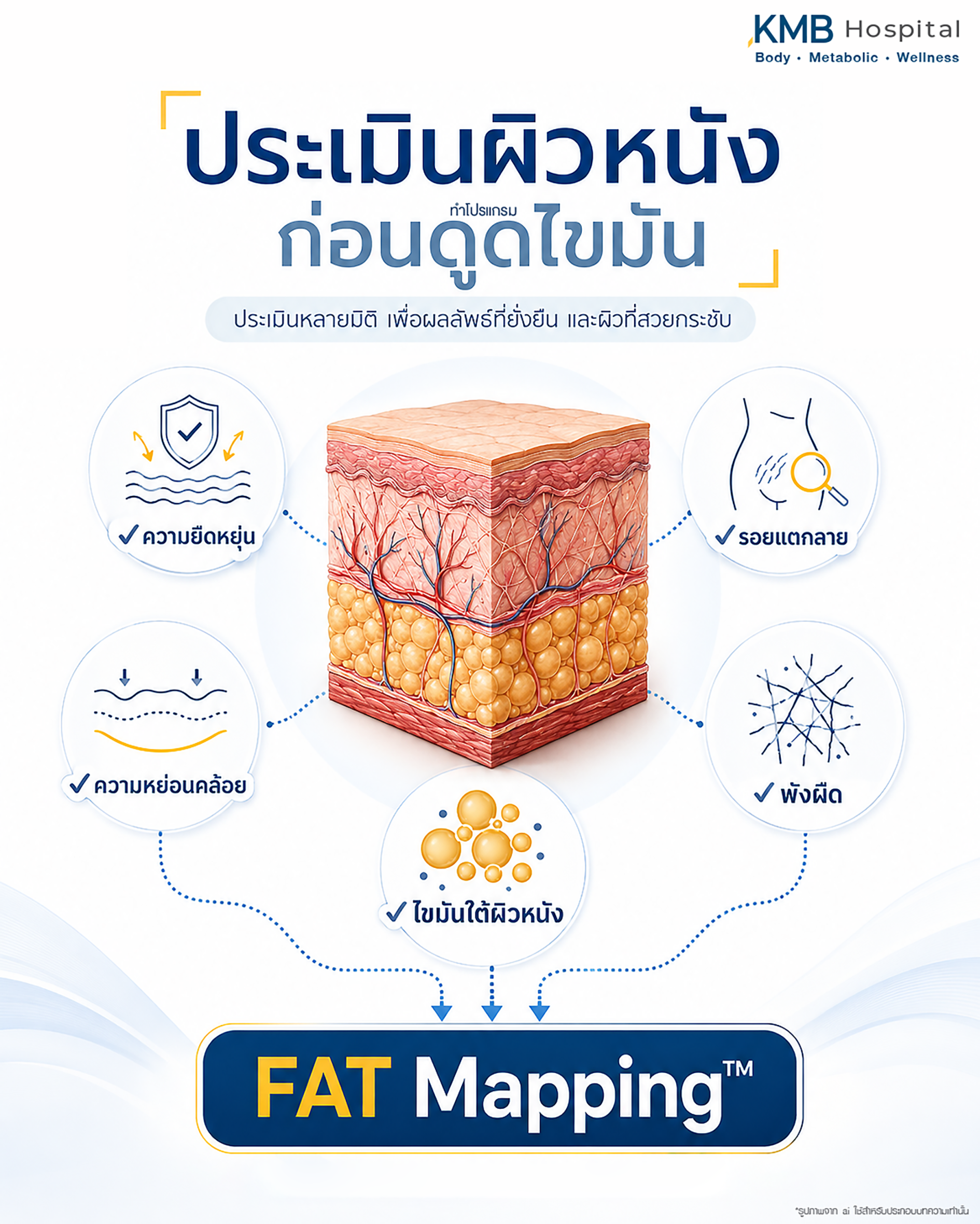
Skin Elasticity
How well can the skin adapt after fat volume decreases
Skin Laxity
How much excess skin is there
Stretch Marks
To what level of skin changes are present
Skin Continuity
Whether the skin is smooth and uniform or has folds as well
Fibrous Tissue and Underlying Structures
Whether it affects tissue adhesion and movement
All these assessments help the doctor understand the condition of the tissues before planning the liposuction program
Why is skin a key part of FAT Mapping™?
Even if clients have similar subcutaneous fat, if the quality of the skin differs, the assessment results before the liposuction program may also differ
The doctor therefore must assess fat volume, skin elasticity, laxity, fibrous tissue, and body structure together
FAT Mapping™ helps gather information on these components to support planning before the liposuction program that is appropriate for each client, under physical examination and physician discretion
How does FAT Mapping™ help assess the skin?
FAT Mapping™ helps gather information regarding fat location, body composition, and data used in conjunction with assessment along with skin quality to help the doctor plan pre-liposuction programs more appropriately, without replacing physical examinations or physician discretion
Summary
Fat and skin work together in determining body shape. Changes in subcutaneous fat alone cannot fully explain body shape or treatment outcomes because skin quality, fascia, and surrounding structures also play an important role.
Before planning a liposuction program, doctors must evaluate both fat and skin together. FAT Mapping™ helps support data collection to ensure planning is appropriate for each client's body structure.
Key Points to Know
Skin and fat work together in determining body shape
The amount of fat alone cannot explain the entire body shape
Skin elasticity varies per individual
Skin affects planning before a liposuction program
Fascia, skin, and fat must be evaluated together
FAT Mapping™ supports systematic evaluation before a liposuction program
Frequently Asked Questions
1. Does skin affect planning for a liposuction program?
It has a significant effect because after subcutaneous fat volume changes, the skin must adapt to the new shape. Therefore, doctors must evaluate skin quality along with fat volume before planning the liposuction program.
2. If skin is sagging, does liposuction help?
It depends on the cause and level of skin sagging, including fat composition, fascia, and surrounding structures. Doctors need to evaluate each case individually before recommending treatment approaches.
3. Do stretch marks come directly from fat?
Not directly. Stretch marks are related to skin stretching and changes in collagen and elastin fibers, more so than just the amount of fat.
4. Will people with the same amount of fat have the same skin?
Not necessarily. People with similar amounts of fat may have different elasticity, thickness, and skin quality, leading to different pre-liposuction evaluation results.
5. Why do doctors need to evaluate both fat and skin before a liposuction program?
Because external shape results from multiple components working together. If only fat volume is evaluated, it may not reflect limitations or the suitability of planning a liposuction program for each individual.
Medical References
- Gray's Anatomy. The Anatomical Basis of Clinical Practice. Latest Edition.
- Hall JE. Guyton and Hall Textbook of Medical Physiology. Latest Edition.
- Baumann L. Cosmetic Dermatology. Latest Edition.
- Endotext. Adipose Tissue Biology.
- American Society of Plastic Surgeons. Patient Education Resources.
- Guyuron B, et al. Skin Elasticity and Soft Tissue Anatomy. Plastic and Reconstructive Surgery.
About KMB Hospital
KMB Hospital offers body shaping, weight loss, and liposuction programs, focusing on systematic pre-treatment assessments to help physicians understand the relationship between fat, skin, fibrous tissue, and body composition before planning appropriate treatments for each client.
Medical Disclaimer
This article is prepared to provide knowledge about the relationship between skin, subcutaneous fat, fascia, and pre-liposuction program assessment. Information cannot be used instead of examination, diagnosis, or specific individual advice from a doctor. The suitability of care guidelines depends on health, skin quality, body composition, goals, and the doctor's discretion in each case.
Evaluate Both Fat and Skin Before Planning
FAT Mapping™ helps gather information about subcutaneous fat, skin quality, elasticity, fascia, and body composition, allowing doctors to use it for appropriate planning for each individual.