
How should goals and expectations be assessed before planning liposuction?

KMB KNOWLEDGE BLUEPRINT™
DOMAIN C — CLINICAL ASSESSMENT BEFORE LIPOSUCTION™ | Article Code: FM-C-K08
FAT Mapping™ | Pre-Liposuction Assessment | Medical Knowledge
Why the Patient's Goals Impact Liposuction Program Planning
Category
FAT Mapping™ | Pre-Liposuction Assessment | Medical Knowledge
Publication Information
First Published: August 11, 2026
Last Updated: August 11, 2026
Reading Time
Approximately 10 minutes
Author and Reviewer
Author: Team Medical Content, KMB Hospital
Medically Reviewed By: Dr. Mandanus Peerapattanchai (Dr. Luk Nook) License No. W.37626
Key Answer
The patient's goals impact liposuction program planning because the doctor must first understand what concerns the patient has, which areas they wish to see changed, and what level of results they expect. Then, this information is considered along with medical history, physical examination, and FAT Mapping™.
Clearly identifying goals helps the doctor explain what can be adjusted with the liposuction program, what has limitations, and how care should be planned to suit each patient's body and information.
Goals Before the Liposuction Program Are Not Just About Saying You Want to Lose Weight
When consulting about the liposuction program, many clients may start with phrases like
"I want my belly to get smaller"
"I want my waist to be more defined"
"I want my body to look more proportional than before"
These answers are important starting points, but the doctor still needs to understand further which area is the main issue, what type of change is important to the client, and what the expected result is.
Therefore, consultation before the liposuction program should allow clients to explain their goals, needs, and concerns frankly, as this information affects the selection of the care approach and explaining possible outcomes.
Why People With Similar Body Shapes Might Have Different Goals
Two clients might have similar physical appearances, but what each person values may differ significantly.
Priorities
One person might worry about the lower abdomen
Another might focus on the continuity between waist and hips
Change Goals
Some want clothes to fit better
While others want to adjust specific proportions without necessarily needing significant weight loss
Thus, doctors cannot plan the liposuction program based solely on body shape, but must understand how the client perceives their own issues and what direction they desire for the change.

What goals must doctors understand?
During the assessment before the liposuction program, doctors may inquire about various aspects of goals, such as:
This information helps doctors visualize both body-related goals and the client's context before linking them with data from physical examinations and FAT Mapping™
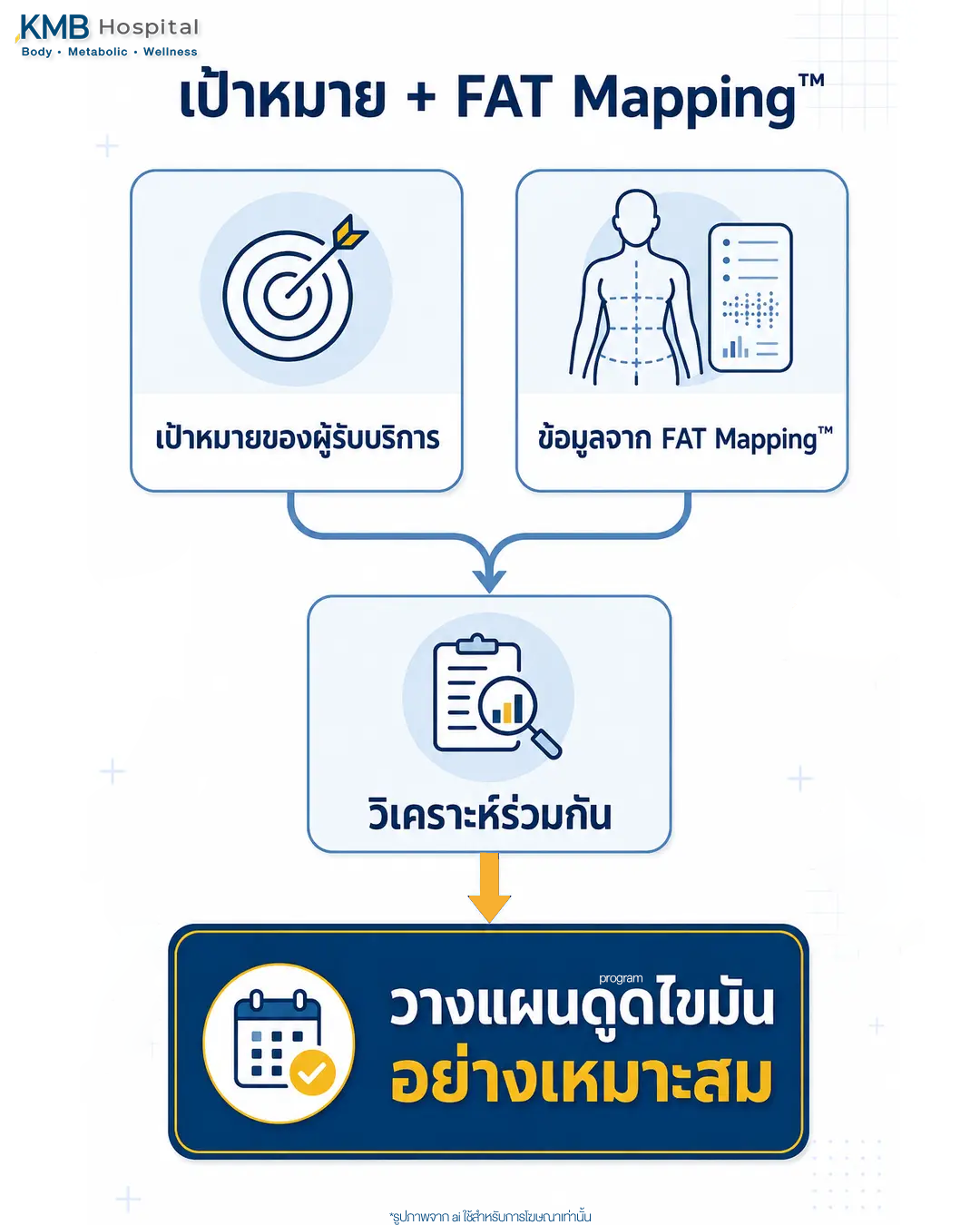
How does FAT Mapping™ help connect goals with body data?
Client Perspective
The client's goals are data from the perspective of the body's owner
Data from FAT Mapping™
FAT Mapping™ helps systematically gather data regarding body shape, proportions, body composition, and fat distribution
When comparing these two sets of data, doctors can explain more clearly that
- What the client worries about relates to which aspect of the body
- Which areas should receive further assessment
- Which things may respond to the liposuction program
- And what may have limitations or require considering other approaches
FAT Mapping™ does not determine goals on behalf of the client but helps ensure discussions between the doctor and client are based on the same set of data
Why doctors must explain limitations before planning a liposuction program
Planning an appropriate liposuction program does not mean immediately accommodating all requests
Some goals may align with body data and can be further planned
However, some goals may involve other factors, such as skin quality, body structure, overall weight, or elements that the liposuction program cannot fully resolve
Liposuction is a targeted fat reduction and body contouring procedure, not an obesity treatment, and cannot solve all issues related to skin or body shape. Therefore, discussing limitations is an important part of pre-treatment consultation
What doctors do when goals do not match assessment data
If the client's goals do not yet align with information from history taking, physical examination, or FAT Mapping™, the doctor may begin by explaining the reasoning to ensure understanding
Then, they may collaboratively adjust the goals to make them more appropriate, such as:
| From original expectations | Towards mutually considered goals |
|---|---|
| Expect significant weight loss | Change to targeting specific areas |
| Focus on a single point | Change to considering overall body balance, or recommend assessing additional factors before planning the liposuction program |
Adjusting goals does not mean reducing the client's needs, but rather making those goals align with body data and actionable plans
Key concept in assessment
Connecting goals with clinical assessment
The client's goals are a crucial part of the pre-liposuction assessment as they help the doctor understand which changes the client prioritizes
When goals are considered alongside history taking, physical examination, and FAT Mapping™, the doctor can more clearly explain feasibility, limitations, and appropriate care directions for each client
Article Summary
A client's goals affect liposuction program planning, as this helps determine what the assessment should prioritize and what information needs further explanation.
Clearly discussing goals, along with information from history taking, physical examination, and FAT Mapping™, helps physicians and clients reach a shared understanding before treatment planning.
Appropriate goals are not merely what a client wants to see, but must also align with body data, the scope of the liposuction program, and individual safety.

Key Points to Know
A client's goal is important information for liposuction program planning.
Physicians do not consider only the area to be treated, but also evaluate whether expectations align with assessment data.
FAT Mapping™ helps physicians explain body data more clearly and connect it to the client's goals.
Clients with similar body shapes may receive different liposuction program plans because they have different goals and limitations.
Direct discussion of goals helps physicians and clients plan treatment based on mutual understanding.
Frequently Asked Questions
1. Why does the doctor need to ask about goals before the liposuction program, and how does FAT Mapping™ clarify the goals further?
Because the client's goals help the doctor understand what problem they want to resolve and the level of results they expect, before considering this data alongside medical history, physical examination, and FAT Mapping™.
FAT Mapping™ allows the doctor and client to see the same set of body data, making discussions about goals more concrete and reducing misunderstandings before planning the liposuction program.
2. If significant weight loss is desired, can the liposuction program help?
The liposuction program's main purpose is body contouring and reducing fat in specific areas, not direct weight loss.
If the main goal is significant weight loss, the doctor may recommend more appropriate care approaches before planning a liposuction program.
3. What happens if the client's goals do not align with the data from FAT Mapping™?
The doctor will explain the assessment data clearly and work together to adjust goals or treatment plans to suit the body data and the client's safety.
4. Why do people with the same body shape receive different recommendations?
Because besides body shape, the doctor considers goals, health status, medical history, physical examination, and FAT Mapping™ data together, allowing liposuction program planning to differ.
5. Should all expectations be communicated to the doctor?
Yes
Transparent communication helps the doctor understand what the client needs and enables clearer explanation of possibilities, limitations, and appropriate treatment plans.
About KMB Hospital
KMB Hospital believes that good liposuction program planning begins with understanding both body data and service recipient goals.
Taking medical history, physical examination, and FAT Mapping™ helps doctors explain options, limitations, and appropriate treatment approaches so that planning proceeds safely and aligns with each service recipient's needs.
Medical Sources
The sources below supplement general information regarding scope, limitations, and decision-making before liposuction programs, and do not replace physician evaluation.
Article Author Information
Written By
Medical Content Team, KMB Hospital
This article is created to convey knowledge about FAT Mapping™, pre-liposuction assessment, and treatment planning processes, enabling readers to use information appropriately alongside their doctor for decision-making.
Medically Reviewed By
Dr. Mardanee Peerapatchai
Doctor Looknuu
Medical License No. W.37626
Founding physician of KMB Hospital and developer of the FAT Mapping™ concept, this medical practitioner reviewed these articles to ensure accuracy, alignment with academic principles, and suitability for communication with the general public.
Article Review Information
First Published: August 11, 2026
Last Updated: August 11, 2026
Start Planning with Clear Data and Goals
Discuss goals and receive an assessment from a physician to understand possibilities, limitations, and appropriate approaches suited to each individual's data before planning treatment.