
What is abdominal fat? Limitations of the liposuction program
KMB KNOWLEDGE BLUEPRINT™ · DOMAIN B · FM-B-K19
What is Visceral Fat? Why Liposuction Doesn't Help in Every Case
First Published: August 2, 2026
Last Updated: August 2, 2026
Reading Time: Approximately 11 minutes
Category: FAT Mapping™ · Visceral Fat · Pre-Liposuction Assessment
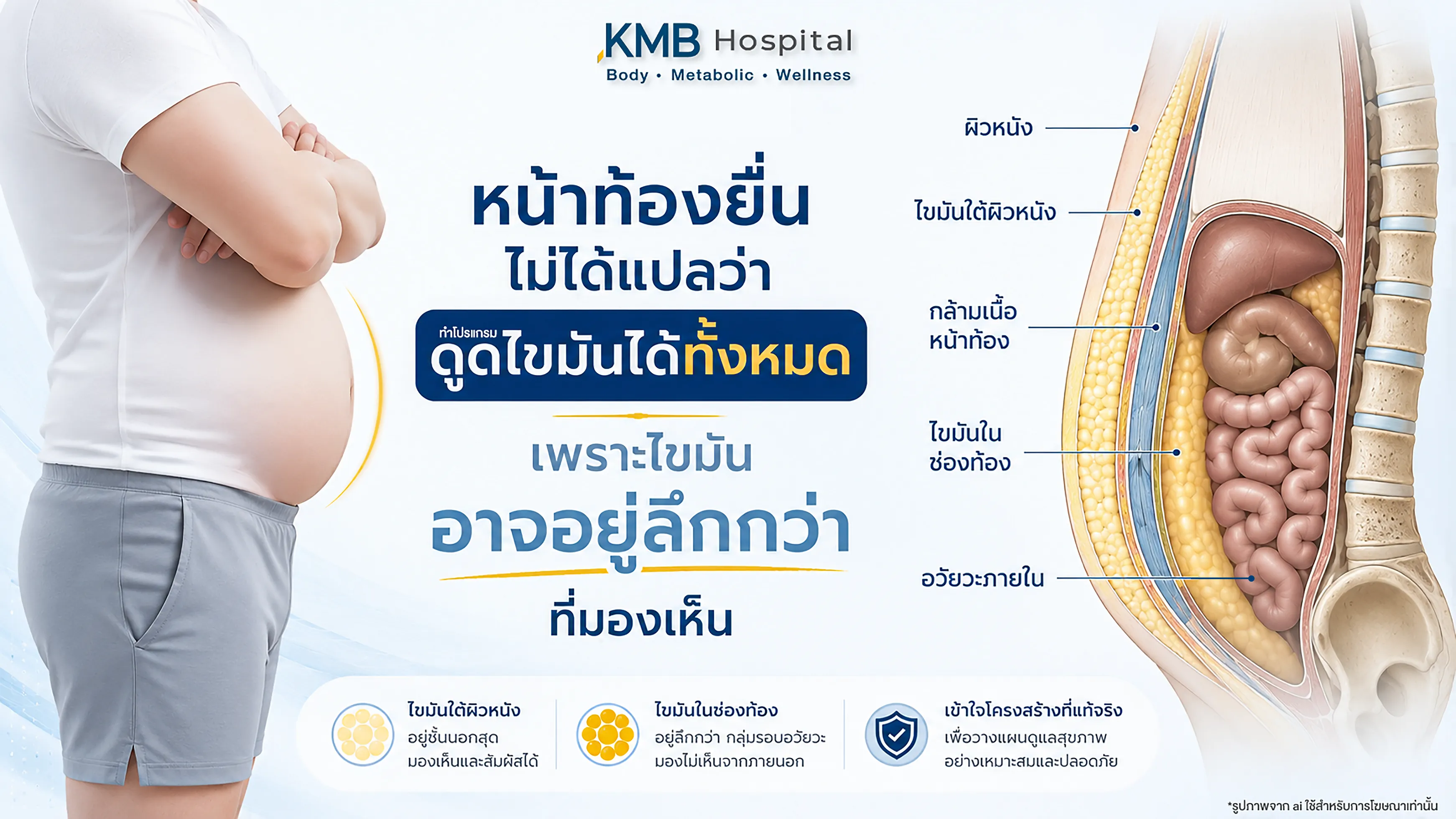
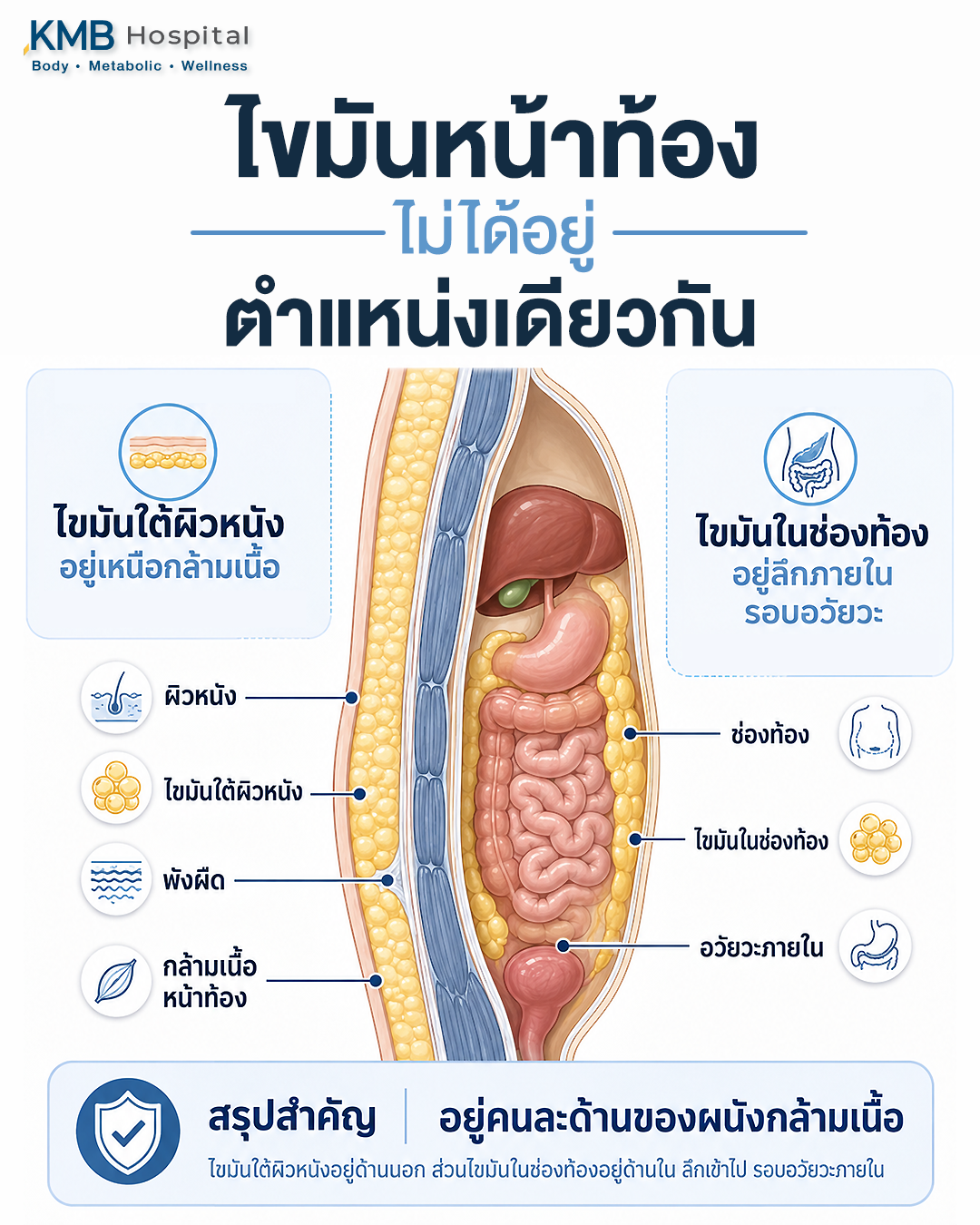
Visceral fat, or Visceral Fat, is fat located deep inside the abdominal cavity and associated with internal organs, unlike subcutaneous fat which lies above the muscle and can be touched or pinched from the outside.
When there is an excess of visceral fat, it can make the abdomen appear protruded or tight from within, even if the touchable subcutaneous fat is not very thick. This type of fat is associated with metabolic risks rather than subcutaneous fat in many contexts, such as insulin resistance, Type 2 diabetes, and cardiovascular disease.
Liposuction programs work on fat under the skin in suitable areas. They do not remove fat located deep beneath the muscle and around internal organs. Therefore, a protruding abdomen caused by visceral fat cannot be expected to change in the same way as an abdomen caused primarily by subcutaneous fat.
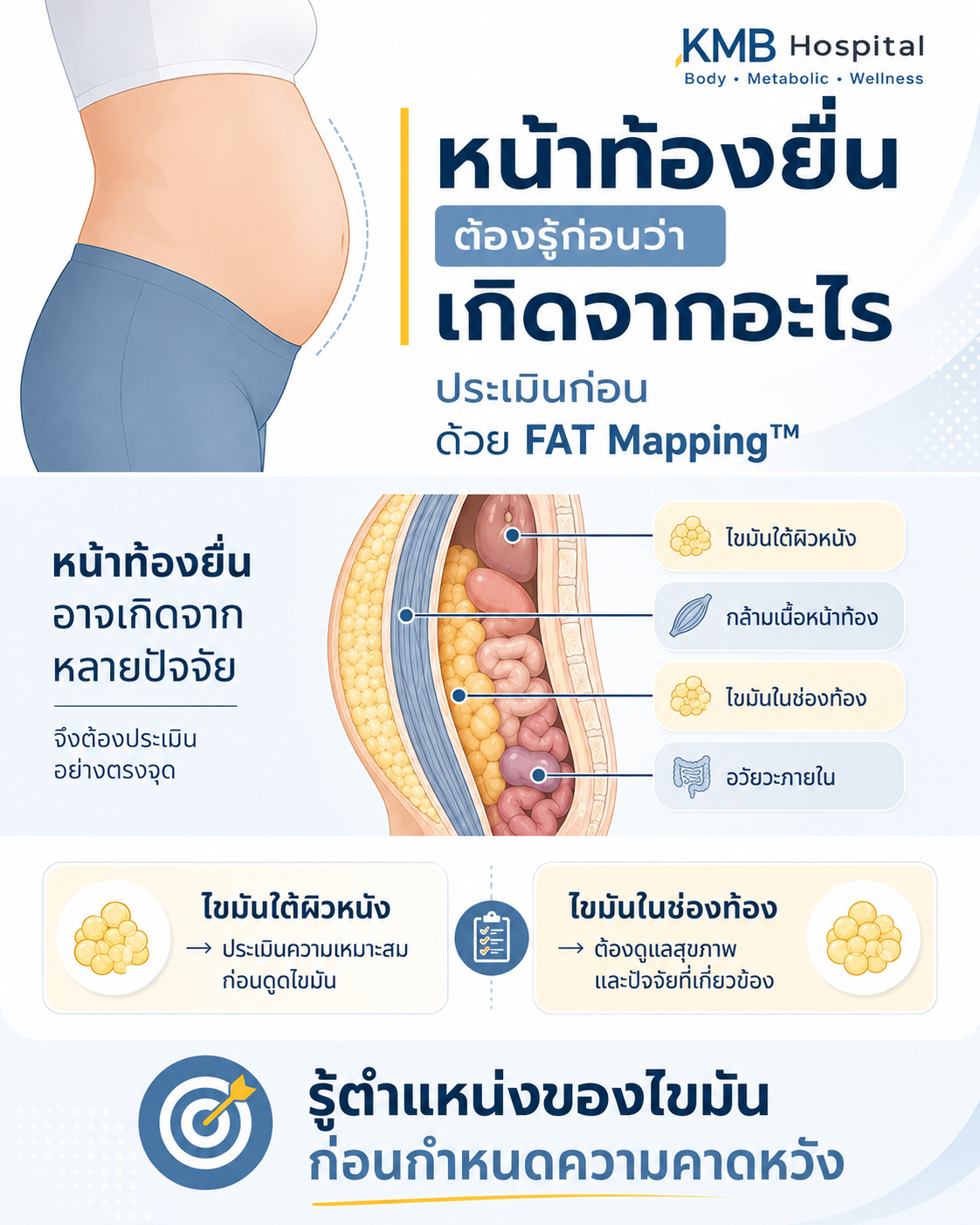
Before planning a liposuction program, FAT Mapping™ helps distinguish clearly whether the seen abdominal shape relates to subcutaneous fat, visceral fat, skin, fascia, muscles, or multiple components combined. All data must be used in conjunction with physical examination, health history, and physician judgment.
What is Visceral Fat?
Visceral fat, or Visceral Adipose Tissue, is fatty tissue located deep inside the body, associated with organ mesenteries and areas around internal organs such as intestines, liver, pancreas, and kidneys.
Visceral fat differs significantly from subcutaneous fat in terms of location, as there is an abdominal wall and muscle in between, so it cannot be touched or pinched directly from the outside.
Having some amount of visceral fat is normal, as fat serves to support and protect organs. However, when accumulation increases, it may be associated with metabolic abnormalities and increased health risks.
Thus, the term "Visceral Fat" in the context of this article does not refer to all fat in the abdominal area, but specifically to the fat located deep inside, distinct from subcutaneous fat which directly affects external body shape.
Where is Visceral Fat Located?
Looking from the outside inwards, the abdominal area consists of important structures arranged in the following sequence:
Position of Abdominal Muscles is a Key Boundary Line
Subcutaneous fat is on the outside of the muscle
Visceral fat is deep inside the muscle wall
This difference is crucial for planning liposuction programs, as liposuction is used to reduce fat in the subcutaneous layer in suitable areas and does not go inside to remove fat between or around internal organs.
How does Visceral Fat differ from Subcutaneous Fat?
Although both types are fatty tissue, they differ in location, characteristics, and implications for assessment.
Subcutaneous Fat
Located between skin and muscle. It is the portion that can be touched or pinched and affects thickness, curves, and external shape.
This type of fat is relevant for planning liposuction programs in suitable areas, but still requires evaluation alongside skin, fascia, blood vessels, nerves, and body shape balance.
Visceral Fat
Located deep within the muscle wall and associated with internal organs, so it cannot be touched or pinched directly from the outside.
When present in large quantities, it may make the abdomen appear protruded, tight, or rounded from within, and is associated with metabolic risks more than subcutaneous fat in many studies.
| Comparison Topic | Subcutaneous Fat | Visceral Fat |
|---|---|---|
| Location | Above the muscle | Deep below the muscle wall |
| Touchability | Can be touched or pinched | Cannot be pinched directly from outside |
| Effect on Shape | Affects external thickness and curves | May cause stomach protrusion or tightness from within |
| Relation to Liposuction | Layer involved in suitability assessment | Not fat removed by liposuction program |
| Health Implication | Consider according to overall health and body composition | More associated with metabolic risks in many contexts |
Why does Visceral Fat Cause Abdominal Protrusion?
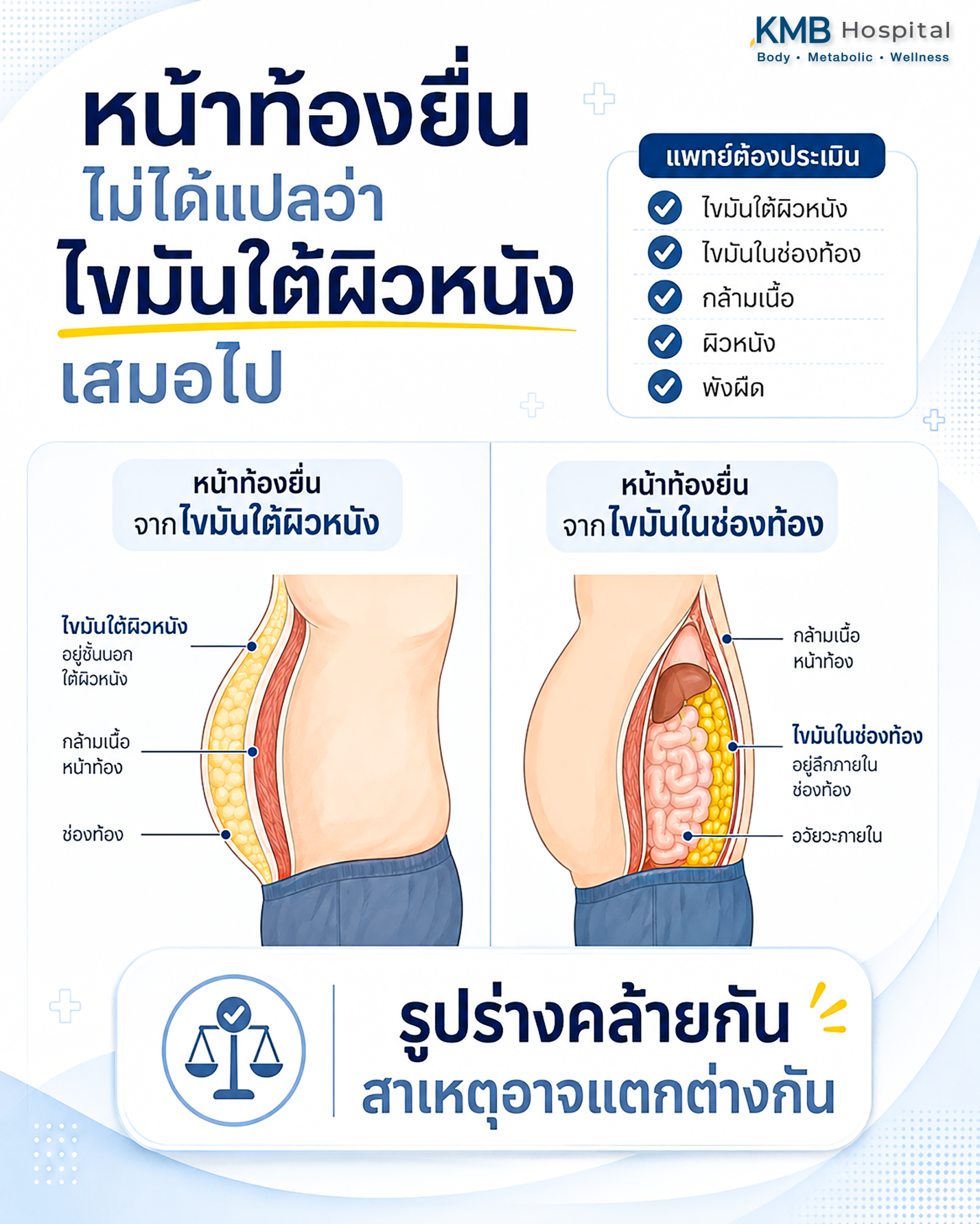
When fat accumulates inside the abdominal cavity, volume inside the body may increase and push the abdominal wall outward. Visible characteristics may include a round, protruded, or relatively tight abdomen, even if the subcutaneous fat layer that can be pinched is not very thick.
However, a protruding abdomen does not occur solely from visceral fat factors, but may relate to several components, including:
Therefore, terms like "Big Belly" or "Protruding Abdomen" are not diagnoses indicating the type of fat, nor sufficient to conclude how much liposuction programs can help change the shape.
What Does It Mean If There Is Little Palpable Fat But Significant Protrusion?
In some patients, doctors may find that there is little palpable subcutaneous fat, yet the abdomen protrudes clearly. This characteristic might raise suspicion that deeper components are involved alongside the subcutaneous layer, such as visceral fat, shape of muscles and abdominal wall, separation of abdominal muscles, or posture and torso structure.
However, conclusions should not be drawn solely from touching. Evaluation must consider body shape from various angles, health history, weight changes, pregnancy history, related symptoms, and information from additional examinations as appropriate. This is why doctors should not plan liposuction programs from photos or remote assessments alone.
Why doesn't Liposuction Help Reduce Visceral Fat?
Liposuction is a procedure used to reduce fat in the subcutaneous layer through small incisions, aiming to reshape suitable areas.
Visceral fat is located deep inside the abdominal wall and associated with vital organs. Passing the tube through the abdominal wall inside the cavity is not a principle of liposuction for reshaping and may cause serious harm to organs and internal structures.
Therefore, the scope of liposuction programs is limited to subcutaneous fat, not fat surrounding internal organs.
Even if the patient has concomitant subcutaneous fat, reducing that portion may help change external thickness to some extent, but if the main protrusion is caused by visceral fat, the abdominal shape may still protrude from within.
Explaining Limitations Before Treatment is Important
To ensure the patient understands the scope of the liposuction program and sets appropriate expectations based on their own body composition.
How is Visceral Fat Related to Health?
Aside from affecting appearance, visceral fat is associated with overall health in many contexts more than subcutaneous fat. This type of fat can produce and secrete various biological substances, which affect metabolism, inflammation, and the body's response to insulin.
Numerous studies have found that high amounts of visceral fat are associated with increased risks of insulin resistance, Type 2 diabetes, high blood pressure, abnormal lipid levels, cardiovascular disease, and metabolic syndrome.
However, having visceral fat does not necessarily mean you will develop diseases, as risk also depends on age, genetics, lifestyle habits, exercise level, and individual health conditions.
Why Does Visceral Fat Increase?
Accumulation of visceral fat results from multiple factors working together, not solely from food consumption.
Age
As age increases, muscle mass often decreases while fat mass may increase, especially in the torso and abdominal cavity areas.
Hormones
Hormonal changes, such as during menopause or certain hormonal disorders, may alter the pattern of fat accumulation.
Lifestyle Habits
Consuming more energy than used, low movement, insufficient sleep, and chronic stress may be associated with increased visceral fat.
Genetics
Some people tend to accumulate fat in the torso more than other areas, even if their body weight is similar to others.
Can People Who Are Not Very Overweight Have Visceral Fat?
Yes. People with normal weight, or whose Body Mass Index (BMI) falls within normal range, may have visceral fat. In academic terms, this condition is sometimes called Normal Weight Obesity or TOFI (Thin Outside, Fat Inside), referring to those who look slender externally but have more internal fat accumulation than expected from external appearance.
Conversely, some may have quite a lot of subcutaneous fat but not much visceral fat, so external appearance alone cannot be used to conclude fat location.
Do Weight or BMI Indicate Amount of Visceral Fat?
They cannot indicate it directly. Weight is just a total number of muscle, fat, water, bone, and organs. BMI is calculated from weight and height, used to assess overall weight status, but does not specify where fat is accumulated.
People with the same BMI may have vastly different body compositions. For example, one person may have high muscle mass, another may have much subcutaneous fat, or another may have significant visceral fat. Therefore, numbers alone are insufficient for planning liposuction programs.
How do Doctors Assess Whether Protruding Abdomen is Due to Visceral Fat?
Evaluation does not rely on any single method but uses multiple sources of information together.
1. History Taking
Inquire about weight changes, pregnancy history, existing diseases, medication use, lifestyle habits, and exercise routines.
2. Body Shape Examination
Assess abdomen, body curvature, balance, fat distribution, waist-to-hip ratio, and relationship with hips and back from multiple angles.
3. Palpation of Tissues
Evaluate subcutaneous fat thickness, tissue softness or firmness, fascia, and skin laxity. Do not rely solely on touch to confirm causes.
4. Body Composition
Consider subcutaneous fat, fat distribution, muscle mass, proportions, skin quality, fascia, and patient goals together.
5. FAT Mapping™
Helps gather multi-dimensional information to answer questions regarding fat location, abdominal composition, skin quality, fascia, and appropriate boundaries for liposuction programs.
All data must be used in conjunction with actual physical examination, not to replace physician examination.
Why is Understanding Visceral Fat Important for FAT Mapping™?
One of the common misconceptions is "Large Belly Equals Liposuction Will Shrink It". But in reality, a protruding abdomen may result from subcutaneous fat, visceral fat, muscles, abdominal wall, fascia, skin, and body structure combined.
Patients with similar external shapes may thus have different assessment plans and care approaches.
FAT Mapping™ helps gather information about fat location, distribution, and abdominal composition for physicians to use in pre-liposuction planning alongside physical examination, health history, and patient goals.
Understanding liposuction limitations beforehand also helps patients set appropriate expectations and understand that liposuction is not a solution to correct protruding abdomens caused solely by visceral fat.
How Does FAT Mapping™ Help Assess Visceral Fat?
FAT Mapping™ helps systematize information about body shape, subcutaneous fat, fat distribution, and abdominal composition to help physicians separate what may respond to liposuction programs from deeper components or non-subcutaneous fat. However, FAT Mapping™ is not a medical diagnosis and should not use any single piece of data to identify the amount of visceral fat or determine treatment alone.
Summary
Visceral fat, or Visceral Fat, is fat located deep inside the abdominal cavity and associated with internal organs, unlike subcutaneous fat which lies above the muscle and can be touched or pinched from the outside.
When visceral fat accumulates, it may increase abdominal volume and make the abdomen appear protruded or tight, even if the subcutaneous fat layer is not very thick. However, a protruding abdomen may arise from multiple combined components, including subcutaneous fat, visceral fat, muscles, abdominal wall, skin, fascia, and body structure.
Excess visceral fat is also associated with increased metabolic risks and cardiovascular disease, but individual risk must be considered alongside age, genetics, lifestyle habits, and other health data.
Liposuction reduces subcutaneous fat in suitable areas and cannot remove fat located beneath the muscle and around internal organs. Therefore, if the abdominal protrusion is mainly due to visceral fat, liposuction alone may not change the abdominal shape as expected.
Before planning a liposuction program, FAT Mapping™ plays a role in helping organize information about subcutaneous fat, fat distribution, shape, and abdominal composition so that physicians can consider it alongside physical examination, health history, and patient goals.
Key Points to Know
Frequently Asked Questions
1. Can Visceral Fat Be Touchable from Outside?
Generally, no. Visceral fat cannot be pinched directly because it is deeper than the abdominal wall and associated with internal organs. Most tissues that can be pinched from the abdomen consist of skin, subcutaneous fat, and fascia. Pinching the abdomen helps initially evaluate the subcutaneous layer, but this method alone cannot confirm the amount of visceral fat.
2. Does a Hard or Tight Abdomen Mean There Is Excess Visceral Fat?
No conclusion can be made from hardness or tightness alone, as such characteristics may relate to visceral fat, muscles, abdominal tension, posture, bloating, or other structures. Doctors must evaluate alongside health history, shape characteristics, physical examination, and additional data as appropriate.
3. Can People of Normal Weight Have Excess Visceral Fat?
Yes, this can happen because weight or BMI does not directly indicate fat location. People with normal weight may have lower muscle mass and higher fat storage in the abdominal cavity than expected from their appearance. Conversely, overweight individuals may have different fat distribution patterns.
4. Does Liposuction Help Reduce Visceral Fat?
It does not directly reduce visceral fat, as liposuction works on subcutaneous fat located above the muscle and does not go inside to remove fat around internal organs. If a patient has both subcutaneous and visceral fat, reducing subcutaneous fat may help change external thickness to some extent, but the protrusion caused by internal fat may remain.
5. How Can Visceral Fat Be Reduced?
Important approaches involve maintaining health and continuously adjusting behaviors, such as controlling energy and food quality, exercising appropriately, increasing physical activity, getting enough sleep, and managing health risk factors alongside medical personnel. Results should not be evaluated solely from numbers on a scale.
Medical References
- Shuster A, Patlas M, Pinthus JH, Mourtzakis M. The Clinical Importance of Visceral Adiposity: A Critical Review of Methods for Visceral Adipose Tissue Analysis. British Journal of Radiology. 2012;85(1009):1–10.
- Ibrahim MM. Subcutaneous and Visceral Adipose Tissue: Structural and Functional Differences. Obesity Reviews. 2010;11(1):11–18.
- Neeland IJ, Ross R, Després JP, et al. Visceral and Ectopic Fat, Atherosclerosis, and Cardiometabolic Disease: A Position Statement. The Lancet Diabetes & Endocrinology. 2019;7(9):715–725.
- Lee MJ, et al. The Pathophysiology of Visceral Adipose Tissues in Cardiometabolic Diseases. 2024.
- World Health Organization. Waist Circumference and Waist–Hip Ratio: Report of a WHO Expert Consultation. Geneva: World Health Organization; 2011.
- American Society of Plastic Surgeons. Ten Common Misconceptions About Liposuction.
- American Society of Plastic Surgeons. Liposuction vs. Weight Loss: What Are the Differences?
- Mayo Clinic. Liposuction.
About KMB Hospital
KMB Hospital provides services for body contouring, weight loss, and liposuction programs. We prioritize systematic pre-treatment evaluation to help physicians understand fat location and characteristics, skin, fascia, muscle, body composition, and related health factors.
The FAT Mapping™ approach is used to gather data to assist in personalized planning. Decisions regarding suitability, scope, and treatment directions require physical examination, health history, patient goals, and physician judgment together.
FAT Mapping™ is not used to replace medical diagnosis and cannot guarantee results from liposuction programs.
Medical Disclaimer
This article is created to provide knowledge about visceral fat, its differences from subcutaneous fat, and the limitations of liposuction programs. The information cannot be used instead of examination, diagnosis, or personalized treatment planning. Individuals concerned about abdominal shape or metabolic health should undergo evaluation by an appropriate physician or medical personnel.
For Protruding Abdomen, Start by Clearly Distinguishing the Cause
FAT Mapping™ assessment helps systematize information about subcutaneous fat, visceral fat, skin, fascia, muscles, and proportions for physicians to use in planning personalized care and explaining the scope of liposuction programs appropriately.