
When should a GLAM Liposculpt™ procedure be divided into more than one session?
GLAM Liposculpt™ Knowledge Library DOMAIN E — GLAM Safety & Patient Care | Article ID: GL-E-K08 Category: Personalized Liposuction Planning with GLAM Liposculpt™ | Liposuction Program Principles | Medical Knowledge
When Should a GLAM Liposculpt™ Program Be Split into Multiple Sessions?
First Published: September 25, 2026 | Last Updated: September 25, 2026 | Reading Time: 8 minutes Author: Medical Content Team, KMB Hospital Medically Reviewed by: Dr. Mantanus Peerapatchai (Dr. Looknuu), License No. 37626
A GLAM Liposculpt™ program may be considered for multiple sessions when the treatment scope involves several areas, or when factors such as health data, physical readiness, fat volume and distribution, and the patient's goals lead the surgeon to conclude that a staged approach is more appropriate.
A staged approach does not mean there is a problem with the treatment plan, and treating all areas at once is not always superior. The goal of GLAM is to select the “treatment scope and timing” that best suits each individual patient.
“Can everything be treated at once?” The answer begins with a personalized plan
Once a patient decides to undergo a liposuction program, many may want to treat all their concerned areas in a single session to minimize downtime and avoid multiple visits.
However, from the perspective of treatment planning, the critical question is not just “Can it be done at once?”
A staged approach does not mean it “can’t be done” or the plan is flawed
The term “staged” sometimes makes patients feel that their case is complex or wonder why it wasn't finished in one go, but that is not necessarily the case.
Splitting a liposuction program into more than one session can be part of the initial treatment plan if the surgeon determines that the scope of treatment is quite broad, multiple areas need to be designed in conjunction, or other factors need to be considered.
Therefore, a staged treatment does not mean a plan has been revised after the fact; it can be a strategy deliberately designed from the very beginning.
FAT Mapping™ helps the surgeon see the “scope” before deciding on the number of sessions
Before answering whether to do it in one stage or multiple stages, the surgeon must first understand what exactly is being planned.
FAT Mapping™ helps gather data regarding fat distribution and the relationship between different areas of the body.
For example, a patient might arrive with concerns about their abdomen, but after assessment, it may be found that the abdominal shape is linked to the waist and back. This information does not automatically mean all areas must be treated at once, but it provides the surgeon with a comprehensive view before making a decision.
Which areas fall within the scope of the plan
How the fat is distributed and how areas relate to each other
Health and physical readiness factors to consider
What the Body Design objective is
The number of areas is not the only deciding factor
We cannot establish a simple rule that says, “If you exceed this many areas, you must split the treatment,” because the term “one area” does not carry the same scope and detail for every patient.
Therefore, the surgeon must consider multiple data points together, such as:
| Considered Information | Implications for the Treatment Journey |
|---|---|
| Area Scope | Helps visualize the extent of care and which areas are interrelated. |
| Fat Distribution and Layers | Used to understand the specifics of each area and the overall picture. |
| Health and Readiness | Part of the assessment of suitability before defining the scope and treatment timing. |
| Anesthesia and Care Approach | Must be considered in line with the plan and patient suitability. |
| Body Design Goals | Helps determine the role of each area in the main goal and how to sequence them. |
| Recovery and Follow-up | Part of designing a Treatment Journey tailored to each individual. |
Both Single-stage and Staged Plans are valid “Plans”
GLAM Liposculpt™ does not operate on the principle that “a single stage is always better” or “a staged approach is more suitable for everyone.” Both are planning options that the surgeon must choose based on the individual patient’s data.
| Type | Meaning | Key Principle |
|---|---|---|
| Single-stage Plan | Planning to treat defined areas in a single session, according to the scope deemed appropriate by the surgeon. | Does not imply it is suitable for everyone. |
| Staged Plan | Splitting care into more than one session, with a sequence determined by the patient’s goals and data. | Can be part of the initial Treatment Journey; it does not mean correcting a previous plan due to problems. |
The key word is “Planning,” because whether it is a single-stage or staged plan, there must be a valid reason why that specific plan suits the data, health, and goals of the individual.
Sometimes, splitting treatment creates a clearer Body Design sequence
If a patient wants to adjust multiple areas, such as the abdomen, waist, back, arms, and thighs, we don't need to start with the question: “Can all of this be done?”
Instead, we might start with the question: “Which area has the most impact on the overall shape, and what should be designed first?”
Some plans may start with the torso, then re-assess the proportions before moving on to the next phase. This is Personalized Planning—not just trying to tick off a checklist, but designing a Treatment Journey for an individual.
Wanting to treat 5 areas does not mean treating them all at once
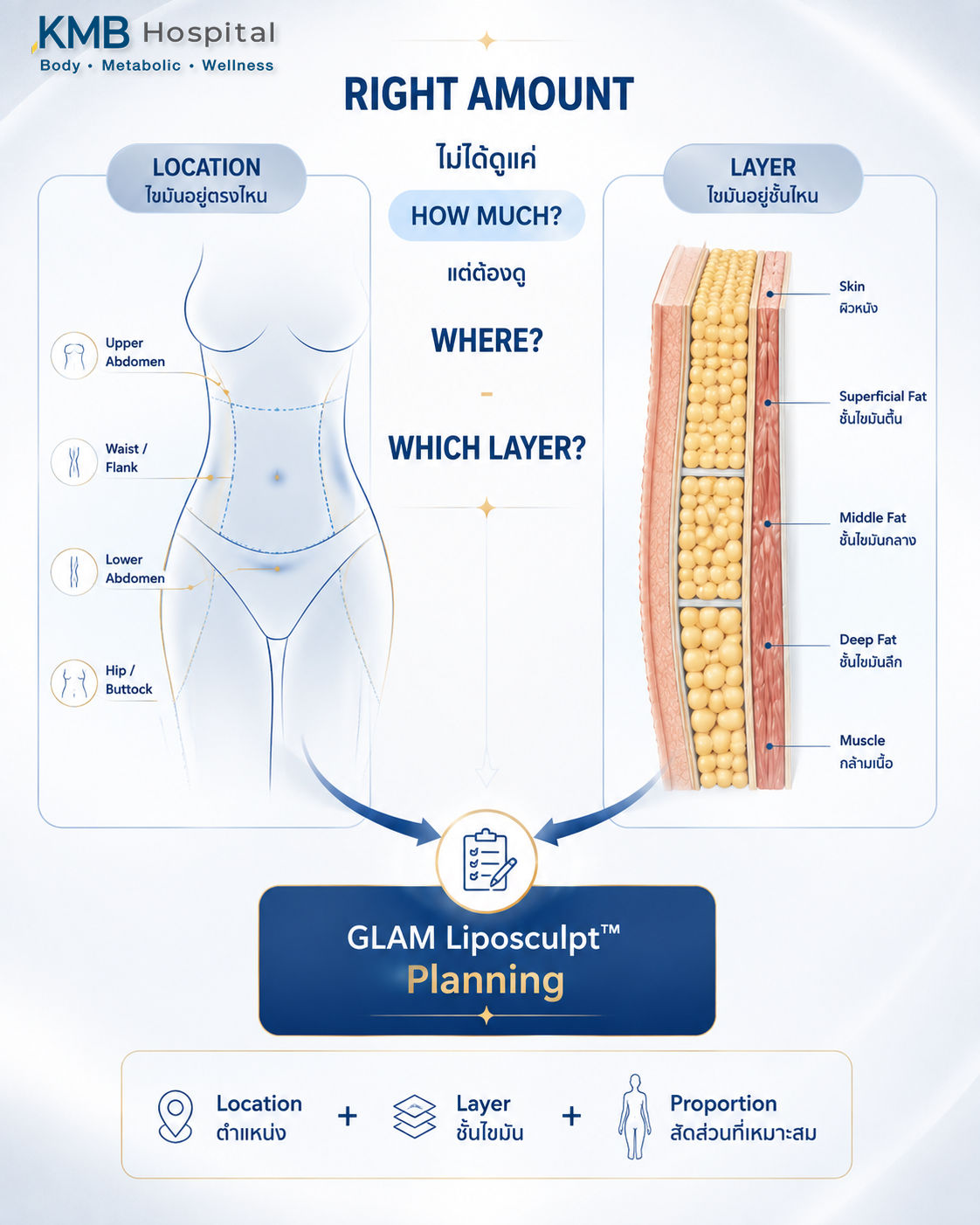
When a patient wants care for the abdomen, waist, back, arms, and thighs, GLAM Liposculpt™ does not start by counting the number of areas, but by using FAT Mapping™ and a physical assessment to see which areas are related, which have more impact on Body Contour, and what the overall scope involves.
Once the big picture is clear, the surgeon considers whether to address several areas together or split them into stages as planned. Both can be personalized, as the decision is not based solely on “much” or “little.”
Right Amount must come with Right Timing and Right Plan
Knowing which areas to treat and the scope involved is only part of the process. The surgeon must also decide when to treat them and how much to do together.
Appropriate scope and volume according to the plan
Appropriate treatment sequence and timing
A plan aligned with the patient’s data, health, and goals
Personalized Liposuction Planning therefore includes not just the choice of position or volume, but also the sequence and timing of treatment.
After each phase, data remains crucial
In cases where the surgeon plans for multiple sessions, follow-ups during the Treatment Journey are vital because the body needs time to recover and adapt after treatment. The surgeon must assess readiness and relevant data before proceeding to the next planned phase. This does not mean the initial plan wasn't clear, but rather that it is part of Personalized Care that incorporates actual data at each stage into the decision-making process.
Key Takeaways
Number of areas and scope must be individually assessed
Used to understand the relationships between areas before defining the scope
No single approach suits everyone
Does not mean changing plans due to surgical complications
The core of a personalized Treatment Journey
Frequently Asked Questions
1. Do multi-area GLAM Liposculpt™ programs require multiple sessions, and when might a surgeon consider a staged plan?
Not necessarily for everyone. The surgeon assesses FAT Mapping™, area scope, health, readiness, and Body Design plans together before determining whether simultaneous treatment or a staged approach is more suitable for the patient.
A staged plan may be considered when the scope is broad, or when health data, physical readiness, fat distribution, and Body Design goals make a staged approach more appropriate. The decision should not be concluded from the number of areas alone.
2. How does FAT Mapping™ help in the decision to split a GLAM Liposculpt™ program?
FAT Mapping™ helps the surgeon understand fat distribution and the relationships between various body areas. This data allows the surgeon to visualize the Body Design scope before deciding which areas should be addressed together and which might be sequenced in other phases. However, FAT Mapping™ is supporting data and not a system that decides the number of sessions in place of the surgeon.
3. Does splitting a GLAM Liposculpt™ program into multiple sessions imply there was a problem with the case?
Not necessarily. A staged treatment can be a plan established by the surgeon from the start if it is deemed suitable for the scope, health, or patient goals. Therefore, splitting the treatment does not mean there were problems with previous surgeries, but that it is part of a Personalized Treatment Planning process from the beginning.
4. Is it better to perform a GLAM Liposculpt™ program in one session rather than multiple?
There is no single answer that is better for everyone. For some patients, treating multiple areas in one go might be appropriate, while for others, splitting the Treatment Journey into more than one stage may be more suitable. GLAM Liposculpt™ does not measure the quality of a plan by the number of sessions, but by how well it suits the patient's data, health, and goals.
5. If a GLAM Liposculpt™ program is planned over multiple sessions, will the next session strictly follow the initial plan?
The surgeon can set the big picture and sequence of the Treatment Journey from the start, but before each phase, the patient's readiness and data must be re-evaluated as appropriate. Personalized Planning does not mean sticking to a plan without considering physical changes, but rather having a clear direction while using actual data to inform decisions at each stage.

Summary
The GLAM Liposculpt™ program does not have a definitive answer such as “one session is best” or “multiple sessions are best.” What is important is knowing which plan is right for the individual.
FAT Mapping™ helps the surgeon see fat distribution and the relationships between areas. Physical exams and health data help determine readiness, while the patient’s goals help shape the direction of the Body Design.
When all these data points are analyzed together, the surgeon can design which areas should be addressed together, which should be sequenced, and how the Treatment Journey should proceed.

Related Articles at KMB Hospital
Read More at DoctorLooknuu.com
Medical References
- American Society of Plastic Surgeons. Liposuction Consultation. Used to support general principles regarding goals, health assessment, medical history, risk factors, options, and individualized treatment planning.
- American Society of Plastic Surgeons. Liposuction Risks and Safety. Used to support general principles regarding risks and safety considerations before treatment.
- Kaoutzanis C, Gupta V, Winocour J, et al. Cosmetic Liposuction: Preoperative Risk Factors, Major Complication Rates, and Safety of Combined Procedures. Aesthet Surg J. 2017. Used to support the principle that patient factors and combined procedures should be considered in risk assessment, and that no single treatment model should be mandated for everyone.
Note: FAT Mapping™ and GLAM Liposculpt™ are proprietary concepts/systems of KMB Hospital; the references above are provided only to support general principles of assessment, risk, and individualized treatment planning.
About This Article
This article explains the planning concept of splitting a GLAM Liposculpt™ program into multiple sessions, connecting data from FAT Mapping™, treatment scope, health, readiness, area relationships, and patient goals, to ensure an understanding that whether treatment is performed in one stage or multiple, it should be considered on an individual basis.
The information provided is for educational purposes and cannot replace professional medical examination, diagnosis, or personalized advice from a doctor.
Article Credits
Medical License No. 37626
Right Amount + Right Timing + Right Plan
The decision of whether to plan for a single-stage or multi-stage liposuction program should be based on an assessment of the patient's data, health, scope, and goals—not on the number of areas alone.