
Why Microbiome Diversity Matters

Why Is “Bacterial Diversity” More Important Than a Single Strain?
Over the past several years, the gut microbiome has become one of the most extensively studied topics in metabolism and hormonal regulation. However, marketing communications often reduce the complexity of these systems to a single “miracle microbe” or a “special probiotic strain.”
From a scientific standpoint, the microbiome does not function as a single component but as a network-level ecosystem with interactions occurring on many levels — spanning metabolism, immune-system responses, and signalling to the hormonal system.
This article explains, from a systems perspective, why “bacterial diversity” is a far more meaningful indicator than focusing on a single strain, while clearly noting the limitations of the evidence.
Table of Contents
- Defining “Diversity” in the Microbiome Context
- The Microbiome Works as a Network, Not a Single Strain
- Diversity and Metabolic Health
- Why Single-Strain Supplementation Yields Variable Results
- Diversity and the Hormonal System
- Stability, Resilience, and Time Dynamics
- Limitations & Measurement Challenges
- Key Takeaway
- References
1) Defining Diversity in the Microbiome Context

In microbiome research, “diversity” has several dimensions, such as:
- Alpha diversity — diversity within an individual
- Beta diversity — differences in composition between individuals
- Taxonomic diversity — diversity of species
- Functional diversity — diversity of biochemical functions
Review articles point out that interpreting alpha or beta diversity alone cannot always confirm the functional capacity of a microbial community, and in many contexts “functional diversity” may correspond more closely to metabolic activity than the number of species alone.
2) The Microbiome Works as a Network, Not a Single Strain

The gut microbiome comprises hundreds to thousands of microbial species that interact in complex ways through:
- metabolic cross-feeding
- substrate competition
- quorum sensing
- immune modulation
For example, the production of short-chain fatty acids (SCFAs) and other metabolites largely does not depend on a single strain but results from the combined activity of many members of the community.
This concept connects to the term functional redundancy — meaning multiple species can perform similar functions. When a system has high diversity, it tends to be more “resilient” to environmental changes such as diet or physiological stress than a community with low diversity.
3) Diversity and Metabolic Health
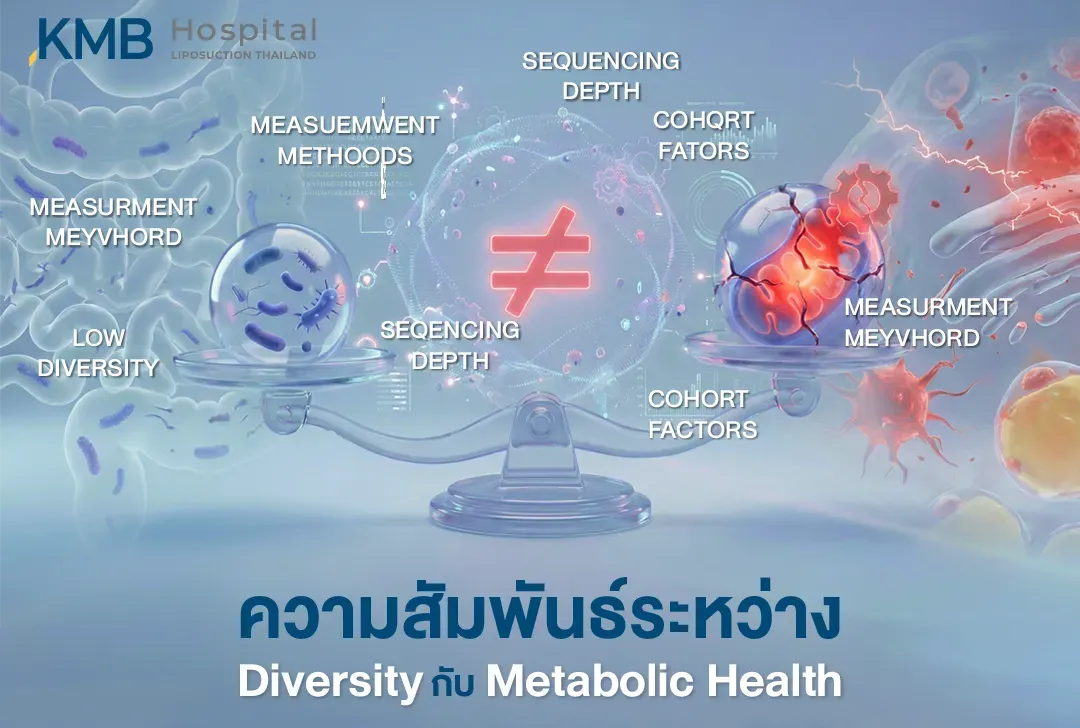
Numerous studies report that low alpha diversity is often associated with obesity or metabolic dysregulation. However, this relationship is not consistent across all populations and may depend on factors such as:
- the method used to measure diversity (e.g., Shannon index vs. Simpson index)
- sequencing depth
- differences between cohorts and confounders
Therefore, diversity cannot be used as a single biomarker to diagnose metabolic dysfunction.
4) Single-Strain Supplementation: Why the Results Are Variable

A number of systematic reviews report that single-strain probiotic supplementation (e.g., a single Lactobacillus strain), in the context of metabolic markers such as BMI, insulin sensitivity, or inflammatory profiles, tends to find that:
- the overall effect size is relatively small
- heterogeneity between studies is high
- the response depends on the individual's baseline microbiome
One systemic reason is that the microbiome is an ecosystem that relies on network interactions rather than simply “adding one strain” in the hope of affecting the entire system.
5) Diversity and the Hormonal System

In the context of the gut–brain–hormone axis, diversity may be related to:
- the consistency of SCFA production
- the modulation of immune tone
- support for barrier integrity
However, much of the evidence remains observational association, and there is currently no standardized clinical diversity threshold that can be used to draw conclusions for an individual.
6) Stability, Resilience, and Time Dynamics

The microbiome is dynamic and can change in response to factors such as diet, sleep, stress, medications, and circadian rhythm.
A system with high diversity may be more resilient to perturbations, but this does not mean that “increasing diversity is always good.” For example, in some acute infection states, diversity may shift in a direction that does not reflect improved health.
7) Limitations & Measurement Challenges

- Diversity measurement varies by method and bioinformatics analysis
- Alpha diversity is not always equivalent to functional capacity
- Association ≠ causation
- Response variability between individuals is high
Therefore, diversity should be interpreted within the framework of ecosystem biology, not a “one strain solves it all” logic.
Frequently Asked Questions
What is microbiome diversity?
It refers to the diversity of microbes in the gut, which includes both the number of species and the diversity of biochemical functions.
Does taking a single probiotic strain help?
In some contexts it may be beneficial, but the microbiome is an ecosystem that operates as a network, so outcomes depend on the entire community rather than a single strain.
Why is bacterial diversity important for health?
High microbial diversity is often associated with metabolic resilience and the stability of the microbial ecosystem.
Key Takeaway
The microbiome works as a network, and changes at the single-strain level cannot explain the system as a whole.
Understanding the microbiome in the context of hormonal and metabolic regulation should therefore sit within a systems-biology framework rather than a reductionist supplementation logic.
References
- Gilbert JA, Blaser MJ, Caporaso JG, Jansson JK, Lynch SV, Knight R. Current understanding of the human microbiome. Nat Med. 2018;24(4):392–400.
- Turnbaugh PJ, Ley RE, Hamady M, Fraser-Liggett CM, Knight R, Gordon JI. The human microbiome project. Nature. 2007;449(7164):804–10.
- Flint HJ, Scott KP, Duncan SH, Louis P, Forano E. Microbial degradation of complex carbohydrates in the gut. Gut Microbes. 2012;3(4):289–306.
- Lozupone CA, Stombaugh JI, Gordon JI, Jansson JK, Knight R. Diversity, stability and resilience of the human gut microbiota. Nature. 2012;489(7415):220–30.
- Le Chatelier E, Nielsen T, Qin J, et al. Richness of human gut microbiome correlates with metabolic markers. Nature. 2013;500(7464):541–546.
- He G, et al. Challenges in measuring gut microbiome diversity: methodological considerations. Front Microbiol. 2020;10:512.
- Plaza-Díaz J, Ruiz-Ojeda FJ, Gil-Campos M, Gil A. Mechanisms of action of probiotics. Adv Nutr. 2019;10(suppl_1):S49–S66.
Hospital Authority
KMB Hospital is committed to fairly evaluating outcomes after liposuction programs over time, ensuring care that is safe, reassuring, and respectful of each patient's body.
Content Information
Written by: Medical Content Team, KMB Hospital
Reviewed by: Clinical Governance Committee, KMB Hospital
Published: 3 March 2026
Last updated: 3 March 2026