
How Lifestyle Rhythm Affects Metabolic Health

Lifestyle Rhythm and Metabolic Health: Why “Consistency” Matters More Than You Think
Lifestyle rhythm refers to the regularity of your sleep, eating, and physical activity times each day, which is linked to the circadian system that governs metabolism, insulin, and various hormones. Metabolic health does not depend on any single type of food, but also on the temporal alignment of your daily behaviours.
What Is Lifestyle Rhythm

“Lifestyle rhythm” refers to the regularity of your daily rhythms, such as when you sleep, when you eat, and when you are physically active. These are linked to the circadian system, which regulates metabolic signaling and many important functions throughout the body.
From the standpoint of metabolic health, then, the question is not only “what you eat” but also “when you eat, when you sleep, and how consistent your daily life is”—because the continuity of your day-to-day behaviours affects the stability of your metabolic and hormonal systems.
1) The Circadian System and Metabolism
The circadian clock, or the body’s internal clock, plays a role in regulating key processes related to metabolic health, such as:
- Insulin sensitivity
- Glucose tolerance
- Cortisol rhythm
- Melatonin secretion
When the circadian rhythm is disrupted, the body may lose its ability to respond efficiently to metabolic signals, which is associated with metabolic dysfunction, including insulin resistance.
2) Irregular Schedule and Insulin Signaling
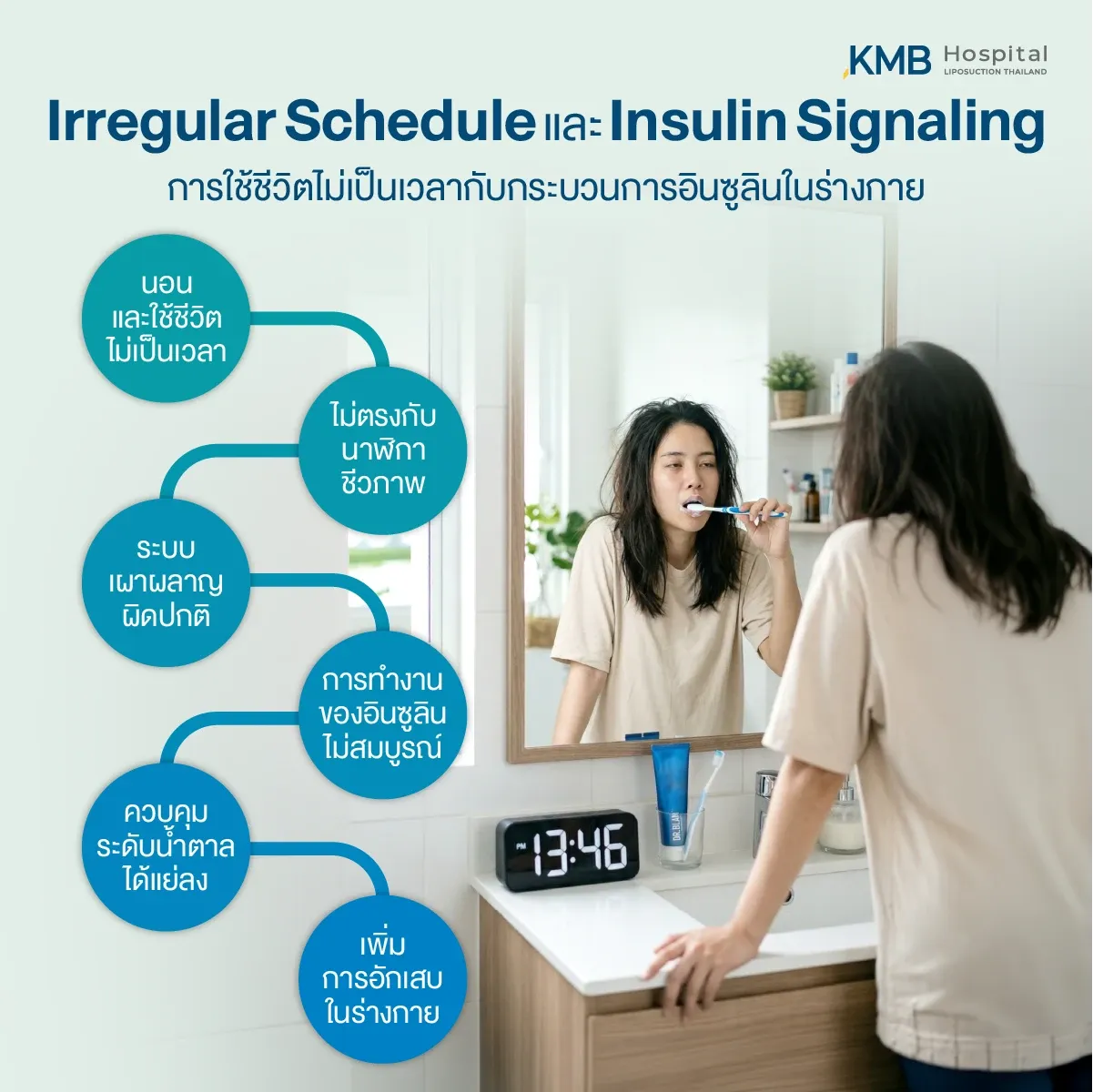
Research has found that behaviours that make daily rhythms irregular, such as:
- Irregular sleep timing
- Social jet lag
- Shift work
are all associated with an increased risk of metabolic syndrome and glucose dysregulation.
Circadian misalignment may increase inflammatory signaling and impair insulin action, weakening blood sugar control and the body’s insulin response.
3) Meal Timing and Metabolic Stability

Research in chrononutrition indicates that eating at consistent times is associated with improved glycemic control and helps the body manage energy in a more systematic way.
Conversely, late-night eating is associated with impaired glucose tolerance and increased postprandial glucose.
Simply put, even with the same type of food in a similar amount, eating at different times can produce different effects on your metabolism.
4) Sleep Regularity and Appetite Hormones
Insufficient sleep, or irregular sleep, can affect the hormones involved in hunger and satiety, such as:
- Decreased leptin
- Increased ghrelin
- Altered cortisol rhythm
These changes are associated with appetite dysregulation and energy imbalance, which may cause greater swings in hunger, make eating behaviours harder to control, and affect metabolic health over the long term.
5) Exercise Timing and Circadian Alignment
Regular exercise is associated with improved circadian amplitude and metabolic regulation, meaning the body has more predictable and systematic functional signals.
Although the evidence on the “best time” to exercise is still emerging, what is clearer is that consistency—the regularity of your behaviour—benefits the metabolic system more than shifting your exercise times around without any pattern.
6) Systems-Level Perspective
Looking at the bigger picture, lifestyle rhythm affects not only weight or blood sugar but also supports the functioning of the body’s systems across multiple dimensions, such as:
- Hormonal predictability
- Stable insulin response
- Gut microbial rhythmicity
- Reduced chronic stress signaling
Therefore, metabolic health is the result of pattern consistency rather than extreme dietary changes alone, because the body responds better to “patterns that are repeated consistently” than to short-term, discontinuous efforts.
Frequently Asked Questions About Lifestyle Rhythm
1. Is lifestyle rhythm more important than counting calories?
It is not a matter of “replacing” one with the other. Energy control still matters, but consistency in your sleep, eating, and exercise times helps your hormonal and insulin systems work more stably. Put another way, pattern consistency supports metabolic predictability.
2. What is social jet lag, and is it related to metabolism?
Social jet lag is a condition in which your sleep–wake times on workdays differ too much from those on days off. Research has found that this condition is associated with insulin resistance and increased metabolic risk, so keeping your sleep times close to the same each day helps reduce circadian disruption.
3. If I eat clean but eat late every day, does it still affect insulin?
Even if food quality is good, late-night eating may occur during a period when insulin sensitivity is naturally lower, so it may affect glucose control more than eating the same meal during the daytime.
4. Do I have to wake up and go to sleep at exactly the same time every day?
It does not have to be exact to the minute, but keeping your times close to the same each day helps make the circadian system more stable—consistency matters more than perfection.
5. How does lifestyle rhythm help with hunger?
A regular daily rhythm helps stabilise the functioning of leptin, ghrelin, and cortisol, which may help reduce appetite fluctuation or excessive swings in hunger.
6. Is it better to exercise at the same time every day?
Regular exercise helps reinforce circadian cues. Although the evidence on the “best time” is not yet clear, consistency benefits the metabolic system and the body’s signals.
7. What should I do if I work night shifts?
People who work night shifts have circadian misalignment by nature. Reasonable approaches include keeping consistent sleep times, avoiding heavy meals before sleep, and managing light exposure during breaks, rather than forcing long fasting that does not suit the realities of your life.
Key Takeaways
- Circadian alignment supports insulin sensitivity
- An irregular schedule increases metabolic risk
- Meal timing affects glucose control
- Sleep regularity is linked to appetite hormones
- Lifestyle rhythm is the system that organises the metabolic network
Hospital Authority
Written by: Medical Content Team, KMB Hospital
Reviewed by: Clinical Governance Committee, KMB Hospital
Published: 31 March 2026
Last updated: 31 March 2026
References
- Qian J, Scheer FAJL. Circadian system and glucose metabolism. Trends Endocrinol Metab. 2021;32(7):508-521.
- Morris CJ, et al. Circadian misalignment increases insulin resistance. Proc Natl Acad Sci U S A. 2020;117(27):15855-15861.
- Garaulet M, Gómez-Abellán P. Timing of food intake and metabolic health. Nutrients. 2020;12(2):343.
- Jakubowicz D, et al. Meal timing and metabolic regulation. Nutrients. 2021;13(4):1141.
- McHill AW, et al. Later circadian timing associated with metabolic risk. J Clin Endocrinol Metab. 2020;105(6):e2303-e2312.
- St-Onge MP, et al. Sleep and appetite regulation. Nat Rev Endocrinol. 2020;16(9):495-507.
- Pedersen BK, Saltin B. Exercise as medicine: dose–response relationships. Nat Rev Endocrinol. 2021;17:251-268.