
How do fat, skin, muscle, and body structure affect the pre-liposuction body contouring design?
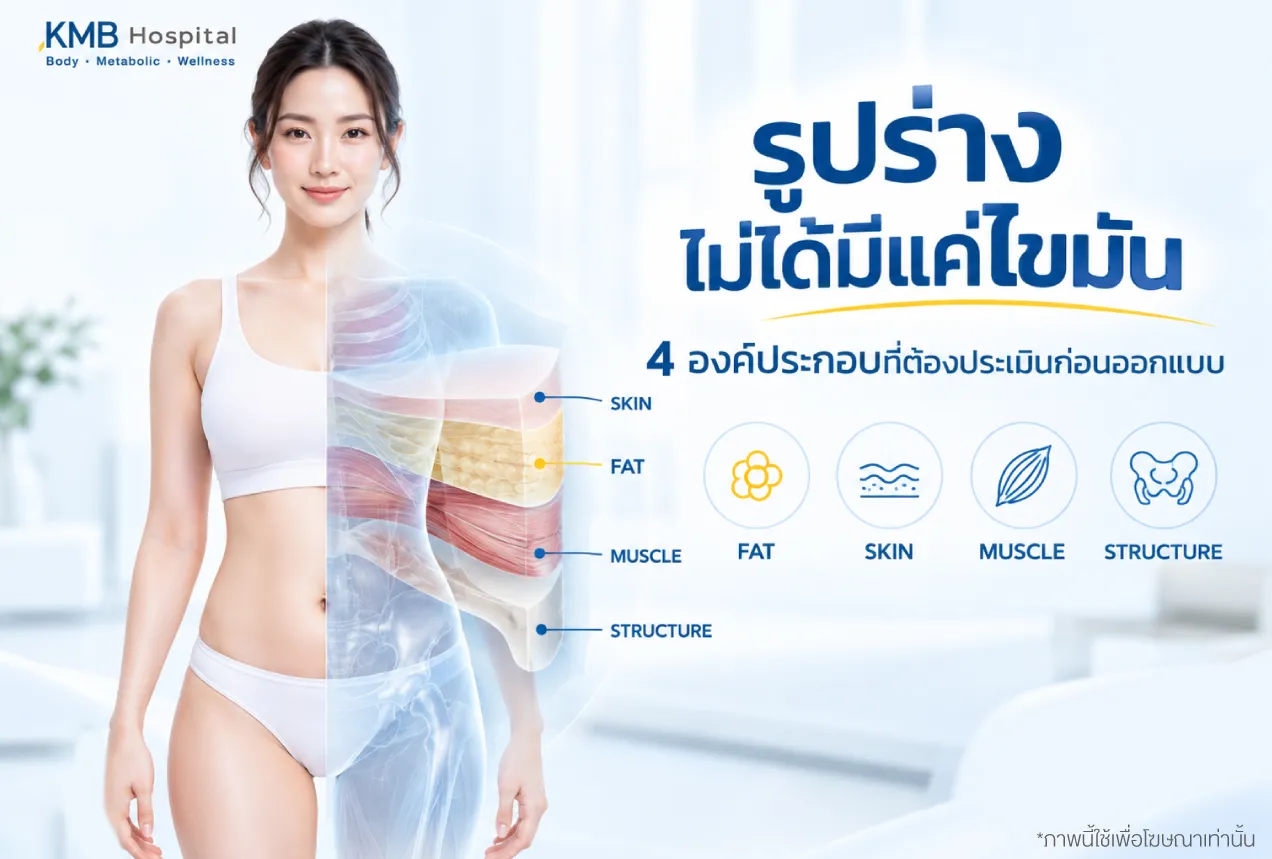
How do fat, skin, muscle, and structure influence body design before a liposuction program?
Body design before a liposuction program should not be assessed solely based on fat volume, because the shape seen externally results from multiple overlapping components: subcutaneous fat, skin quality and elasticity, underlying muscle and tissue, as well as original body structure.
In the KMB Hospital Body Design framework, separating these elements helps answer critical questions such as “which parts of the body shape are due to fat that can be reduced,” “which parts are limited by skin or structure,” and “if fat volume changes, how will the remaining shape relate to each other” before defining an individualized treatment plan.
If your figure looks large, is what you see really just "fat"?
When people look at their abdomen, upper arms, waist, or thighs and feel "it's too big," the first thing many think of is "there must be a lot of fat."
Sometimes this is true, but not always. Because the shape seen by the eye externally is the sum of multiple layers of tissue stacked together.
Try thinking of the body as a 3D image. The outermost thing we see is skin; under the skin, there is fat and connective tissue; deeper down, there is muscle; and inside, there is bone structure serving as the basic frame of the body.
Therefore, a single body shape is not made from just one layer of "fat."
Before asking where to reduce fat, the doctor must first distinguish what makes up the shape you see.
The 4-element body reading framework of Body Design
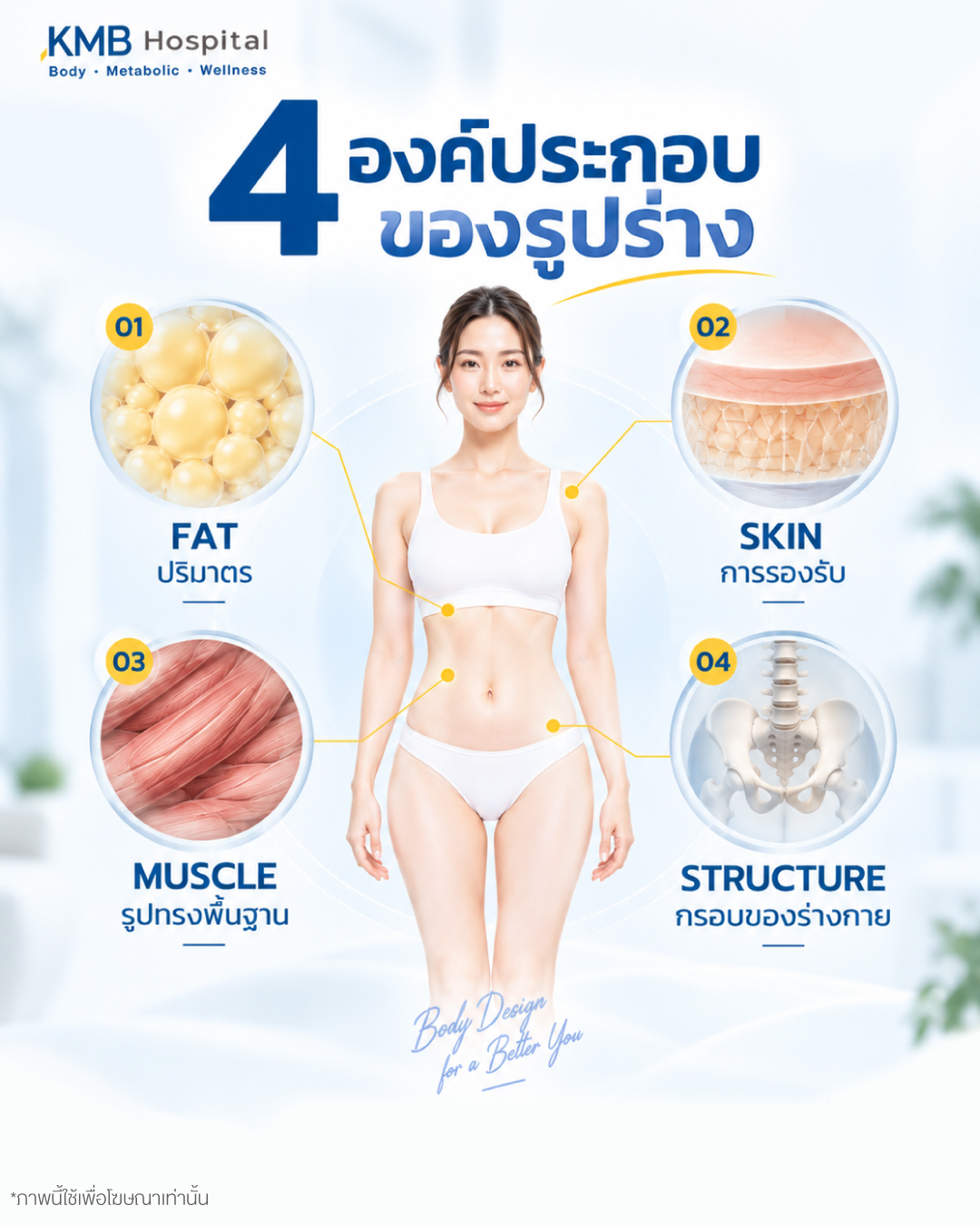
To make Body Design easier to understand, in Series 4, we use a 4-element body reading framework. All 4 parts work together, and each part has things that can be changed, things that can be partially changed, or things that are not the target of a liposuction program. Separating these layers is the foundation before entering body design.
FAT — Fat
The part that a liposuction program changes directly is the subcutaneous fat in specifically appropriate areas.
SKIN — Skin
When subcutaneous volume decreases, the overlying skin must adjust, so quality and elasticity must also be assessed.
MUSCLE & SOFT-TISSUE SUPPORT
Muscle and supporting tissue are deeper than fat, but still contribute to the volume and form of the body seen externally.
STRUCTURE — Structure
Original body structure is the frame of body shape and does not change through subcutaneous fat reduction.
1. FAT — Fat is the part that a liposuction program changes directly
A liposuction program is a procedure for reducing subcutaneous fat in specific areas to help adjust body contour and proportions. It is not a procedure for overall weight loss.
But even though we use the word "fat," subcutaneous fat is not a single lump that looks the same in every location.
Anatomically, subcutaneous fat tissue can have superficial and deep layers, separated and linked by the superficial fascia system in each area. The distribution, thickness, and characteristics of the fat layer therefore vary according to the anatomy of that specific area.
How much is there?
Where is it located?
How does it connect to other parts?
Fat doesn't just have the function of making things "bigger"
The position of volume also affects the shape. Suppose two people have similar overall fat amounts. The first person accumulates fat predominantly in the front of the abdomen, while the other accumulates it continuously along the waist and flanks. Even if the total amount might not be very different, the silhouette seen can be different.
Fat is therefore an "adjustable material," but that doesn't mean it should all be removed
The term "body design" does not mean making the fat layer as thin as possible, because fat tissue and superficial fascia relate to the body's contour, and treatments that do not respect the anatomy or areas of tissue adhesion can increase the risk of contour irregularity [2] [3].
The Body Design question therefore is:
2. SKIN — When fat decreases, the overlying layers must adjust
Imagine there is a volume under the skin. When that volume decreases, the overlying skin must adjust to the new shape. This is why skin quality is another component that a doctor must read before designing.
The American Society of Plastic Surgeons states that skin with good firmness and elasticity tends to be more suitable for contour adjustment, while skin quality is one of the factors that must be considered alongside other components [1].
When evaluating skin, doctors don't just look for "sagging or not sagging"
Why "removing more fat" might not be the answer when skin has limitations
If the skin already has reduced support, reducing more subcutaneous volume does not always mean it will become firmer. Therefore, body design must create a balance between what you want to reduce and what the skin can support after the volume has decreased.
This is a clear example that Body Design is not just Fat Removal Planning.
3. MUSCLE — Muscle is under the fat, but affects the image we see
Next from the fat and fascia layers down is the component related to muscle and supporting tissue.
A liposuction program does not have the goal of reducing bone size or turning muscle into a new shape, but muscle still plays a part in the volume and form of the body we see externally. The ASPS includes muscle tone as one of the components to consider together with skin quality and specific area fat [1].
Why separating "fat" from "muscle" is important
Let's use the upper arm as an example. An upper arm that looks voluminous may consist of subcutaneous fat, muscle, bone structure, skin, and tissue.
If the part causing the size of the arm comes mainly from fat, a liposuction program may play a role in the volume of that area. But if the majority of the volume is related to muscle or original structure, trying to reduce more fat will not make the muscle or bone smaller. Therefore, before designing, one must distinguish which layer what the eye sees is in.
Another example is the abdomen
An abdomen that looks protruding does not always mean it is caused solely by subcutaneous fat. The shape of the abdominal area can have multiple components combined, such as subcutaneous fat, skin and tissue, abdominal wall muscle, torso structure, and intra-abdominal components.
Therefore, if the cause of the contour seen is not entirely in the subcutaneous fat layer, a liposuction program alone cannot change all those components. This is why a doctor must evaluate first, not conclude from external appearance alone.
4. STRUCTURE — Structure is the frame that Body Design must respect
The last component is the original body structure, such as shoulder width, ribcage shape and width, torso length, pelvis width, bone alignment, length of arms and legs, and individual anatomy patterns.
These build the "frame" for Body Shape and do not change through reducing subcutaneous fat with a liposuction program.
A simple example: Why everyone's waist cannot be equally defined
Suppose two people have similar fat in the waist area, but the first person has a wider ribcage and a shorter distance between the ribs and pelvis, while the other person has a narrower torso and a longer waist. Even if they reduce a similar amount of fat, the waist line seen afterward can be different.
It is not because someone "did a better job," but because the baseline structure is not the same.
This is why Body Design should not have a "standard waist" used for everyone.
Structure is not always a "problem" that needs solving
Body Design does not view original structure as a defect, but uses the structure as a baseline to understand what this body starts with, and what should be designed within that frame.
Therefore, when a doctor sees that "this is the original structure," it does not mean that the structure is not good, but that one should not set treatment goals expecting a liposuction program to change what is not in the fat layer.
How these four elements work together
This is the heart of this chapter. In actual evaluation, we can hardly separate the body into just fat, just skin, or just structure because what is seen is the sum of everything.
Let's use one case as an example: the patient feels that "the abdomen looks big and there is no waist." If looking only at fat, we might ask: how many centimeters of fat are there? But in Body Design, we open the questions into 4 sides.
| Component | Questions in evaluation |
|---|---|
| FAT | Where is the fat volume, and how is it distributed? |
| SKIN | How much elasticity and support does the skin have? |
| MUSCLE & SOFT-TISSUE SUPPORT | How does the form of the torso wall and deeper tissue contribute to the contour? |
| STRUCTURE | What kind of frame do the ribs, pelvis, and waist length create? |
When combining all information, the phrase "no waist" may have different causes in each person.
This is why people with similar shapes may not have the same plan
Two people can be close in height, close in weight, have close waist measurements, and look similar in front photos, but when evaluated, they may have different information.
Person 1
Prominent fat, skin still has good elasticity, muscle and structure have no prominent elements that interfere with the contour.
Person 2
Fat is not as much as the external picture tells, has more skin laxity, different torso structure, and other tissue components involved.
Similar Shape ≠ Same Anatomy
And when anatomy is not the same, treatment planning should not be made from the same template.
KMB does not start Body Design with the question "What shape do you want?"
In the KMB Hospital Body Design framework, we start by separating what is seen before asking what needs to be done with it.
This is the difference between "seeing fat and planning to remove it" versus "understanding the body before planning to change the contour."
Then what is the role of FAT Mapping™ at this stage?
In the KMB Hospital system, we place FAT Mapping™ as an Assessment Foundation because before designing, one must have information first.
FAT Mapping™ and doctor examination serve to help gather information about what is being evaluated, such as fat distribution, the relationship of various areas, shape from multiple angles, information of tissue layers according to the scope of evaluation tools, skin quality, and other supporting information from the exam and the body's baseline before planning.
Assessment Foundation
Interpretation & Design
Choosing the right approach
Then it enters Body Design, which doesn't ask "What information is there?" but asks "What does this information mean for this person's body?"
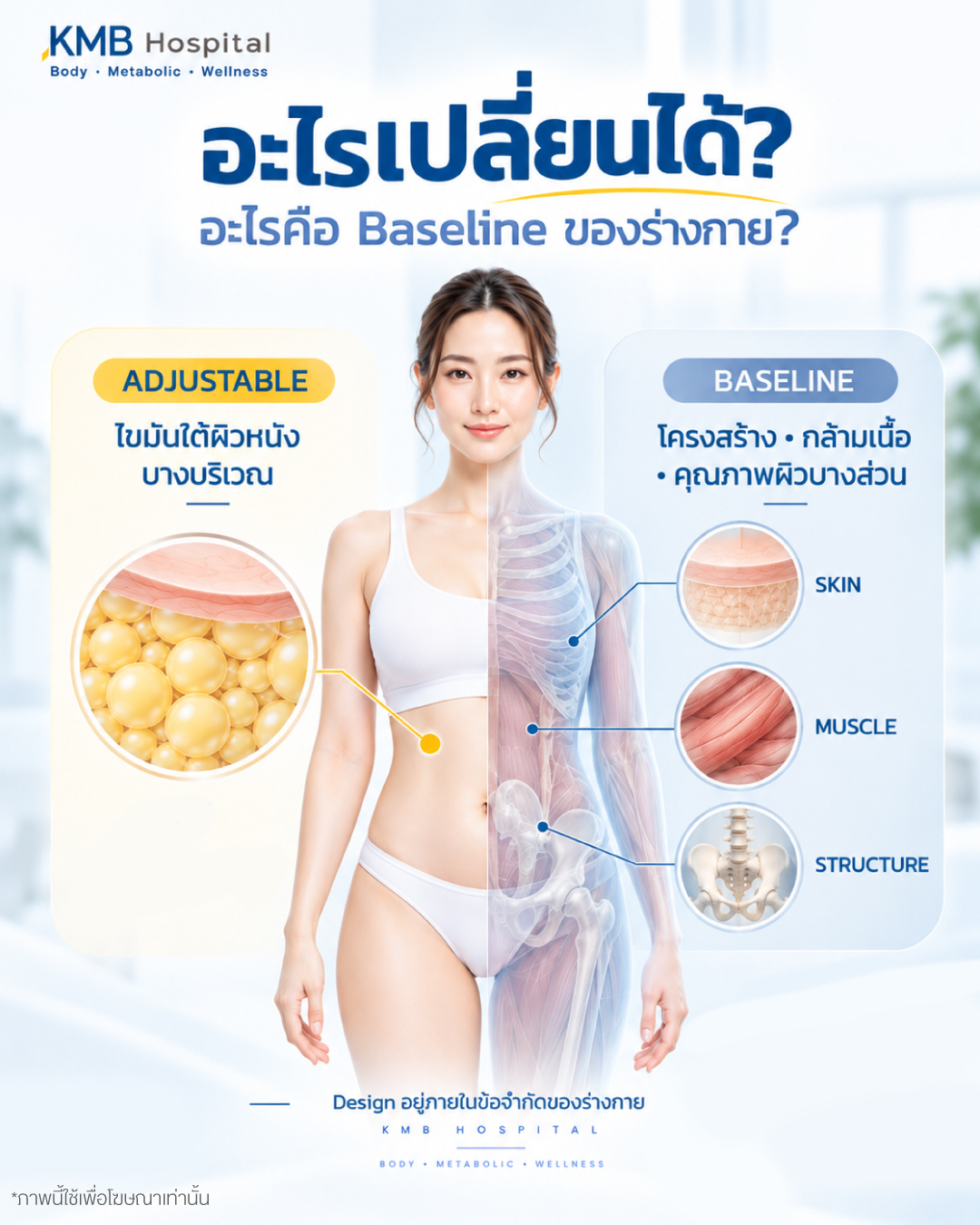
What can be changed and what should not be expected from a liposuction program
| What a liposuction program can directly change | What a liposuction program does not directly change |
|---|---|
| Volume of subcutaneous fat in appropriate areas. When volume changes, local contour can change, the perception of proportions can change accordingly, and the overall shape may look different. | Bone width, torso length, ribcage shape, pelvis width, arm or leg length, joint structure, turning muscle into a new structure, or significantly excess skin disappearing automatically. |
A liposuction program can affect the overall body shape through changing fat and contour, not by changing the anatomy of every layer of the body, and it is not a procedure for treating obesity or replacing weight control [4].
"Limitation" does not mean it cannot be designed
In Body Design, the word limitation does not mean something negative, but refers to information that must be known before planning.
If the waist structure is relatively short, the doctor must design based on that waist length. If skin has reduced elasticity, skin quality must be considered together with the volume to be reduced. And if some mass comes from muscle more than fat, one must not set expectations that such parts will be reduced by fat removal.
Understanding limitations does not block options, but helps make goals more aligned with the actual anatomy.
Body design therefore has both "things to adjust" and "things to keep"
When talking about design, many might think about changing, but in Body Design, another half of the work is deciding what should not be changed.
Because some volumes help create transitions, some help maintain proportional relationships, some are natural anatomy, and some, if reduced too much, could make the contour look discontinuous.
An understanding of the anatomy of fat layers, superficial fascia, and zones of adherence is used in liposuction literature to help reduce the risk of contour deformity, reflecting that body contouring requires more than just measuring the amount of fat to be removed [2] [3].
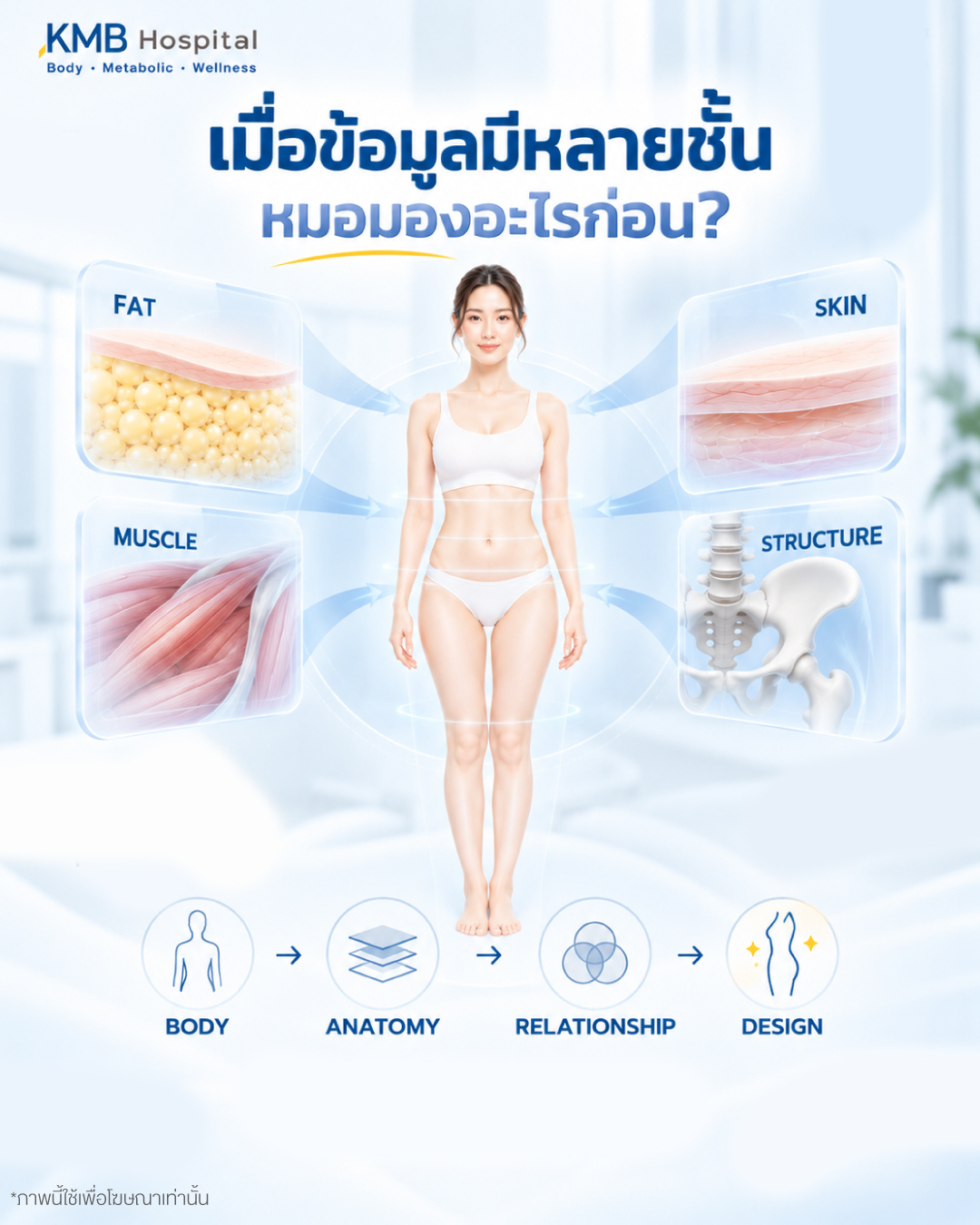
4 questions KMB uses as a framework before designing
1. What creates the shape we see?
One must separate whether it is fat, skin, muscle, structure, or multiple components combined.
2. What are the adjustable parts?
Find parts that fall within the scope of the treatment approach being considered.
3. If those are adjusted, what will the rest look like?
Because fat decreases, but skin, muscle, and structure still play a role in the contour after treatment.
4. What should be kept?
Not all volume needs to be reduced, and not all curves need to be made to disappear.
This framework of questions helps change the way of thinking from Fat Reduction to Body Design.
Things Dr. Looknu wants to leave with you
When we look at a body from the outside, we only see the final image. But before designing, the doctor must try to look deeper into what that image was created from.
Sometimes what is seen is fat, sometimes skin plays a large role, sometimes what the person wants smaller is part of the muscle or original structure, and often it is a combination of several things.
Therefore, before asking "How much can be removed?"
The doctor wants to answer the question first: "What are we going to change?" and "After changing, what will stay there?"
For me, body design does not start with taking fat out, but starts with understanding the anatomy of the person right in front of me.
Frequently asked questions
Does a large-looking shape always come from fat?
Not always. The external shape is a sum of fat, skin, tissue, muscle, and body structure. Therefore, it should be evaluated before concluding that the visible part is primarily fat.
If there is a lot of fat, does removing more always lead to a better body shape?
Not necessarily. The appropriate amount depends on the anatomy of the area, skin quality, relationships with neighboring areas, and the treatment plan. Removing too much fat in some areas can increase the risk of unevenness or make existing laxity more visible.
Can sagging skin be solved by liposuction alone?
This must be evaluated on an individual basis. Liposuction's main goal is subcutaneous fat, not removing excess skin. Those with significant sagging or reduced elasticity may need to consider other options with the doctor according to indications.
Can a liposuction program make muscles smaller?
A liposuction program targets subcutaneous fat and is not a method for reducing muscle size. Therefore, if the volume of that area is largely due to muscle, the effect on the size will differ from cases where it is primarily due to fat.
Does body structure affect the results after a liposuction program?
Yes, it affects the initial shape and the limits of what can be changed, such as ribcage width, pelvis width, and torso length. Liposuction can change fat volume and some contour, but not the basic bone structure.
From KMB Hospital to the doctor's perspective
Domain A of KMB has brought us to this point: what is Body Design → why look at the whole body → how shape / proportion / contour differ → and how one body shape is built from fat, skin, muscle, and structure.
The next question is not a theory, but a question of: when a patient actually stands in front of the doctor, what does the doctor look at first?
Related articles
Body Design Foundations
Assessment FoundationFAT Mapping™ — Evaluation before body and liposuction program planning
Medical resources
- American Society of Plastic Surgeons. Liposuction Candidates. Used for information on skin elasticity and muscle tone in patient evaluation.
- Si L, Li H, Li Z, et al. The Superficial Fascia System: Anatomical Guideline for Zoning in Liposuction-Assisted Back Contouring. Plast Reconstr Surg. 2023;151(5):989–998.
- Advances in Liposuction: Five Key Principles with Emphasis on Patient Safety and Outcomes. Used for information on zones of adherence and avoiding contour irregularities.
- American Society of Plastic Surgeons. What is Liposuction?. Used for information that liposuction is for localized fat reduction to adjust contour, not for treating obesity or replacing weight control.
About the authors and reviewers
Author: Medical Content Team, KMB Hospital
Medically reviewed by: Dr. Mantanas Peerapatchai (Dr. Looknu), License No. 37626
Medical disclaimer
This article is intended to provide knowledge about body components related to assessment and body planning before a liposuction program and cannot be used as a substitute for individual medical examination, diagnosis, or advice from a doctor.
The Fat–Skin–Muscle/Supporting Tissue–Structure framework in this article is used as a Body Design framework for Series 4 to help understand body evaluation and is not a standard medical diagnostic system used to replace physical examinations.
The suitability of a liposuction program, scope of treatment, techniques, and expected outcomes vary for each individual and should be assessed for health, anatomy, fat distribution, and tissue quality by a doctor before deciding on treatment.
Need an evaluation of your body shape before planning a liposuction program?
Individualized evaluation allows the doctor to consider fat, skin, muscle/supporting tissue, structure, and proportional relationships together before choosing an approach appropriate for each person's body.