
Before liposuction, why must the doctor assess the entire body shape instead of only the areas with fat?
KMB Hospital · Series 4 — Body Design & Body Proportion · S4-A-K02
Before Liposuction: Why Must Doctors Assess the Entire Body, Not Just the Area with Fat?
First Published:29/10/2026 Last Updated: 4/11/2026 Estimated Reading Time: 8–10 minutes Category: Body Design & Body Proportion Author: KMB Hospital Medical Content Team Medically Reviewed by: Dr. Mantanas Peerapatchai (Dr. Looknuu) License No. 37626
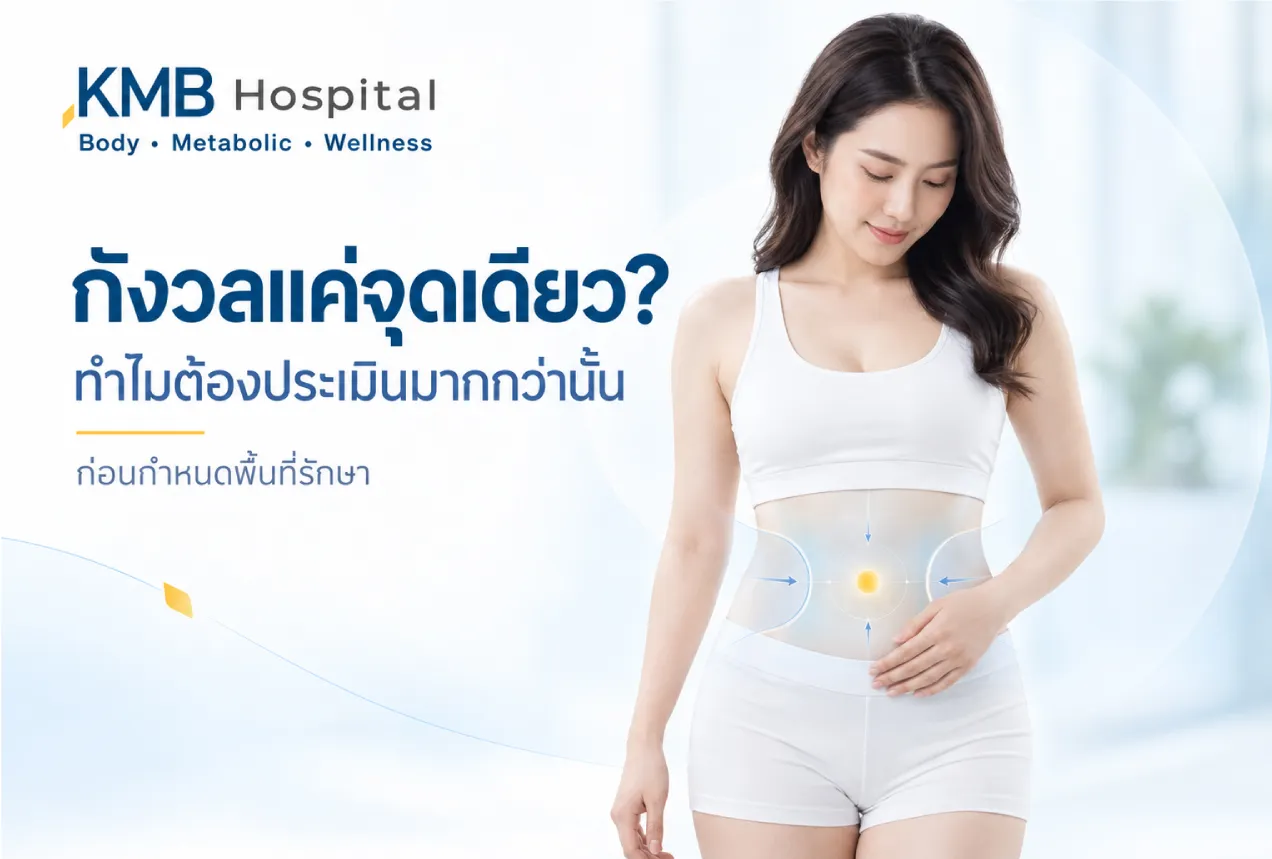
Even if an individual is concerned about only one specific area—such as the abdomen, upper arms, or thighs—planning a liposuction program should not focus solely on that area. The shape we see is the result of the continuity of many areas, involving structure, fat distribution, skin quality, muscle, and the proportions of adjacent zones.
Assessing the entire body does not mean you must undergo treatment on the entire body. Instead, it is about understanding how the "area of concern" plays a role in the overall silhouette. This helps to distinguish which parts should be adjusted, which parts should be preserved, and which parts are not actually caused by fat in the first place.
Concerned about only one area—why must the doctor look at the whole body?
When people look at their own bodies, they usually start with the area that stands out the most.
"Belly fat"
"Unclear waist"
"Large arms"
"Large thighs"
It is natural to think that if the problem is in a certain area, you should treat only that area. However, from the perspective of Body Design, the term "the area we see" and the "cause of the shape we see" may not be the same thing. The shape perceived by the eye is not caused by the size of any single spot alone, but rather by the constant comparison of that area with the surrounding areas. A simple example:
Whether the waist looks defined does not depend on the "waist" alone, but on the relationship between: Chest → Waist → Hips.
The same applies to the upper arms:
Whether the arms look large or balanced does not depend only on the circumference of the upper arm, but also relates to the: Shoulders → Armpits → Upper Arms → Torso sides.
This is why assessment before planning a liposuction program should prioritize seeing the big picture before seeing the details.
"Full body assessment" does not mean "full body treatment"
This is an important point to clarify. When a doctor assesses the entire body, it does not mean the doctor will recommend treatment on multiple areas, and it certainly does not mean:
"If you come in for the abdomen, you must always treat the waist, back, or other areas."
The role of a full-body assessment is to gather data for planning, not to expand the treatment area. After assessment, the doctor might find that:
- The main problem is specifically in the area the patient is concerned about.
- Surrounding areas affect the silhouette but do not require treatment.
- Some parts are original structures that should not be changed.
- Some parts are related more to skin or muscle than to fat.
- Or in some cases, treating only one area is sufficient to achieve the goals.
Whole-body Assessment ≠ Whole-body Treatment
A broad assessment does not mean the scope of treatment must follow suit.
In reality, the body has no lines saying "this is the abdomen, this is the waist"
When describing the body, we need to name different areas to make communication easier.
Abdomen
Waist
Flanks
Back
Hips
Thighs
But in the real body, there are no straight lines drawing boundaries between these areas. The human shape is a continuous line. Viewed from the front, one line might start from the chest, go down to the waist, and continue to the hips. When turning to the side, the same line might continue from the abdomen to the flanks, and when viewed from the back, those flanks connect to the back and hips.
Therefore, if you change the volume of one area, the perception of adjacent areas may change as well, even if those adjacent areas were not treated. This is why Body Design must care as much about the "transition" between different areas as it does about the areas with fat accumulation.
The area that looks large may not be the root cause of the body shape
Suppose two people say the same thing: "I want to reduce my abdomen."
The first person might have significant fat accumulation in the front abdomen, while the waist and torso sides remain relatively balanced.
Another person might have less fat in the front, but there is continuous accumulation extending from the abdomen to the waist and flanks, making the mid-torso look straight when viewed as a whole.
The phrase "large abdomen" for these two people does not mean the same problem and should not be automatically translated into the same Treatment Plan. The assessment must first answer:
What do we see?
Then ask, what causes what we see? Before reaching the final question of:
How should it be planned?
Why looking only at "size" is not enough
Shape is not the sum of circumference numbers alone. For example, two people might have the same waist circumference, but when viewed by eye, they may have very different silhouettes because of differences in:
- Rib cage width
- Pelvic width
- Fat accumulation locations
- Fat thickness in each area
- Muscles
- Skin quality
- Torso length
- Waist-to-hip relationship
Therefore, body assessment should not be concluded from "how many centimeters" alone, but must look at what structure that number is on and how it relates to other parts.
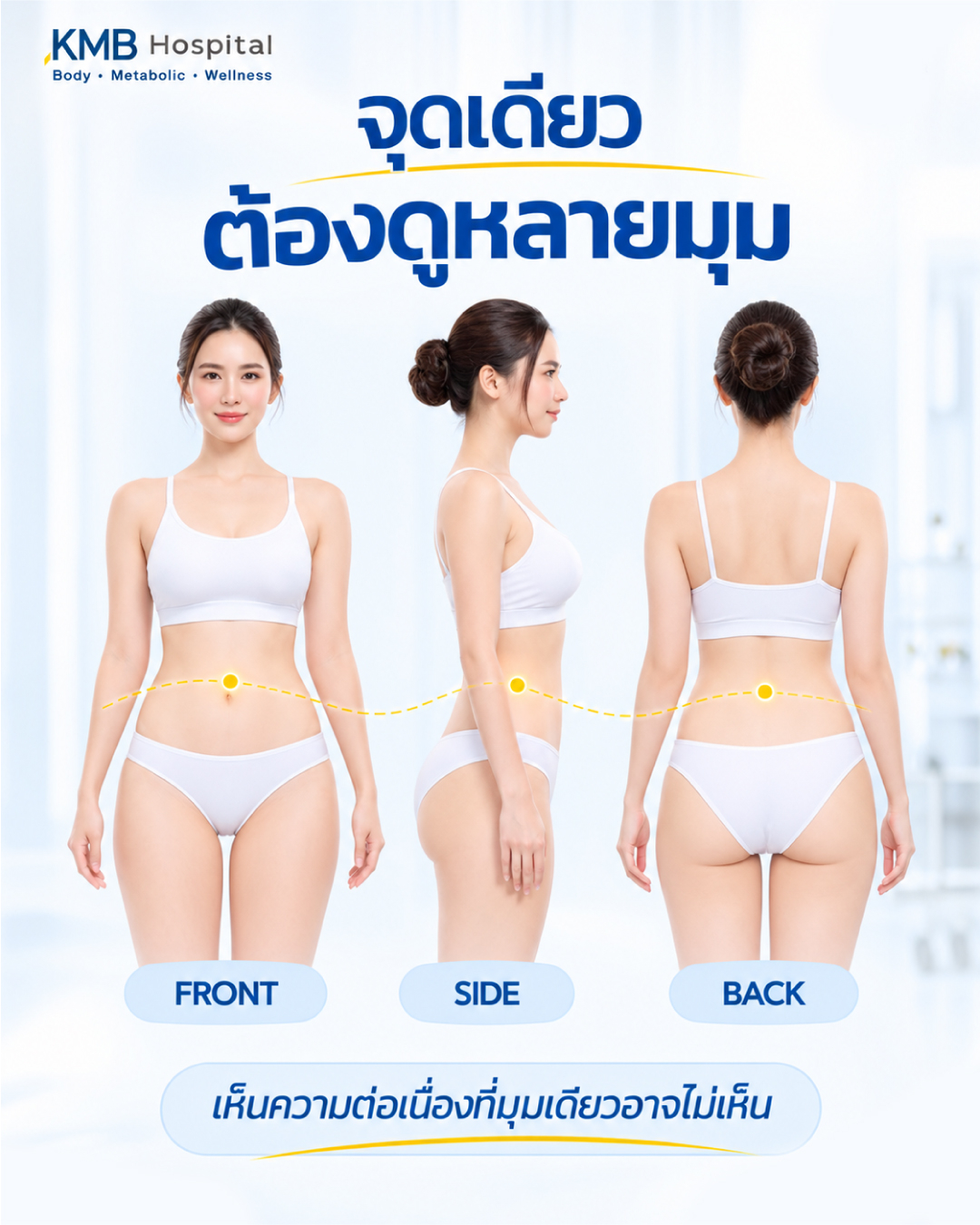
Why look from the front, side, and back?
The body is a three-dimensional structure, but the images we see in a mirror or a single photograph are only one angle. Therefore, some problems may appear clearly in one view but be barely visible in another.
| Viewing Angle | Helps to observe |
|---|---|
| Front View | Torso width · Overall symmetry · Waistline · Shoulder, waist, and hip relationship · Thigh and leg lines |
| Side View | Abdominal projection · Continuity between abdomen and waist · Back line · Hip position · Skin laxity in certain areas |
| Back View | Flank line · Back · Posterior waist · Hips · Posterior thigh line |
When combined, these three angles help the doctor understand that what looks like a localized problem from one angle is actually part of a continuous contour.
Examples: Abdomen, upper arms, and thighs
Example 1 — Consulting for the "Abdomen"
If we only look from the front, we might see only the volume in the abdominal area. However, Body Design will continue to ask:
- What are the upper and lower abdomen like?
- What is the waist like?
- How far do the flanks extend toward the back?
- What kind of transition lines exist on the torso?
- How elastic is the abdominal skin?
- And is the visible contour caused entirely by fat?
The primary goal of liposuction is to reduce localized fat and adjust the body contour—not to treat obesity. A suitable candidate must also consider health, skin quality, muscle, and treatment goals. Therefore, the question before planning is not just "How much fat is in the abdomen?" but rather:
"What are the components of the visible abdomen, and how does it connect to the waist?"
Example 2 — Consulting for "Large Upper Arms"
When a patient feels their upper arms are large, the first thing seen might be the volume around the middle of the arm. However, if assessing to design properly, one must also look at the:
Shoulders → Armpits → Upper Arms → Elbows → Torso sides
- Because some people have prominent fat only in one part of the upper arm.
- Some people have concomitant skin laxity.
- Some people have shoulder structures or muscle mass that make the arm shape look different.
- And some people may have upper arms that do not have much fat, but compared to the torso or shoulders, they feel the arms look prominent.
This is why:
"Large arms" does not mean "remove as much arm fat as possible."
Assessing skin quality is crucial because after reducing fat volume, the skin must adapt to the new contour. If skin elasticity is reduced, removing too much fat may make previous laxity or unevenness more apparent.
Example 3 — Consulting for "Large Thighs"
"Large thighs" can come in many forms:
- Some people are prominent in the outer thigh area.
- Some in the inner area.
- Some continuous with the hips.
- Some have thighs that aren't very large, but the area around the knees makes the leg line look discontinuous.
Body Design therefore does not look at the thigh as a single piece, but looks at the continuous lines of:
Hips → Thighs → Knees → Calves
This is to understand what creates the silhouette of the entire leg. This does not mean everyone must treat every area, but it means that before deciding where to treat, one must see what context that area is in.
"The area of concern" and "the area to assess" do not necessarily have to be the same
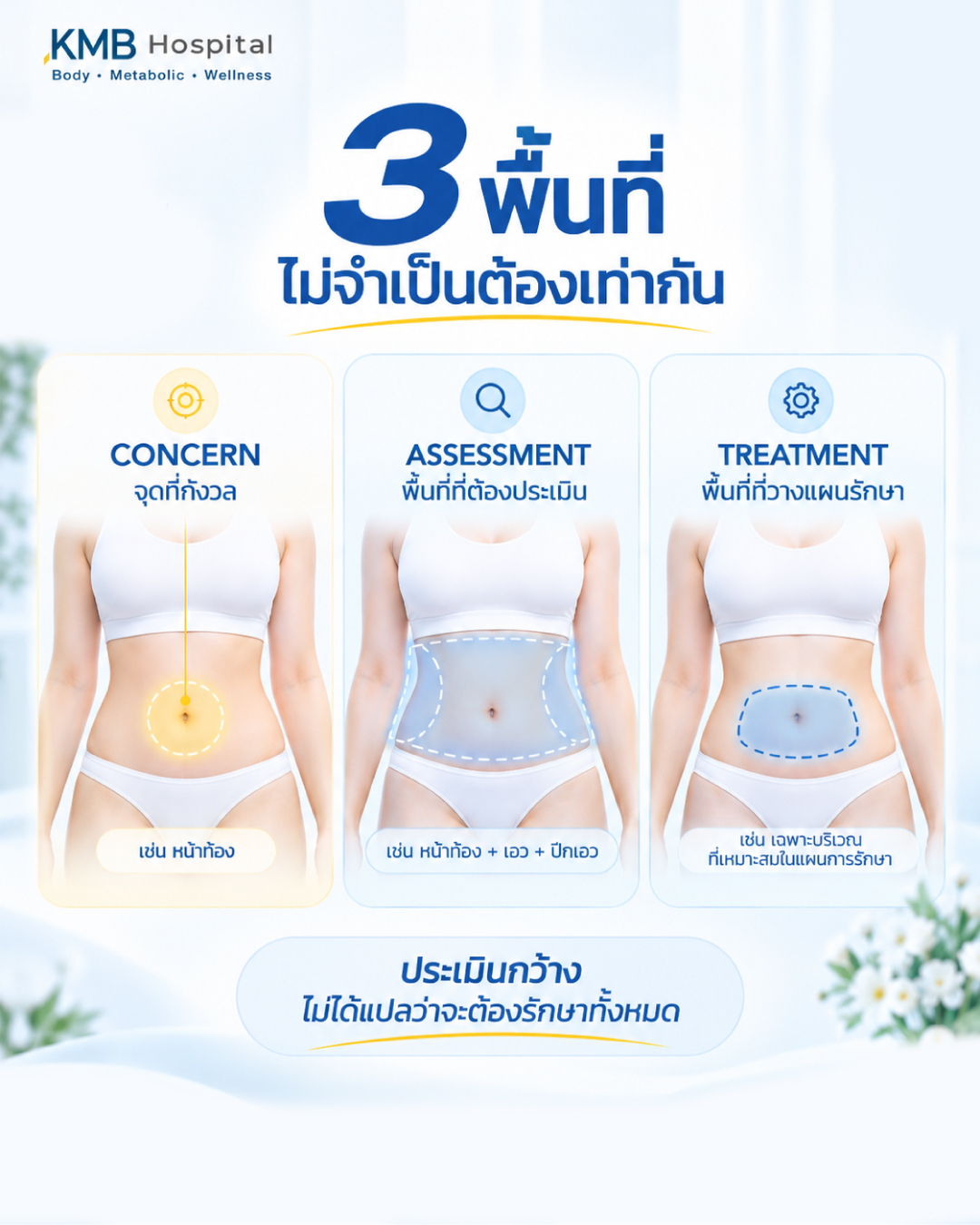
This is another key principle of Body Design. A patient can have Concern Area = 1 spot, but the doctor may need to have:
Assessment Area = Broader than that
This is to understand the root cause of the body shape. For example: Concern Area: Abdomen | Assessment Area: Abdomen + Waist + Flanks + Back + Skin Quality + Torso Structure. But in the end, after assessment, the Treatment Area might still be:
The abdomen only
It is possible. Therefore, we can simplify this into three layers:
| Assessment Layer | Definition |
|---|---|
| Concern Area | The area the person is worried about |
| Assessment Area | Areas and components the doctor must examine to understand the problem |
| Treatment Area | The areas the doctor and patient agree have indications for treatment and are appropriate for their goals |
These three do not necessarily have to be the same size.
What should a doctor look for before determining the Treatment Area?
1. Listen to the person's concerns first
- Body Design should not start from what the doctor wants to change.
- But it should start from listening to what the person sees, feels, and wants to change.
- Because everyone's goals are different.
2. Look at the overall body shape
- After knowing the concerns, step back and look at the big picture.
- Upper body vs. lower body.
- Shoulders vs. hips.
- Waist vs. torso.
- Proportion of arms to body.
- Continuity of leg lines.
- This step is not meant to judge whether the shape is good or bad, but to understand the baseline of that person.
3. Assess fat in specific areas
- The doctor must differentiate how much of the visible area is comprised of fat and how the fat position relates to the contour.
- Medical evidence on liposuction programs emphasizes the proper selection of candidates, anatomical assessment, and avoidance of excessive fat removal, because inappropriate fat reduction can cause contour irregularities.
4. Assess skin quality
- Must look at elasticity, laxity, thickness, stretch marks, and tissue characteristics.
- Because fat reduction is only one part of the equation.
- After fat is reduced, what remains is skin + tissue + original structure.
- Skin quality affects planning and expectations for the contour after treatment.
5. Separate what is fat from what is not fat
- This is a very important step.
- Because what makes the shape look prominent, large, or discontinuous may not be entirely due to subcutaneous fat.
- It may involve muscle, skin, bones, rib cage shape, pelvis, and the individual's original anatomy.
- If these components aren't clearly separated, trying to fix it by fat reduction alone may not solve the root cause.
6. Assess health and readiness
- Liposuction is a medical procedure; planning does not end with body shape.
- Consider overall health, underlying diseases, medications or supplements taken, smoking or vaping, medical history, recovery readiness, goals, and expectations.
- Selecting candidates and pre-operative assessment are essential components of safety and body contouring planning.
Where does FAT Mapping™ fit in?
In the KMB Hospital system, we position FAT Mapping™ as an Assessment Foundation. The role of this step is to help collect and organize data before the doctor plans the treatment. FAT Mapping™ questions focus on: "What are we seeing?"
For example:
- Fat accumulation patterns
- Related areas
- Shape from multiple angles
- Supporting information about tissues and proportions based on assessment tools
Then it enters Body Design, which asks: "What do these data mean for this person?"
And "If we plan this, how should we consider the relationship of each part?" The sequence can be viewed as:
FAT Mapping™
→ Seeing data
Body Design
→ Interpreting relationships
Treatment Planning
→ Choosing appropriate approaches
Body Design does not start by finding "where else to treat"
Another important issue is that looking at the entire body is not intended to find additional areas to treat. On the contrary, a good assessment might lead the doctor to remove some areas from the plan, because after looking at the big picture, they might find that:
- This doesn't need to be changed.
- Some volume should be preserved here.
- What the patient is concerned about is not primarily caused by fat.
Therefore, Body Design has the responsibility to both:
Choose what to adjust AND choose what NOT to adjust.
When might localized treatment be sufficient?
After completing the assessment, the doctor might see that the problem is truly localized, for example:
- Localized fat accumulation.
- Adjacent areas have balanced proportions.
- Appropriate skin quality.
- Other structures are not major factors.
- And the patient's goal is to adjust only that area.
In such cases, localized treatment may be a more appropriate approach. This is why "full body assessment" does not make the plan have to be larger, but it helps the scope of the plan have more reasoning.
A note from Dr. Looknuu
When a patient comes to see me and points out, "Doctor, I want to fix just this," that is a very important starting point. But before answering "Can it be done?" or "How much should be done?", I want to look around first. Not because everyone needs multiple treatments, but because I need to know how the point the patient sees connects to other parts. Sometimes, once you see everything, the answer is:
- Treating only one point is enough.
- Sometimes the answer is that you must understand the surrounding areas first, but they don't need treatment.
- And sometimes, what the patient thinks is fat may have other components involved as well.
For me, designing does not start from the question, "How many points will we treat?" but starts from:
"What makes this shape the way we see it?"
When you understand first, the planning will follow.
Frequently Asked Questions
If I want to undergo a liposuction program for the abdomen only, do I need to assess other parts?
You should assess at least the areas related to the abdomen, such as the waist, flanks, and torso sides, including skin quality and overall structure, to understand what components are forming the abdomen you see. However, this does not mean that every assessed area must be treated.
Does a full body assessment mean I have to take off all my clothes?
The form of the examination depends on the areas that need assessment and the clinic's guidelines. Privacy must be maintained, appropriate attire should be used, and the assessment should focus only on parts necessary for planning the treatment.
If the doctor finds multiple points after assessment, should I treat them all at once?
Not necessarily. The scope of treatment must be considered based on indications, health, safety, goals, and individualized plans. Finding fat in multiple areas does not mean every area must be treated.
Can it be planned by looking at photographs alone?
Photographs help you see proportions and contours from multiple angles, but they cannot replace a full physical examination. Assessing tissue, skin quality, health, and other elements requires a physical exam and additional information as appropriate.
Why do two people who want to reduce the abdomen get different plans?
Because the structure, fat distribution, skin quality, muscles, surrounding area proportions, health, and individual goals are all different. Therefore, a Treatment Plan should be designed based on each individual's data, not just from the area's name.
Next Chapter
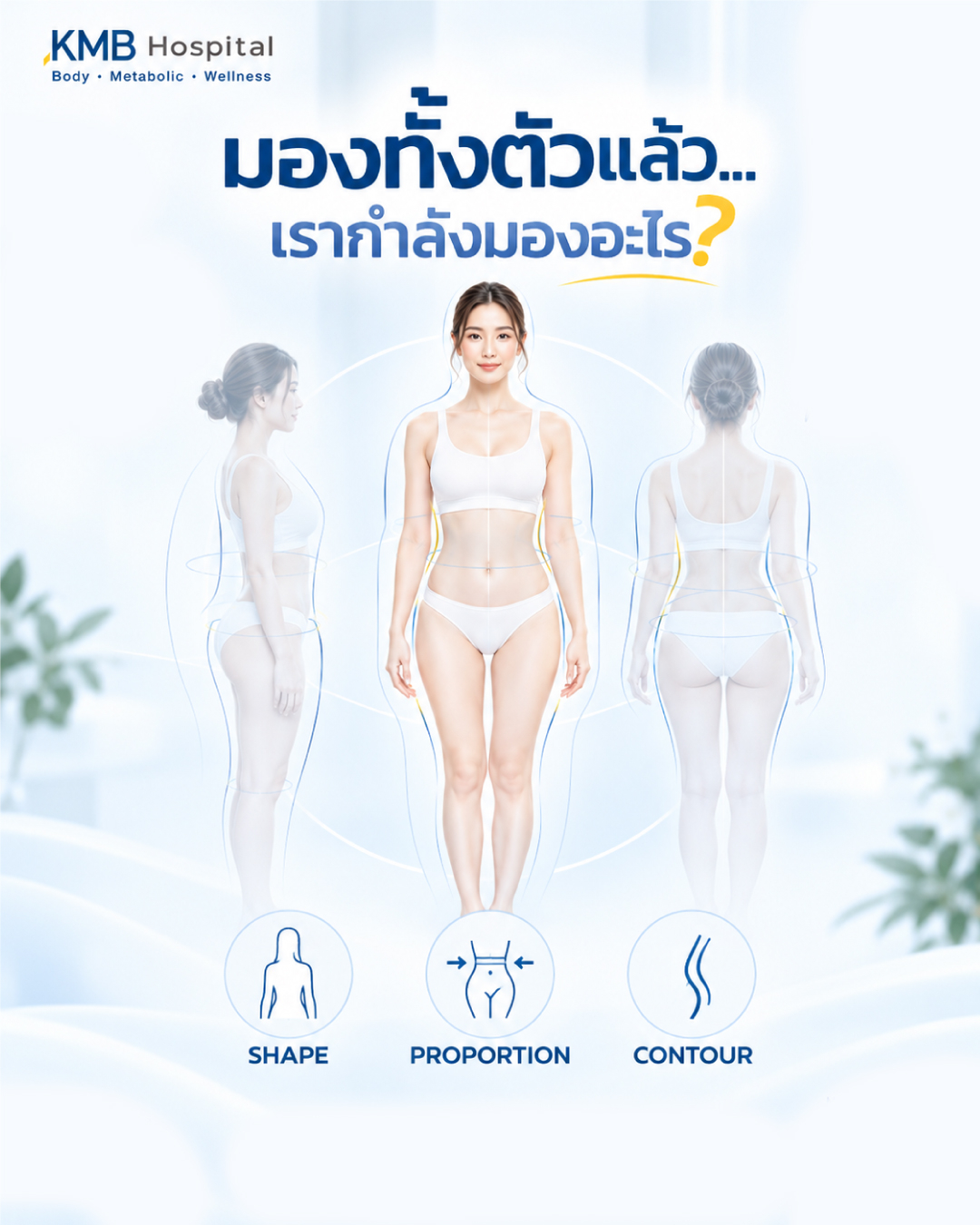
We now understand that looking at body shape requires looking at relationships, not looking at each part in isolation. But there are still 3 terms often used interchangeably:
Shape — Proportion — Body Contour
Do these three terms mean the same thing? And what role does each play in design before a liposuction program?
Read more in the article: "How are Shape, Proportion, and Body Contour Different in Planning a Liposuction Program?"
Medical Sources
The original text states that data on candidate selection, skin quality, and anatomical assessment are based on ASPS and medical literature regarding liposuction/body contouring.
The original text does not specify the names of documents or a full bibliography, so no specific references are created in this article.
Medical Disclaimer
This article is provided to educate on the principles of body shape assessment before planning a liposuction program. It cannot replace a formal examination, diagnosis, or advice from a doctor for individuals.
The suitability of the treatment area, number of areas, treatment techniques, and expected results vary by individual and should be considered in conjunction with the health, body structure, fat characteristics, skin quality, and goals of the patient.
Concerned about only one area? Start by understanding the big picture.
Assessing the whole body does not mean you must undergo treatment on the entire body, but it helps to see how the concerned area relates to the structure, fat, skin, and surrounding areas before setting an appropriate scope for treatment.