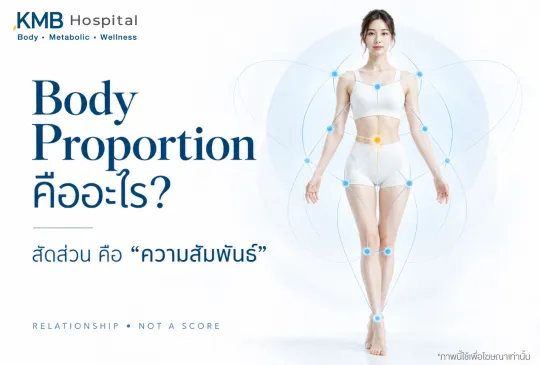
How do the proportions of the upper body, waist, and hips relate to each other in pre-liposuction planning?
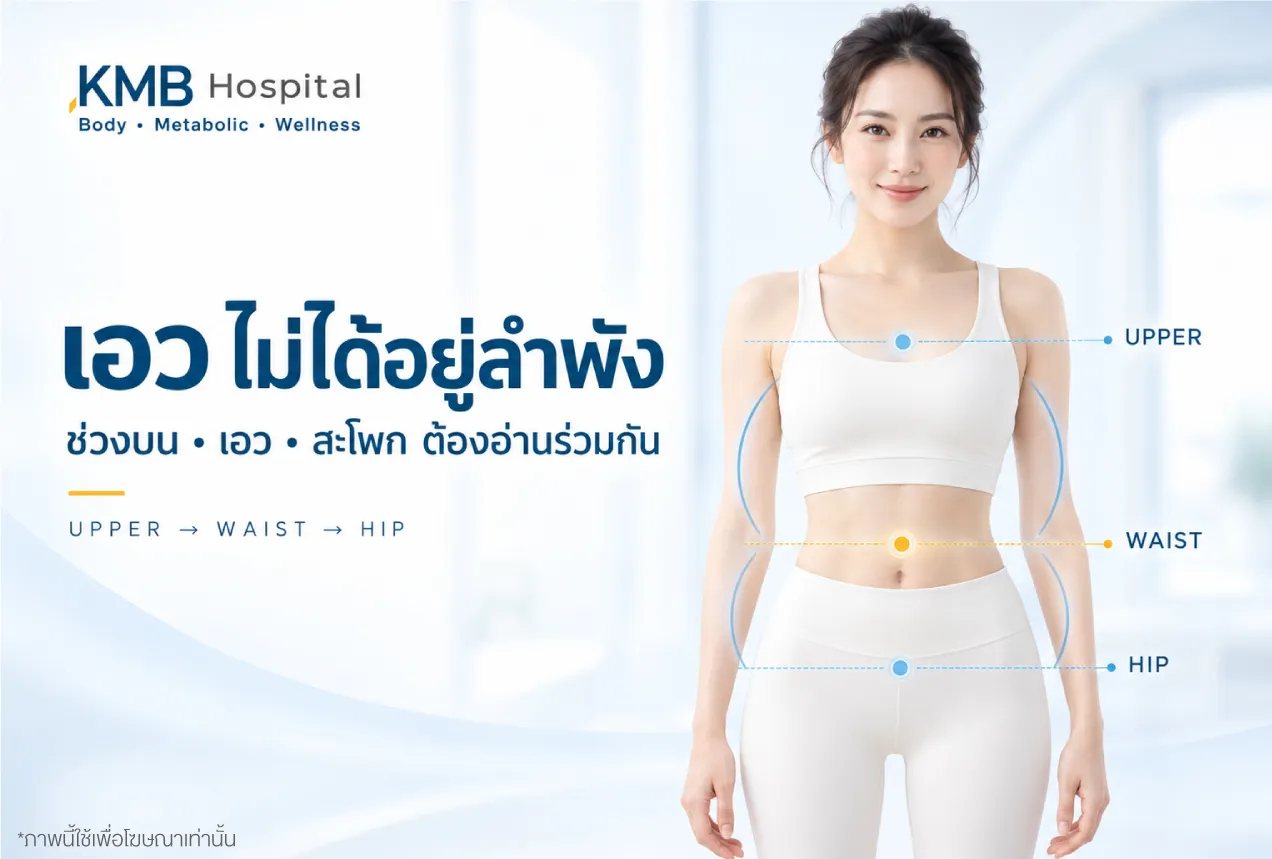
How Are the Upper Body, Waist, and Hips Related When Designing a Liposuction Program?
First Published: 04/11/2026 Last Updated: 05/11/2026 Estimated Reading Time: 10–12 minutes Category: Body Design & Body Proportion Author: Medical Content Team, KMB Hospital Medical Review by: Dr. Mantanas Peerapatchai (Dr. Looknuu), License No. V.37626
The proportions of the upper body, waist, and hips are not viewed as three separate sizes, but as the relationship between continuous areas. Therefore, whether the “waist appears defined” does not depend on waist size alone, but on the width and frame of the upper body, how the hips below create a reference point, and where the volume in the waist area is positioned relative to these two sections.
Before planning a liposuction program, physicians should not aim for the smallest possible waist or use a specific Waist–Hip Ratio as a beauty target for everyone. Instead, they should interpret the relationship between the Upper Body → Waist → Hip based on each individual’s anatomy, then determine which local fat volume truly plays a role in the proportions the patient is concerned about. Liposuction plays a primary role in reducing localized fat and adjusting body contours, not in changing the entire body structure or treating obesity.
Contents of this article
Before talking about the “waist,” you must know what the waist is between
When looking at body shape, we often speak in parts:
But our eyes do not evaluate these 3 parts as separate images. We are automatically comparing one part to another. For example:
One waist might appear quite defined when placed between a certain type of upper body and hips, but a waist of similar size can look different when placed on another frame.
Therefore, in Body Design, the crucial question is not just:
Body Proportion is about “Relationship”
The important thing is that none of these three parts have a complete visual meaning by themselves. Because the Upper Body is the top reference for the waist and the Hip is the bottom reference for the waist, the waist is always in the middle of these two simultaneous relationships.
KMB UPPER–WAIST–HIP FRAMEWORK
For this chapter, KMB uses a simple framework:
This framework is not used to calculate a beauty score and does not have target numbers, but it helps answer: to what extent is what we see as a “waist” caused by the waist itself, and to what extent is it caused by the references surrounding it?
1. UPPER REFERENCE — How does the upper body affect the perception of the waist?
The term “Upper Body” in this context does not mean only the breasts, but the upper region of the torso that helps create a visual reference above the waist, such as:
- rib cage
- lateral torso
- width of the torso
- shoulder–torso relationship
- torso length
These are part of the Baseline Anatomy and are not entirely changed by a liposuction program.
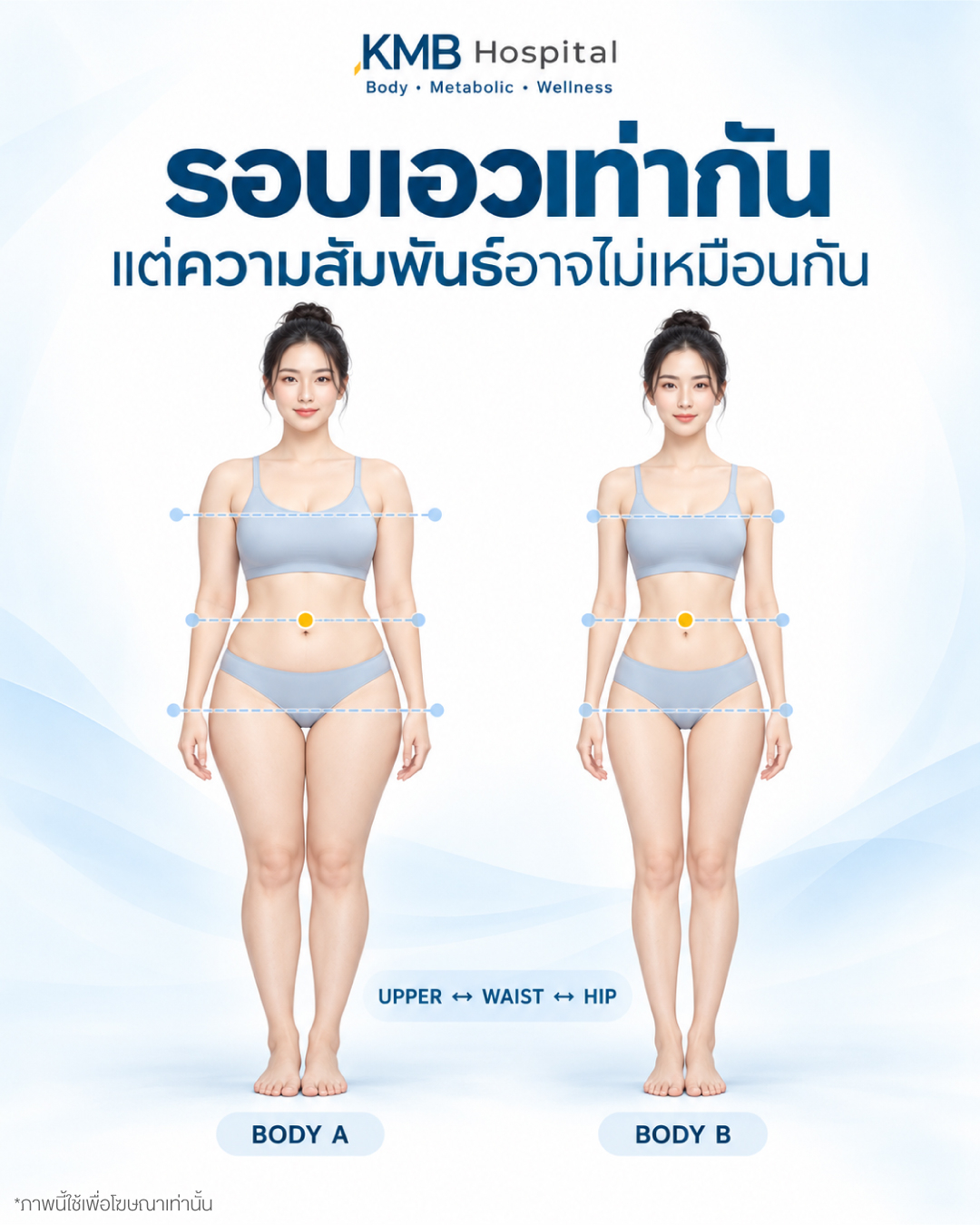
Different upper body widths make the same waist look different
Let’s assume two people have similar waist widths:
Has a wider Upper Frame
Has a narrower Upper Frame
When placing the same waist size between different references, the eyes can perceive different relationships. This does not mean one frame is better than the other, but it demonstrates that:
The frame is a baseline, not a beauty problem
Series 4 does not attempt to rank which rib cage is more beautiful, or which upper body width is best. The frame simply tells us what kind of body we are designing volume on. Therefore, what the design must do is work within the baseline, not try to change every baseline into the same structure.
2. WAIST VOLUME — The waist is not just about “width”
When patients say “I want a more defined waist,” what they see might relate to:
- lateral abdominal fat
- flank
- anterior abdominal context
- posterior trunk context
- skin
- frame
Therefore, Waist Volume is not just “a lump of fat on the side” and should not be assessed from a single front view. Small waist and defined waist are different questions—this is the most important sentence in this chapter.
Describes size or volume
Describes the visual relationship with the parts above and below the waist
These two issues can be related, but they are not the same thing. Thus, reducing local waist volume might affect waist definition, but the degree of change depends on the surrounding references as well.
Therefore, waist circumference cannot tell the whole story of body proportion
Circumference is useful data, but one number doesn't tell us:
- How much volume is in the front
- How much on the sides
- or how much in the back
And it doesn't tell us what the Upper Frame and Hip Reference are like.
3. HIP REFERENCE — Why do hips affect the perception of the waist?
Because the eye does not stop at the waist; from the waist, it continues into the Hip Region. Therefore, the hips act as the lower reference for the waist proportion. What must be cautioned is that we are not saying hips must be large or that there is a specific Waist–Hip Ratio, but that the waist will be viewed in comparison to the hips that person actually has.
Same waist, but different hips, result in different proportion perceptions
Suppose the Waist Volume of Person A and B is similar, but Hip Width or Hip Volume is different. The eyes viewing the Waist ↔ Hip might perceive the difference differently. Therefore:
Hips are not a target just because they are a reference
This is a principle that must be locked in: a physician must look at the hips, which does not mean they must treat the hips or make the hips change. The reference has the role of helping to understand.
Proportion is not an added treatment area. Therefore:
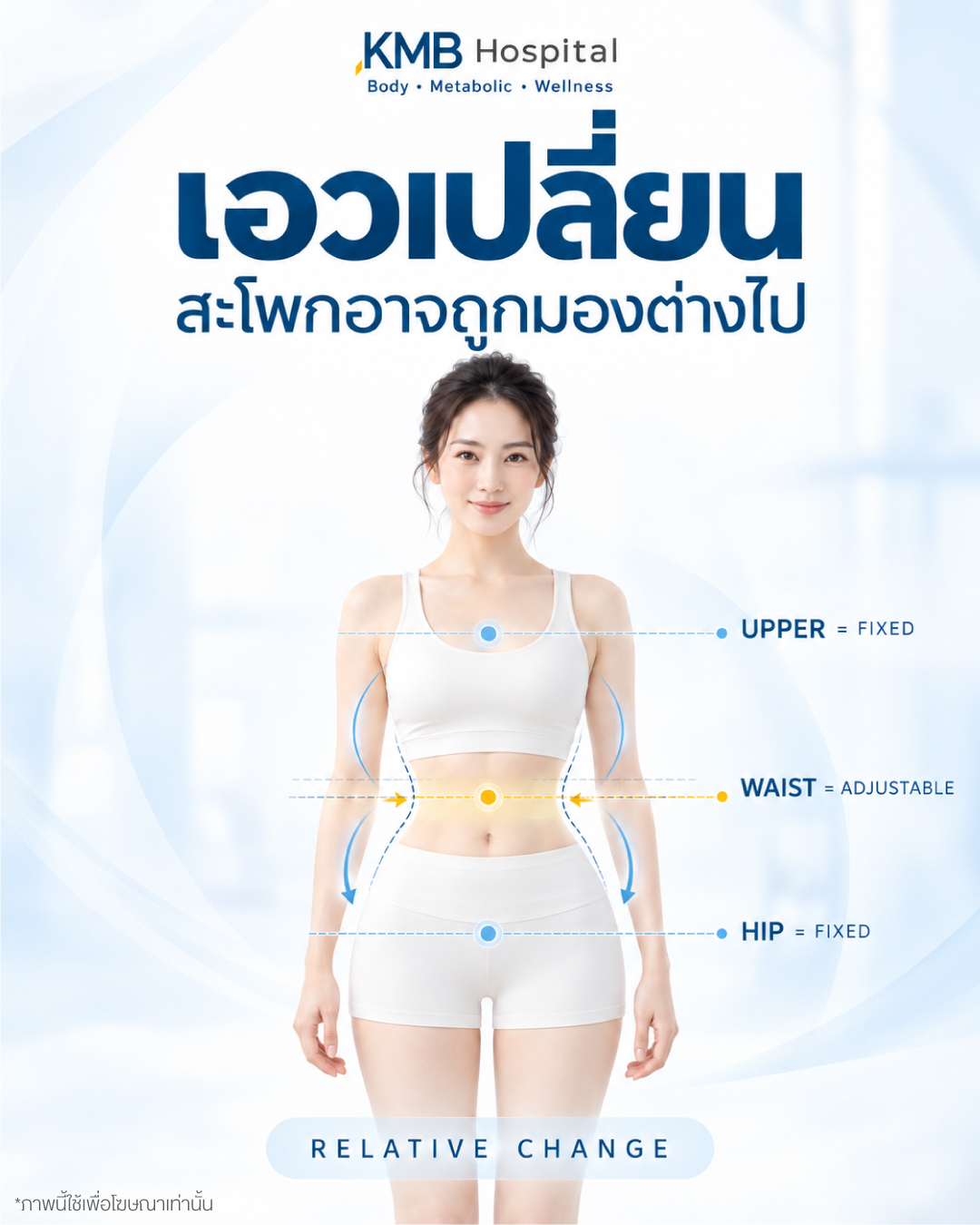
If the waist changes, the hips may “look more prominent” without the hips changing
This is a key example of RELATIVE CHANGE. Suppose Waist Volume decreases, but Hip Volume does not change; what actually happens is:
The waist changes, but the difference between Waist ↔ Hip increases. The result is:
The hips might be visually perceived as more prominent than before, even though no volume was added to the hips. Therefore:
Relative Change is the heart of Body Proportion
In Body Design, we do not evaluate only Absolute Change
such as how much the waist has decreased, but we must also look at Relative Change regarding:
after the waist changes, how the relationship with the Upper Body and Hips changes. This is why local treatment can have a Regional Visual Effect without needing every region to be actually treated.
Example 1 — Waist changes, but hips stay the same
Before: Upper → Waist → Hip After changing Local Waist Volume:
What changes, therefore, is not only the “Waist Size” but also the Relationship between the 3 Regions.
Example 2 — Abdomen changes, and the waist might be viewed differently
Although this chapter focuses on the Upper–Waist–Hip, the abdomen is one of the contexts that connects to the waist. If the anterior/lateral abdominal volume changes,
Waist Entry can be viewed differently by the eyes. This is why reading the waist should not completely remove the torso context. The details of Front–Side–Back Continuity will be delved into further in the next content.
Example 3 — Different Upper Frames, even if Waist–Hip are similar
Two people can have similar Waist and Hip Widths, but different Upper Frames. When looking at the whole body, the overall proportion can still be different. This emphasizes that Body Proportion should not be reduced to just a single Waist–Hip Ratio value.
Why does KMB not use an Ideal Waist–Hip Ratio as a design formula?
Because the goal is not to define which proportion is the “most beautiful” or the “most correct.” The Master Register sets clear boundaries that it does not create an “ideal proportion” or a fixed beauty standard, but instead interprets individual proportion relationships.
Therefore, KMB does not use:
- Golden Ratio
- Ideal Waist–Hip Ratio
- or an Hourglass Template
as a target design for everyone.
Numbers can be useful without becoming a Beauty Target
Measurement is still useful for:
- Baseline
- Monitoring
- Body Composition
- Clinical Information
But having numbers does not mean there is a “beautiful number” that everyone should reach. This is the difference between:
What can a liposuction program change in this relationship?
Liposuction has the main goal of reducing localized subcutaneous fat in various areas such as the abdomen, waist, hips, and other appropriate areas, and is used to adjust body contour, not as a treatment for obesity.
Therefore, what can be changed is:
in appropriate areas, but what is not directly changed in the same way includes:
- rib cage
- pelvis
- skeletal width
- muscle frame
- body height
- torso length
These remain as references of proportion after treatment.
Skin also has an effect on contour after volume changes
Although this chapter focuses on proportion, fat reduction does not work in a system with only volume. Skin quality and elasticity affect how the skin adjusts to the contour after fat is removed, and individuals with different skin laxity can have different contour responses. Therefore, two people with similar Waist Volume should not be expected to have the same results simply because they started with similar numbers.
Trunk anatomy is not the same in every position
Another reason not to think about the Waist–Hip Relationship as just a geometric ratio is that subcutaneous tissue and fascial attachments have actual regional anatomy.
Literature on central trunk liposuction explains zones of adherence and the importance of understanding three-dimensional anatomy to help reduce contour deformities.
Therefore, Body Design should not think of the body as a geometric shape that, if one side is reduced, will always yield the desired ratio.
KMB PROPORTION READING
If this chapter were to be summarized into 4 questions, KMB would ask:
What kind of Upper Body and Frame reference is it?
How is the Local Volume and Waist Context?
What kind of lower reference is the Hip?
If one point of local volume changes, how will the relationship of all three regions be perceived?
This is how to read
in a way that doesn't require an Ideal Ratio.
Where does FAT Mapping™ help?
In the KMB Hospital system, FAT Mapping™ plays the role of an Assessment Foundation. Data related to proportion may include:
- Body shape from multiple angles
- Fat Distribution
- Volume Pattern
- Body Composition
- Frame Context
- Relationship of each Region
- Skin and information from examinations as appropriate
But FAT Mapping™ does not automatically create an Ideal Proportion. After obtaining the data, it must still pass through CLINICAL INTERPRETATION to see which parts are truly relevant to the goal.
Data tells us “how” the body is, but not “how it should be”
This is a very important Knowledge Boundary:
- Body Scan
- Measurement
- or AI 3D
can help explain the baseline, but should not be used to declare whether a patient’s proportions are good or bad from a single number. The tools should help:
Proportion Design is therefore “reading relationships,” not “chasing numbers”
When talking about designing before a liposuction program, the goal should not be
making the Waist Number as low as possible, but rather asking: Does the volume being considered for change actually play a role in the relationship the patient is concerned about? This is a question closer to Personalized Body Design.
So should “defined waist” be a goal?
It can be a patient’s goal, but the term “defined waist” must first be decoded as to what it means, for example: they want to reduce Local Waist Volume,
- want the Front Silhouette to have more contrast
- want the Waist–Hip Relationship to be more defined
- want the lateral abdomen to be lighter
- or have some reference image in mind
When the goal is clear, then we look at what the Anatomy and Design Range can support.
The goal of this chapter is not “which waist is beautiful”
but rather understanding why the same waist can look different when placed between different Upper Bodies and Hips, and understanding that changing one point of Local Volume can change the Relative Proportion without other parts actually changing. These two issues are the heart of
and always ask: If we adjust the middle, how will the relationship between the top and bottom be perceived differently?
What KMB wants you to remember from this chapter
When a patient says “I want a more defined waist,” the doctor shouldn't immediately look only at the fat on the sides or the waist circumference number, but must first see that the waist sits between what kind of upper body and what kind of hips, because what we call a “waist”
is not viewed in isolation. For KMB, Body Proportion is not about finding the perfect number, but rather reading how each part is creating a reference for the other, and then considering how changing local volume is meaningful to the overall picture.
Frequently Asked Questions
Does proportion always improve once the waist gets smaller?
Not always, because body proportion is a relationship between many parts. Changes to the waist are viewed in conjunction with the upper body, hips, frame, and surrounding areas; therefore, “smallest waist” should not be a standard goal for everyone.
Why do people with the same waist circumference look like they have different waists?
Because waist circumference is only one piece of data, while waist appearance is also influenced by the upper frame, hip reference, volume distribution, and trunk context.
Why must I look at the hips when designing the waist?
Because the hips act as a lower reference for the waist. If the waist volume changes, the waist–hip relationship can be visually perceived differently, even if the hips do not change in actual volume.
Why do I have to look at the upper body too?
Because the upper body is another reference for waist proportion. People with similar waist sizes but different upper frames can have proportions that are perceived differently by the eyes.
Does KMB use the Waist–Hip Ratio to define an ideal body shape?
No, it is not used as a beauty target for everyone. Domain B explicitly states that it must not create an ideal proportion or a fixed beauty standard, but instead focuses on reading individual relationships.
Additional issues
Not necessarily. It may be a relative visual effect from the changed waist–hip contrast, without the hips having increased in actual volume.
Next Chapter
Once you understand that UPPER → WAIST → HIP is a relationship,
the next question is: how can we know if the same body shape, when viewed from the front, side, and back, is providing different information?
The next chapter is
Why planning a liposuction program must assess the shape from the front, side, and back together
which will shift from Proportion Relationship to 3D Body Context.
Related Articles
What is Body Proportion and how does it affect liposuction program planning?
It is a mandatory internal link and helps establish the foundation that proportion is a relationship, not just size, according to the Master Register.
Need to assess Body Proportion before planning a liposuction program?
The assessment should consider anatomy, volume, skin, frame, and individual goals together to set appropriate boundaries and realistic expectations.
Author and Reviewer Credits
Author: Medical Content Team, KMB Hospital
Medical Review by: Dr. Mantanas Peerapatchai (Dr. Looknuu), License No. V.37626
Medical Disclaimer
This article is provided to educate on Body Proportion in the context of pre-liposuction assessment and is not a medical diagnosis or proportion formula.
The terms Upper Reference, Waist Volume, Hip Reference, Relative Proportion, and Framework
UPPER REFERENCE + WAIST VOLUME + HIP REFERENCE → RELATIVE PROPORTION
are KMB Hospital’s communication framework in Series 4, not a Beauty Score, Ideal Ratio, or standardized diagnostic system.
Liposuction plays a primary role in reducing localized subcutaneous adipose tissue and adjusting body contour, while body shape still correlates with Skin, Muscle, Frame, Regional Anatomy, and individual factors.
The appropriateness of the treatment scope and outcomes must be assessed on an individual basis, and specific Waist Size, Waist–Hip Relationship, or body shape cannot be guaranteed.
References
- American Society of Plastic Surgeons — Liposuction
Explains that liposuction is used to reduce localized fat to adjust body contour and can be used on the abdomen, waist, hips, and other areas, but it is not a treatment for obesity. - Bartow MJ, Szymanski KD, Raggio BS. Liposuction. StatPearls.
Explains that liposuction aims to reduce subcutaneous adipose tissue and emphasizes the importance of skin laxity, fat-layer anatomy, and patient selection in planning. - Rohrich RJ, Smith PD, Marcantonio DR, Kenkel JM. The zones of adherence: role in minimizing and preventing contour deformities in liposuction.
Explains the importance of three-dimensional anatomy and zones of adherence in central trunk body contouring. - American Society of Plastic Surgeons — How skin tightening improves liposuction results and body contouring.
Explains that skin quality and response affect contour after fat removal and should be assessed in conjunction with fat volume.