How do Shape, Proportion, and Body Contour differ when planning a liposuction program?
Body Shape, Proportion, and Contour are not the same
When talking about our physique, we often use terms interchangeably without realizing it, such as:
“I want my figure to look better.”
“I want a more proportional waist.”
“I want clearer contours.”
“I want my arms to look slimmer.”
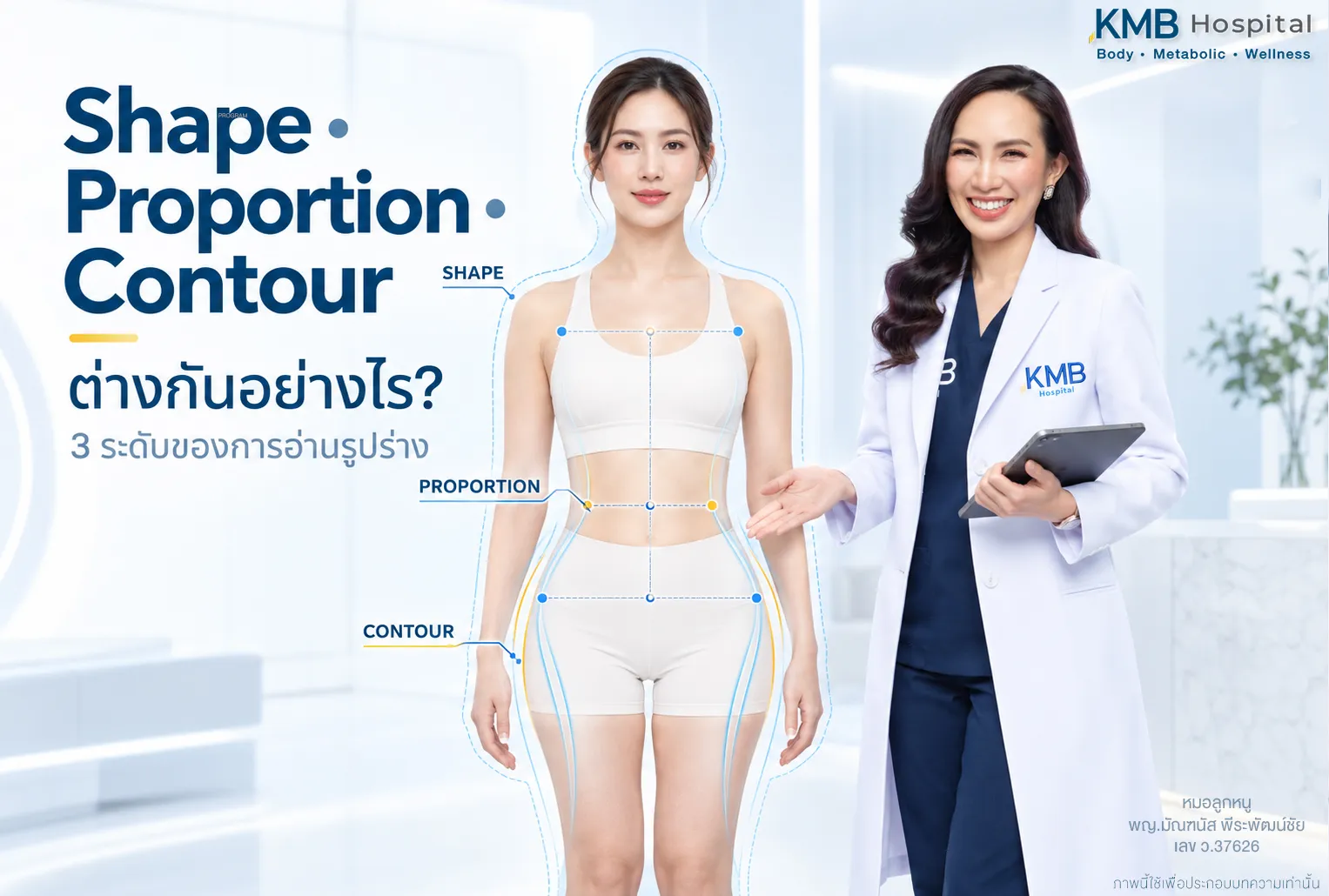
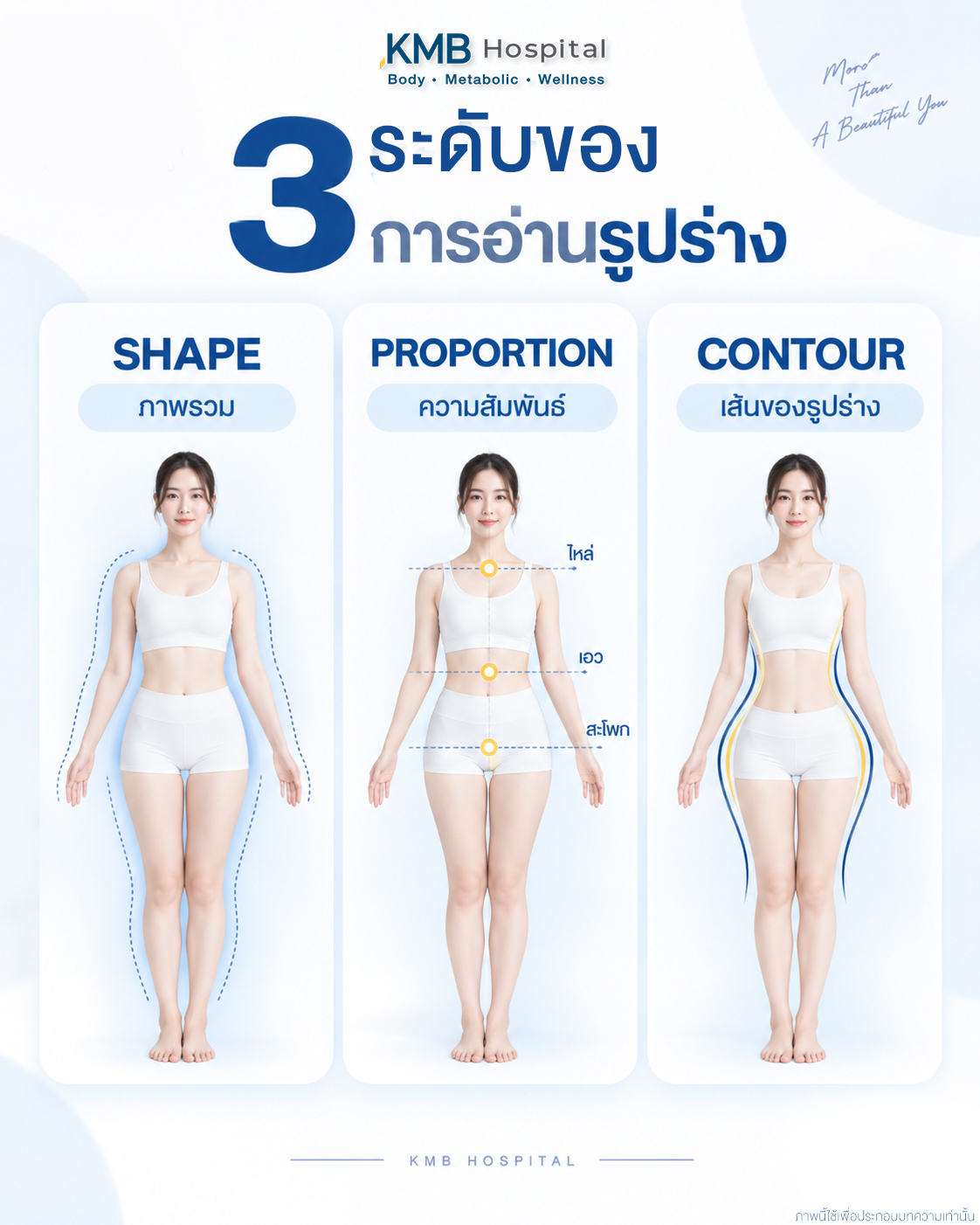
These sentences sound similar, but from a Body Design perspective, each term refers to a different level of the body. To make it simple, in Series 4, we divide the analysis into 3 layers:
BODY SHAPE
= Overall physique
↓
BODY PROPORTION
= Relationship between body parts
↓
BODY CONTOUR
= Lines, edges, curves, and transitions
These three levels are not mutually exclusive, but separating them helps doctors and patients communicate more clearly about what actually needs to be changed.
First, understand that this is a “conceptual framework”
The terms Body Shape, Body Proportion, and Body Contour can be used differently in medical, artistic, anatomical, or aesthetic contexts. We are not stating that these 3 terms have a single, rigid medical definition.
Instead, we use them as a framework for reading the body before planning, to break down questions into: What overall shape do we see? How do the parts relate to each other? And How do the body lines in that area connect? When these questions are distinct, planning does not simply start from the basic question: “Where is there a lot of fat?”
1. Body Shape — The “overall image we see”
Body Shape is the broadest level. Imagine looking at someone from a distance; before seeing small details, we perceive the overall torso first, such as:
Whether the upper body is wider than the lower body.
Whether the torso looks straight or has curves.
Whether the hip area is prominent.
Whether the legs look long compared to the torso.
Whether the midsection looks voluminous.
These are perceptions of the overall body shape, and this overall picture is formed by many elements simultaneously, not just fat.
What creates Body Shape?
The overall shape can be influenced by:
- Bone structure
- Shoulder width
- Ribcage structure
- Pelvic width
- Torso length
- Arm and leg length
- Muscle mass
- Position and amount of fat
- Skin quality and laxity
- Body posture
Therefore, Body Shape is not something that a liposuction program can “completely redesign,” as many elements are fundamental body structures that do not change from fat reduction.
Example
Two people may have similar abdominal fat, but the first has broad shoulders, a narrow pelvis, and a long torso, while the other has narrower shoulders, a wider pelvis, and a shorter torso. Even after reducing fat in the same area,
the Body Shape after the procedure will not necessarily be the same.
Because the body starts with a different structure, this is why Body Design should not start by trying to imitate someone else’s physique.
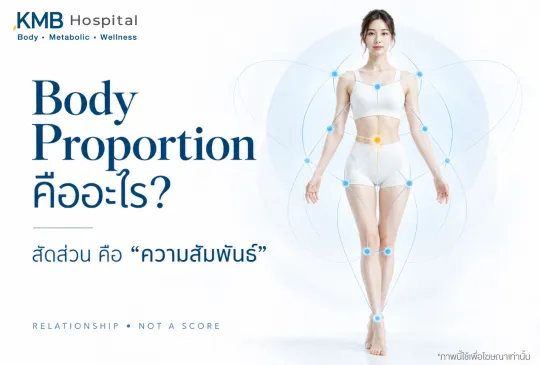
2. Body Proportion — The “relationship”
If Body Shape is the overall picture, Body Proportion steps in one level closer. The important question is not “Is this part big or small?” but rather:
“Big or small compared to what?” because the term “proportion” arises from relationship.
A simple example
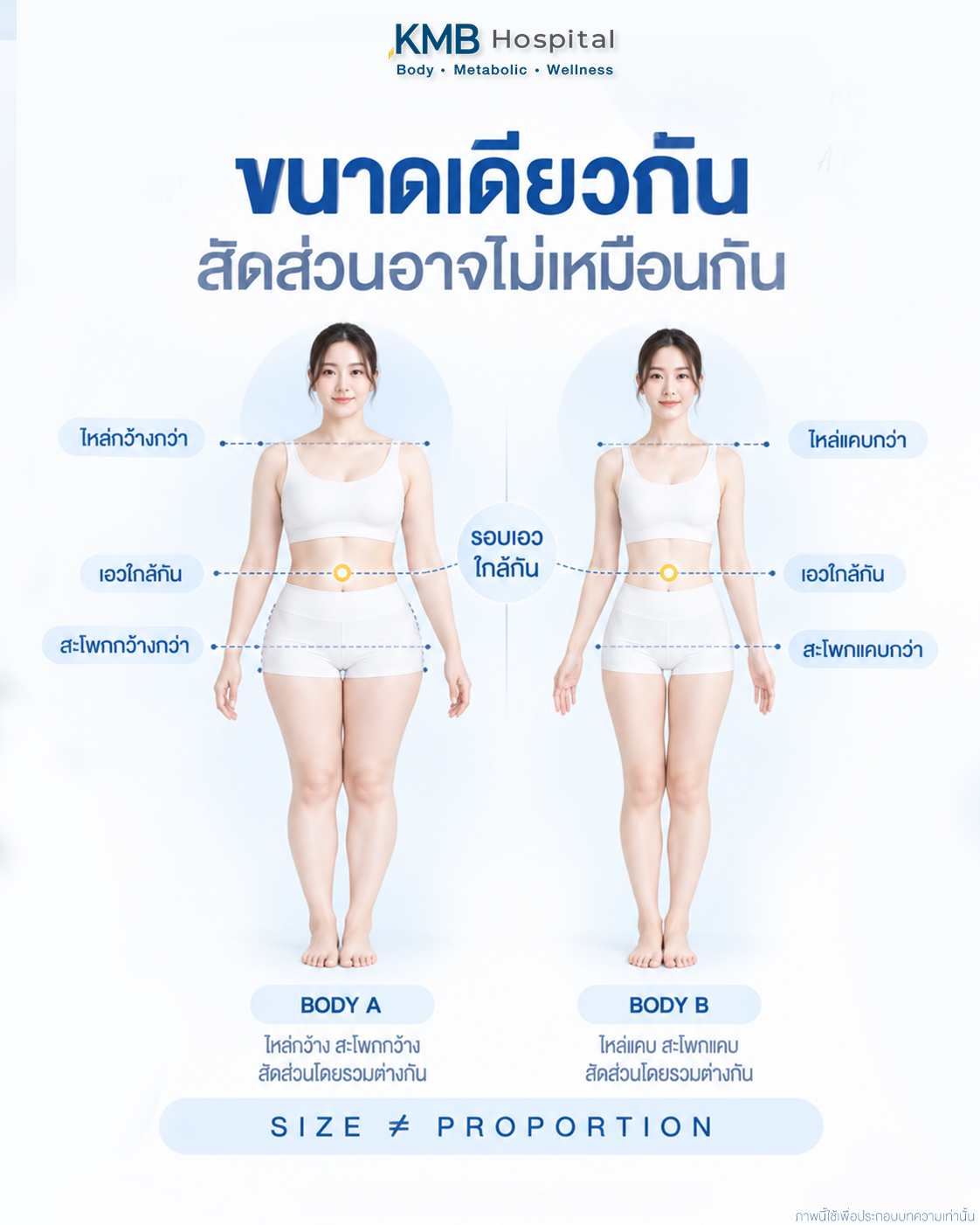
A 27-inch waist, as a single number, does not tell us if that person’s waist is
small
large
balanced
or unbalanced
Because one must also know how wide the chest is, how wide the hips are, the height, and the torso structure to understand what kind of proportion that waist fits into. Therefore,
Size ≠ Proportion
The size of one area does not equal the body’s overall relationship.
Proportion does not have a single number that suits everyone
In the context of Body Design, we should not interpret that
the waist must be exactly this small
the arm must have this circumference
the thighs must have this gap
or that everyone must have the same ratio.
Because anatomical structures and body foundations differ, design should ask: How does this proportion relate to this person’s existing body? Not: Does it fit someone else’s formula?
Body Proportion is about “Relationship”
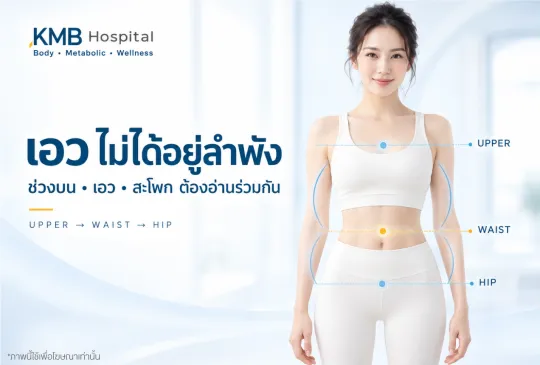
Examples of relationships that a doctor might consider include:
Shoulder ↔ Waist
Waist ↔ Hips
Torso ↔ Legs
Upper arm ↔ Shoulder and Torso
Thigh ↔ Knee and Calf
The key point is that changing one part can make the perception of the proportion of another part change, even if that second part was not adjusted at all.
Example: Why the hips might look more prominent after a waist reduction
Suppose the volume of the hips was not increased at all. But if the volume around the waist is reduced appropriately, when looking at the overall figure, the difference between the waist ↔ hips may be clearer, making the eye perceive the hips as more prominent. What has changed is not just the “waist size” but the relationship between the waist and the hips. This is the concept of Body Proportion.
3. Body Contour — The “lines the eye sees”
If Body Shape is the big picture and Body Proportion is the relationship, Body Contour descends into the details of
Lines
Curves
Edges
Surface
and body transitions
The word contour helps explain how, from one point to another, the body “flows together.”
Examples of Body Contour
Such as the line from Abdomen → Waist or Waist → Waist Wings → Back, or Shoulder → Upper Arm → Elbow, or Hip → Thigh → Knee. Each area is not a separate mass; what the eye sees is a continuous line. Therefore, when talking about Body Contour,
it does not mean just “is this area smaller now,” but also:
Do the lines flow smoothly together?
Are there points of sudden level change?
Is there too much or too little volume in some parts compared to neighboring areas?
Liposuction programs are most directly related to Body Contour
The American Society of Plastic Surgeons explains that liposuction has the goal of reducing localized fat deposits to help improve body contour and proportion. However, this does not mean
the more fat you remove, the better the contour, because the contour seen after the procedure still depends on:
- The remaining fat layer
- The anatomy of that area
- Skin quality
- Skin retraction
- Connective tissue
- Muscle
- Anatomical attachment points
- Connections to neighboring areas
Anatomical research on liposuction also shows that different areas have different superficial fascia and zones of adherence, which are important for avoiding contour deformity and planning three-dimensional treatments.
What is the simplest way to differentiate Shape / Proportion / Contour?
Try thinking of the body as one image.
And when applied to Body Design, doctors don't just ask one question, but continue to ask:
What can and cannot be changed by liposuction?
This is a very important point in this chapter.
Because when you understand Shape, Proportion, and Contour, you will see that liposuction does not have the power to change every element of the body.
What liposuction can directly affect
Mainly, the volume of subcutaneous fat in the appropriate area.
When the volume in one area changes, the Body Contour of that area can change accordingly, and when the contour changes, the perception of Body Proportion may also change. This creates a sequence such as:
Fat Volume changes
↓
Local Contour changes
↓
Relationships between areas may change
↓
Overall Body Shape may appear changed
But this does not mean liposuction can change the structure
Liposuction does not change
- Shoulder bone width
- Rib shape
- Pelvic width
- Torso length
- Leg length
- Bone shape
- Joint position
- The body's fundamental anatomy
Therefore, Body Design must distinguish whether the things we want to change are in a layer that liposuction can change. This is the difference between “wanting a certain shape” and “what our body can actually adjust.”
Example 1 — Abdomen and Waist
Suppose someone feels they have “no waist.” We can analyze this at 3 levels.
BODY SHAPE
Looking at the big picture: How do the shoulders, torso, waist, and hips create a silhouette?
BODY PROPORTION
Observing: How does the waist width compare to the shoulders, ribs, and hips?
BODY CONTOUR
Looking at the details: How do the lines from the abdomen to the waist look? Is there fat on the sides? How far do the waist wings extend to the back? Are there any transition points that make the waist look undefined?
When broken down like this, the phrase “no waist” is not immediately translated as “must remove a lot of waist fat.” One must first understand if that shape is caused by fat, structure, proportion, or a combination of multiple elements.
Example 2 — Upper Arms
Two patients might say the same thing: “My arms are big.” But when reading the 3 levels, it might be a different story.
BODY SHAPE
How do the arms play a role in the overall upper body? E.g., are the shoulders broad or narrow?
What is the size of the torso? Are the arms prominent compared to the torso?
BODY PROPORTION
Looking at the relationship of Shoulder ↔ Upper Arm ↔ Torso.
One person might have arms that look large compared to a small torso, while another might have the same arm circumference but a larger torso, so it looks different.
BODY CONTOUR
Observing the lines from the shoulder down to the upper arm, the back of the arm, and the elbow, including skin quality and fat position. Therefore, looking only at arm circumference cannot tell the whole story for Treatment Design.
Example 3 — Thighs
Analyzing thighs is the same. BODY SHAPE views the overall lower body: hips, thighs, knees, calves, and leg length.
BODY PROPORTION
Looking at the relationship of Hip ↔ Thigh and Thigh ↔ Calf.
BODY CONTOUR
Viewing the lines from the hip down the outer thigh, inner thigh down to the knee,
the knee down to the calf. Sometimes the point where people feel “my thighs look big”
may not be caused by thigh volume in one area alone, but from the relationship of the entire leg line.
Can two people have the same shape but different contours?
Yes. Imagine two people have similar height,
similar weight, and similar waist circumference. Roughly speaking, the Body Shape may be similar, but one might have more fat accumulated on the lower abdomen, while the other has more volume in the waist wing area. Therefore, when looking closely, Body Contour can be different.
This is why numbers alone cannot represent an entire body assessment.
Can two people have similar proportions but different shapes?
Yes, also. Two people may have similar relationships between their shoulders, waist, and hips, but one person is taller, has a longer torso, or has slimmer, longer legs, making their overall Body Shape different. This reinforces that:
Shape / Proportion / Contour are related, but they are not the same term.
Why is understanding this important before liposuction?
Because if we don’t separate these 3 things, we might set the wrong goal from the start. For example: A patient wants to “change their entire Body Shape,”
but the primary factor of that shape is bone structure. Liposuction cannot create all the changes one might imagine. Or, some people might want “proportions to look different,” which might not require reduction in every area.
But one must understand how changing the volume of one area affects the relationship of the overall picture. Meanwhile, some people have primary problems with localized Body Contour; e.g., fat accumulation in some areas makes the body line look discontinuous. In this case, the planning goal may be different.
Is it true that the more fat you remove, the clearer the contour?
Not always. Because creating a contour does not mean having the least amount of fat possible. The results of liposuction also relate to skin quality and retraction. Removing too much fat in areas where the skin has reduced support can make laxity or unevenness more apparent.
Therefore, in the Body Design perspective, the question is not “How much can be removed?” but rather “Where should the volume be adjusted, and what should be left behind, so that the transitions of the body are still related?”
Body Contour is not equal to “thinness”
People with less fat do not always have a contour that is better suited to themselves.
Because contour relates to the position of volume, body lines, skin quality, structure, and continuity between areas.
The goal of Body Design is not to make every part as small as possible, but to understand what volume is creating what kind of line, and how changing that volume will affect other areas.
What should a doctor start looking at first?
In practice, Body Design analysis can be thought of from big to small:
View Shape
Step back and see the whole body first. What is the overall figure?
View Proportion
Compare the relationships. Which part relates to which part?
View Contour
Look into the details. How do the lines and transitions of that area look?
Separate Anatomy
Is what you see caused by fat, skin, muscle, structure, or a combination?
Then plan
After that, answer: What should be adjusted, what preserved, what can change, and what are the limitations of the existing body?
How does FAT Mapping™ connect to these 3 things?
In the KMB Hospital system, we position FAT Mapping™ as an Assessment Foundation, because before talking about Design, we must have data on what the body looks like.
FAT Mapping™ helps gather data used for assessment, such as:
- Fat position
- Body shape from multiple angles
- Relationships between areas
- Data on layers and components within the scope of each assessment tool
The doctor then uses the data to perform an examination to read:
Shape
↓
Proportion
↓
Contour
Then proceed to
Body Design
And if there are indications, proceed to Treatment Planning
We should not start with “I want this shape.”
Reference images can help communicate what a patient likes, dislikes,
or is looking for in terms of lines, but they should not be used as a template to be imposed on everyone, because the person in the reference image might have:
Different shoulder structures
Different ribcages
Different pelvises
Different torso lengths
Different muscle mass
Different fat distribution
Therefore, Body Design changes from the question “Can you make me look like this person?” to “Based on my own structure, what can be designed appropriately?”
Body Design is not about creating the “Perfect Body”
It does not have the goal of determining which figure is best, which proportion is most beautiful, or what contour everyone should have. On the contrary,
this concept is based on the truth that everyone starts with a different anatomy. Design should therefore respect:
The original structure
Differences in the body
The goals of the individual
and medical limitations
The goal is not to create the same standard shape, but to plan based on the individual's specific data.

A message from Dr. Looknuu
When a patient tells me, “I want my figure to be more proportional,” I won't rush to answer where we should operate, because first, we must distinguish if what the patient is talking about is Shape? Proportion? Or Contour?
Sometimes the concern is actual fat volume.
Sometimes it is the relationship between two areas.
Sometimes it is the transition line.
And sometimes it is caused by the original structure that liposuction cannot change. When we can separate these things, the goal becomes clearer as to:
What can be done
What should not be forced
What should be preserved
For me, this is the starting point of Body Design.
Frequently Asked Questions
Are Body Shape and Body Contour the same?
Not entirely. In the context of this series, Body Shape refers to the overall figure, while Body Contour focuses on the lines, edges, and transitions of the body’s surface in each area. Both are related but represent different levels of assessment.
Must Body Proportion be measured as a number?
Numbers can be supporting data, but Body Proportion should not be concluded from a single number, as it requires considering structure, height, torso length, and the relationships of multiple areas together.
Can a liposuction program change Body Shape?
Reducing localized fat volume can change the contour and the perception of the overall shape, but it cannot change bone structure, torso length, pelvic width, or fundamental anatomy.
If I want better proportions, must I treat multiple areas?
Not necessarily. Proportion assessment is meant to understand the body's relationships, not to imply that every area needs treatment. After evaluation, some people might only have indications for a single area.
Can the desired shape be designed to look like a reference image?
Reference images help communicate preferences, but they cannot guarantee that a shape identical to another person can be created, because anatomy, structure, fat distribution, skin quality, and individual responses differ.
Next Article
Once we distinguish that Shape = Overall, Proportion = Relationship, and Contour = Body Lines,
the next question is: Then how does a doctor know which proportion is “suited to this person” without using the same formula for everyone?
The next article will take you to see what analyzing Body Proportion must start from, and why body design should not begin from a single “ideal proportion” formula.
Understand your body before planning a liposuction program
If you are considering a liposuction program, the assessment should cover Body Shape, Proportion, Contour, structure, skin quality, and individual data to clarify goals and limitations before deciding to treat.
About this article
Author
Medical Content Team, KMB Hospital
Medical Reviewer
Dr. Manthanas Peeraphatchai, Dr. Looknuu
Medical License No. 37626
Review Date
Medical Disclaimer
This article is intended to provide knowledge about the concepts of Body Shape, Proportion, and Contour for assessment and planning.
The three terms used in this article are frameworks for explaining the concepts of Series 4 and are not intended to set a standard physique or define an ideal proportion for everyone.
The suitability of a liposuction program, scope of treatment, technique, and expected results vary by individual and should be examined and assessed by a doctor before making any decision.
References
- American Society of Plastic Surgeons (ASPS). What is Liposuction? — Supporting text regarding localized fat reduction to improve body contour and proportion, including skin and structural limitations. Read source
- Rohrich RJ, Smith PD, Marcantonio DR, Kenkel JM. The zones of adherence: role in minimizing and preventing contour deformities in liposuction. Plast Reconstr Surg. 2001;107(6):1562-1569. PubMed
- Si L, et al. The Superficial Fascia System: Anatomical Guideline for Zoning in Liposuction-Assisted Back Contouring. Plast Reconstr Surg. 2023;151(5):989-998. PubMed
Review History
Initial version: Body Design & Body Proportion
Last reviewed: November 5
Medical Reviewer: Dr. Manthanas Peeraphatchai, Dr. Looknuu, License No. 37626