
How is the GLAM Liposculpt™ multi-area liposuction program planned to ensure a balanced physique?

GLAM Liposculpt™ Knowledge Library
DOMAIN E — PERSONALIZED LIPOSUCTION PLANNING | Article Code: GL-E-K09
Category: GLAM Liposculpt™ | Personalized Liposuction Planning | Multi-area Body Design
How to Plan GLAM Liposculpt™ Multi-area Liposuction for a Balanced Silhouette
First Published: September 13, 2026 | Last Updated: September 13, 2026 | Reading Time: 8 minutes
Author: Medical Content Team, KMB Hospital
Medical Review by: Dr. Mantanas Peerapatchai (Dr. Looknuu), License No. 37626
GLAM Liposculpt™ multi-area liposuction is not planned by simply lining up individual areas. Instead, doctors use data from FAT Mapping™ and physical examinations to analyze how the abdomen, waist, back, upper arms, thighs, or other areas relate to the body's proportions, then design each area to work together as one cohesive silhouette.
The goal is not to make every area as small as possible, but to create harmony across the entire body by defining the scope, volume, and treatment sequence tailored to each individual patient.
“Multiple Areas” Does Not Mean “Combining Multiple Plans”
Some patients wish to address multiple areas simultaneously, such as the abdomen, waist, back, upper arms, or thighs.
If you view the body as a checklist, it might look like several separate plans, but GLAM Liposculpt™ does not think that way because all areas belong to the same body.
When the proportions of one area change, the perception of adjacent areas can also change. Therefore, the first thing a doctor must consider is not “how many areas?” but “how will all these areas come together to form one body?”
FAT Mapping™ Provides the Big Picture Before Focusing on Specifics
FAT Mapping™ plays a vital role in planning multi-area liposuction as it helps doctors gather data on fat distribution and the proportional relationships between different sections.
Abdomen
Influences the frontal view.
Waist
Influences the side curves.
Back
Influences waist continuity when viewed from behind.
By evaluating the abdomen, waist, and back together, doctors are not merely reducing fat in three spots; they are designing a comprehensive Trunk Contour.
Body Balance Does Not Mean “Everything Must Be Equally Small”
The term “balance” in Body Design does not mean reducing every area by the same amount, nor does it mean that the left and right, or upper and lower body, must have identical measurements.
Waist
Some individuals may require more emphasis on waist contouring.
Lower Body
Some individuals already have prominent lower body features, requiring a different approach to the trunk-to-hip relationship.
Upper Body
Some individuals have upper arm volume that makes the upper body appear heavier relative to the torso.
Balance means that every part exists in a proportional relationship when the body is viewed as a whole.
Doctors Must Define “Primary Areas” and “Connecting Areas”
When considering multiple areas, they do not all need to carry the same weight in the plan.
Primary Area
The core area with the most significant impact on the Body Design goal.
Connecting Area
An area evaluated alongside others because it affects the continuity of the shape.
For instance, if the goal is torso design, the abdomen may be a Primary Area, while the waist and back may be evaluated as Connecting Areas.
“Evaluating together” does not mean “must be treated all at once.” Final decisions are based on personalized data and suitability.
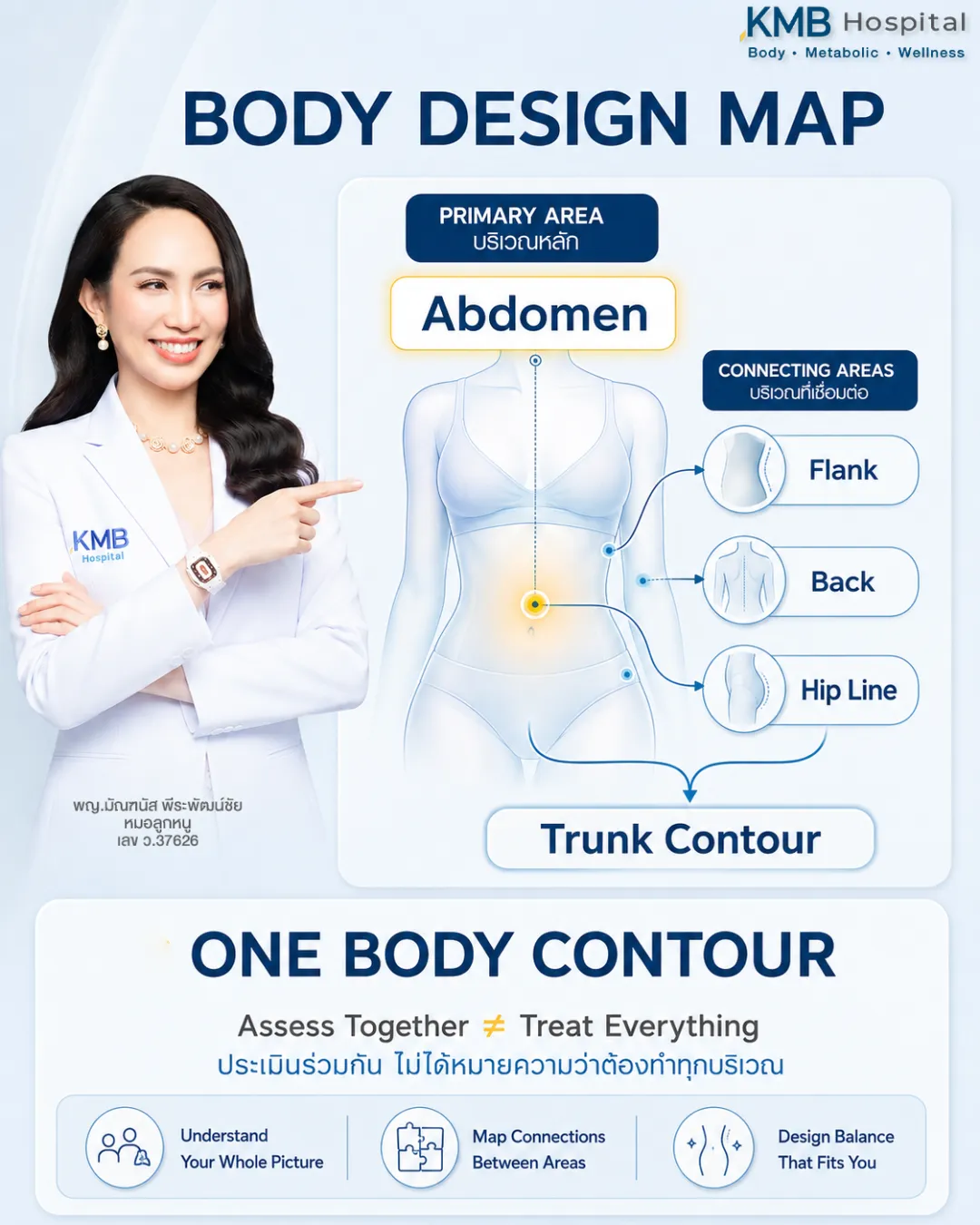
Every Area Does Not Need to be Treated “Equally”
When planning multi-area liposuction, doctors do not distribute fat removal volume equally across all sites.
| Different Factors | Implications for the Plan | Goal |
|---|---|---|
| Fat Accumulation | Each area may require different adjustments | Not distributing volumes equally |
| Role in Body Contour | Some are primary, some are connecting | Seamless final shape |
| Fat Layers | Superficial, middle, and deep layers vary by location | Tailored design per structure |
The question in GLAM is not “How much to remove from each spot to make them equal?” but “How should each spot be designed so that, combined, they look balanced?”
Multiple Areas Does Not Mean Doing Everything at Once
Multi-area planning and the decision of how many areas to perform in a single session are entirely different matters.
Doctors may envision the full Body Design from the first day but choose to structure the Treatment Journey into multiple stages as appropriate.
Right Amount
Appropriate volume and scope.
Right Timing
Appropriate pacing and sequence.
Right Plan
A plan suitable for health, readiness, and goals.
Personalized Planning can have one major goal with multiple treatment stages.
From Multiple Body Areas to One Body Design
Whether we are talking about the abdomen, waist, back, arms, or thighs, ultimately all these areas belong to the same person.
GLAM Liposculpt™ does not design each area to look beautiful in isolation; instead, it ensures every part relates to the others when viewed from the front, sides, back, and as a holistic physique.
Multiple Areas. One Body Design.
FAT Mapping™ provides the data for each area, while GLAM Liposculpt™ analyzes that data collectively to transform multiple areas into a single, personalized body design plan.
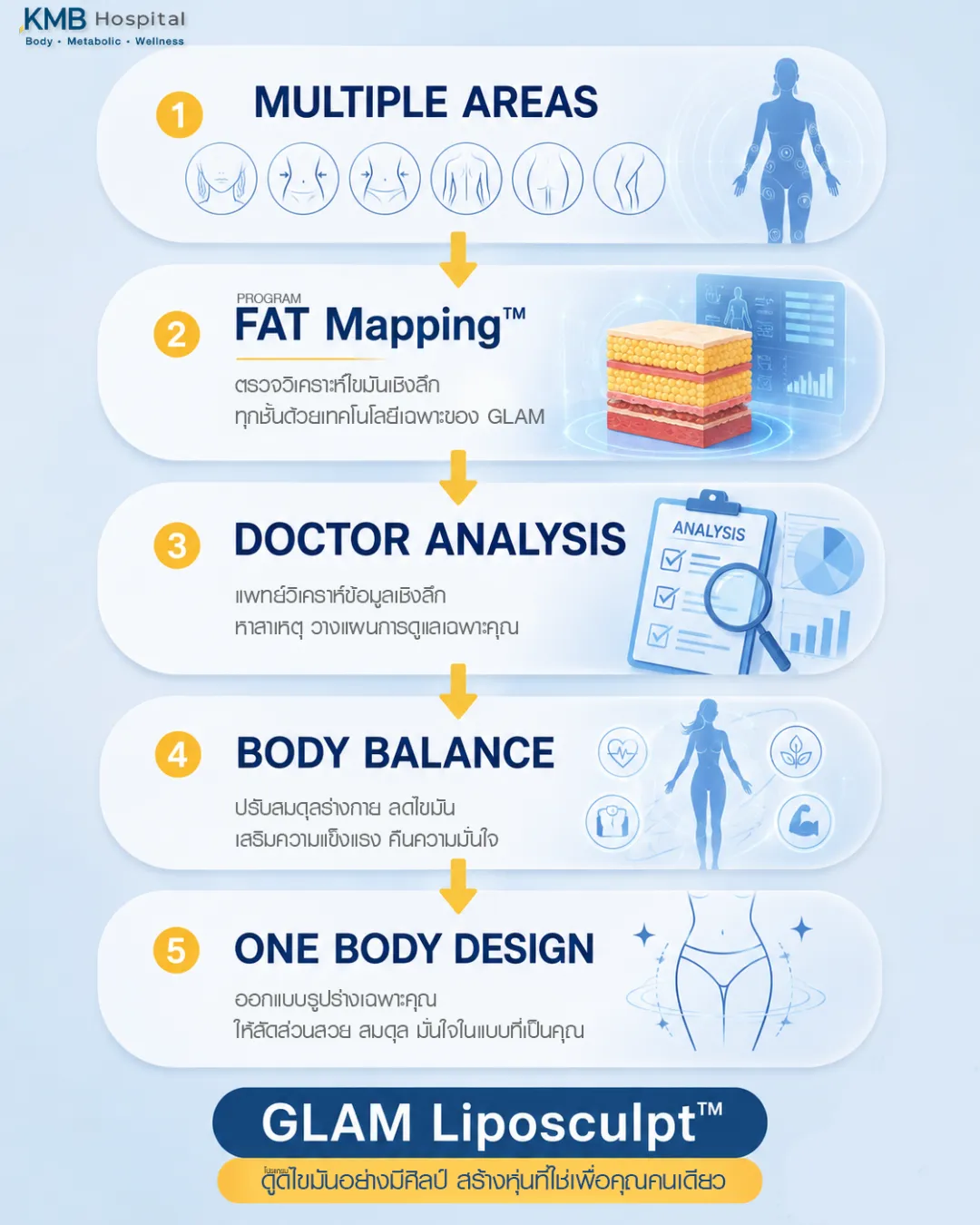
When a Patient Worries About 4 Areas, Doctors Don’t Start with “4 Points”
Imagine a patient consulting: “I want to do liposuction on my abdomen, waist, back, and upper arms.”
If thinking solely area-based, one might immediately treat them as four separate points. In GLAM Liposculpt™, the doctor steps back to view the whole picture first.
Torso Group
The abdomen, waist, and back are directly related as components of the torso.
Upper Body Group
The upper arms are related to the shoulders, armpits, and upper body proportions.
After performing FAT Mapping™ and a physical exam, what the patient views as “4 problems” may consist of 2 groups of Body Contour that are interrelated.
The planning approach shifts from “There are 4 spots; what do we do with each?” to “How will we design the entire body's proportions so that each part works together?”
Designing Multiple Areas Requires Priorities
Balance must be viewed from multiple angles, not just the front, because Body Contour is three-dimensional.
A waist that appears balanced from the front may still require consideration of the continuity of the waist and back when viewed from the side or back. Similarly, the arms must relate to the shoulders and upper body when viewed from other angles.
When a patient has multiple areas to address, not every area requires the same priority. The doctor must evaluate which area impacts the overall look the most, which are interrelated, and which can be sequenced in later stages of the Treatment Journey.
Right Amount
Appropriate volume and scope.
Right Timing
Appropriate pacing and sequence.
Body Balance
Every area must come together to form one body.
Key Takeaways
Frequently Asked Questions
1. How does GLAM Liposculpt™ multi-area liposuction differ from single-area liposuction planning?
When planning for multiple areas, doctors consider not only individual data but also the relationships between these areas. FAT Mapping™ and physical exams help visualize the big picture, enabling doctors to define Primary Areas, Connecting Areas, and Body Design directions so that they work together as one cohesive silhouette.
2. How does FAT Mapping™ aid the GLAM Liposculpt™ multi-area planning process?
FAT Mapping™ compiles data on fat distribution and proportional relationships between sections. Doctors combine this with physical assessment, skin quality, health status, and patient goals to determine which areas should be considered together and how they should be designed. FAT Mapping™ serves as data for planning and does not replace the doctor's expert judgment.
3. Does GLAM Liposculpt™ multi-area liposuction require treating every area with equal intensity?
Not necessarily. Each area has different fat volumes, structures, and roles in the overall Body Contour. Layer depths may also vary. Doctors plan each area based on individual data, aiming for a balanced physique rather than identical metrics across all parts.
4. If I want abdominal liposuction, do I have to treat the waist and back as well?
Not for everyone. Doctors will assess how your abdomen relates to your waist and back. If adjacent areas affect your Body Design goals, they may be considered together. “Evaluating together” does not mean “must treat everything at once.”
5. Does GLAM Liposculpt™ multi-area liposuction have to be performed all at once, and what is the primary objective?
No. Doctors envision the full Personalized Body Design from the start but can schedule the Treatment Journey as one session or multiple stages based on health, readiness, and goals. The goal is not to shrink every area to the smallest size, but to design them to work in harmony for a balanced, overall look.
Article Summary
GLAM Liposculpt™ multi-area liposuction does not simply chain together individual site plans; it starts by recognizing that every area is part of one body.
FAT Mapping™ helps doctors visualize fat distribution and proportional relationships, then analyzes which are Primary Areas, which are Connecting Areas, how much design is required for each, and where they fit into the Treatment Journey.
True balance is not achieved by making every part small, but by ensuring every part works in relation to the others.
Multiple Areas. One Body Design. — Multiple areas, one goal: a balanced physique for that specific person.

Read More from DoctorLooknuu.com
About This Article
This article explains the concept of GLAM Liposculpt™ multi-area liposuction planning by connecting data from FAT Mapping™, physical exams, proportions, skin quality, health, and patient goals to define Primary Areas, Connecting Areas, scope, and appropriate Treatment Journeys.
The goal is to enable all areas to work together as a Personalized Body Design, rather than reducing fat in isolated spots.
The information in this article is for educational purposes and cannot replace professional medical consultation, diagnosis, or personalized advice.
Article Credits
Written by
Medical Content Team, KMB Hospital
Medical Review by
Dr. Mantanas Peerapatchai
Dr. Looknuu
Medical License No. 37626
Review Information
First Published: September 26, 2026
Last Updated: September 26, 2026
Medical Disclaimer
This article is for educational purposes regarding GLAM Liposculpt™ multi-area liposuction. It cannot replace personalized medical examination, diagnosis, or advice. Suitability, treatment scope, risks, limitations, sequence, and outcomes vary by individual. Interested persons should undergo an assessment and provide complete health information before making decisions.
Multiple Areas. One Body Design.
Multi-area planning starts by understanding that all parts belong to the same body. FAT Mapping™ and clinical assessment help doctors design Primary Areas, Connecting Areas, Right Amounts, and Right Timing tailored to each specific patient.