
Before undergoing a GLAM Liposculpt™ procedure, how should you discuss your desired results with your doctor?
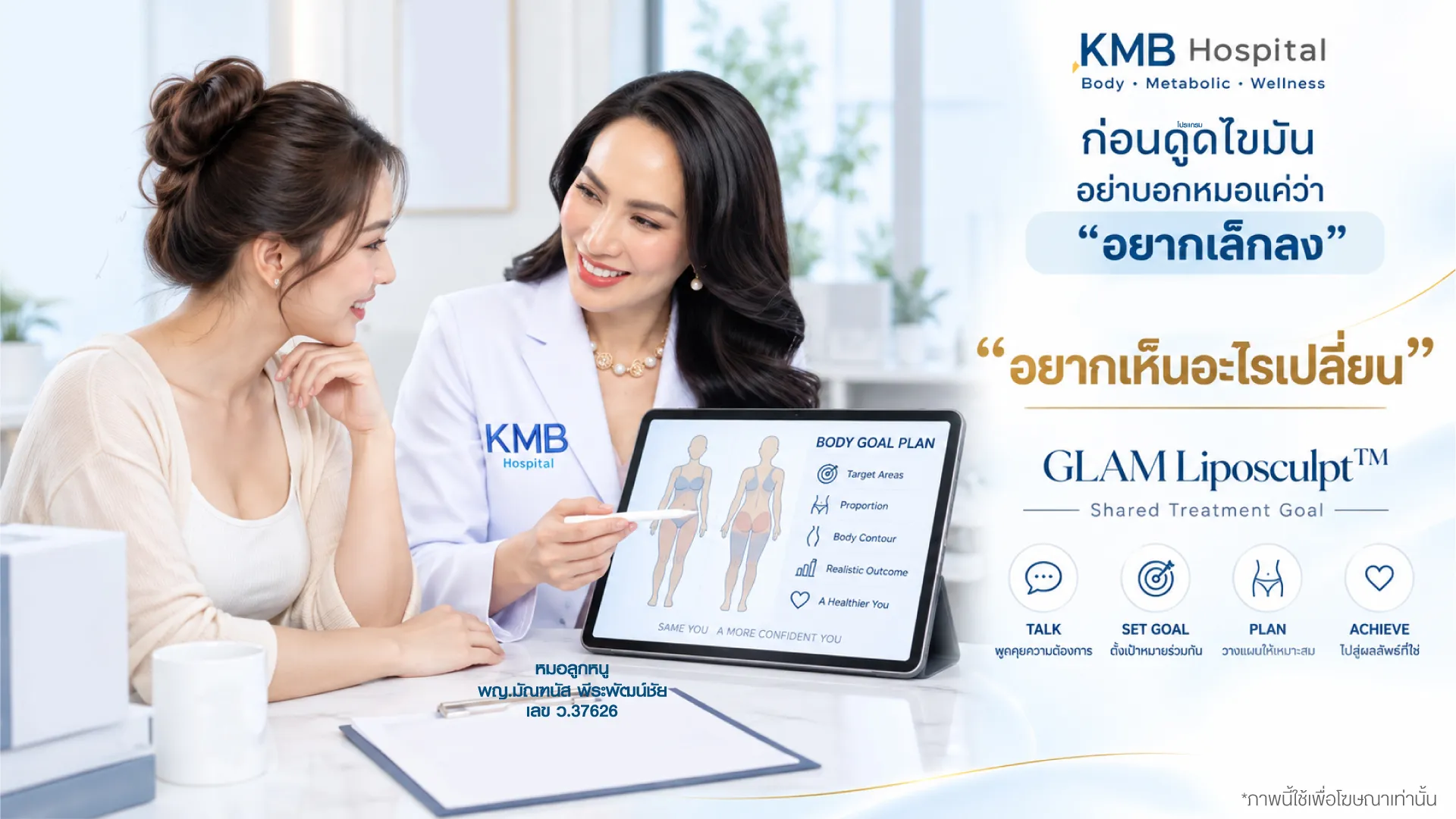
How to discuss desired results with your doctor before the GLAM Liposculpt™ liposuction program
Before undergoing the GLAM Liposculpt™ liposuction program, patients should clearly communicate which areas concern them, what kind of changes they wish to see, and what the most important outcomes are to them. The doctor will then consider these goals alongside FAT Mapping™, physical examinations, body proportions, skin quality, health, and individual structural limitations.
Article ID: GL-E-K10 Reading time: Approx. 8 minutes Category: Personalized Liposuction Planning with GLAM Liposculpt™
First published: 27/9/2026 Last updated: 27/9/2026
Before undergoing the GLAM Liposculpt™ liposuction program, patients should clearly communicate which areas concern them, what kind of changes they wish to see, and what the most important outcomes are to them. The doctor will then consider these goals alongside FAT Mapping™, physical examinations, body proportions, skin quality, health, and individual structural limitations.
Therefore, a good goal is not just defining a shape based on an image in your mind, but finding common ground between "what the patient wants" and "what is suitable for that person's body" before starting the liposuction program.
Before liposuction, don't just start with "I want to be smaller"
When consulting for liposuction, many patients start with simple sentences like:
These are good starting points, but they are not enough for treatment planning.
Because "smaller" means something different to everyone.
Some want clothes to fit easier.
Some want a clearer waistline.
Some want a balanced profile from the side.
Some don't want major changes, just a smoother, more natural silhouette.
Therefore, before liposuction, it is important to clearly discuss:
Not just "What do we want to treat?"
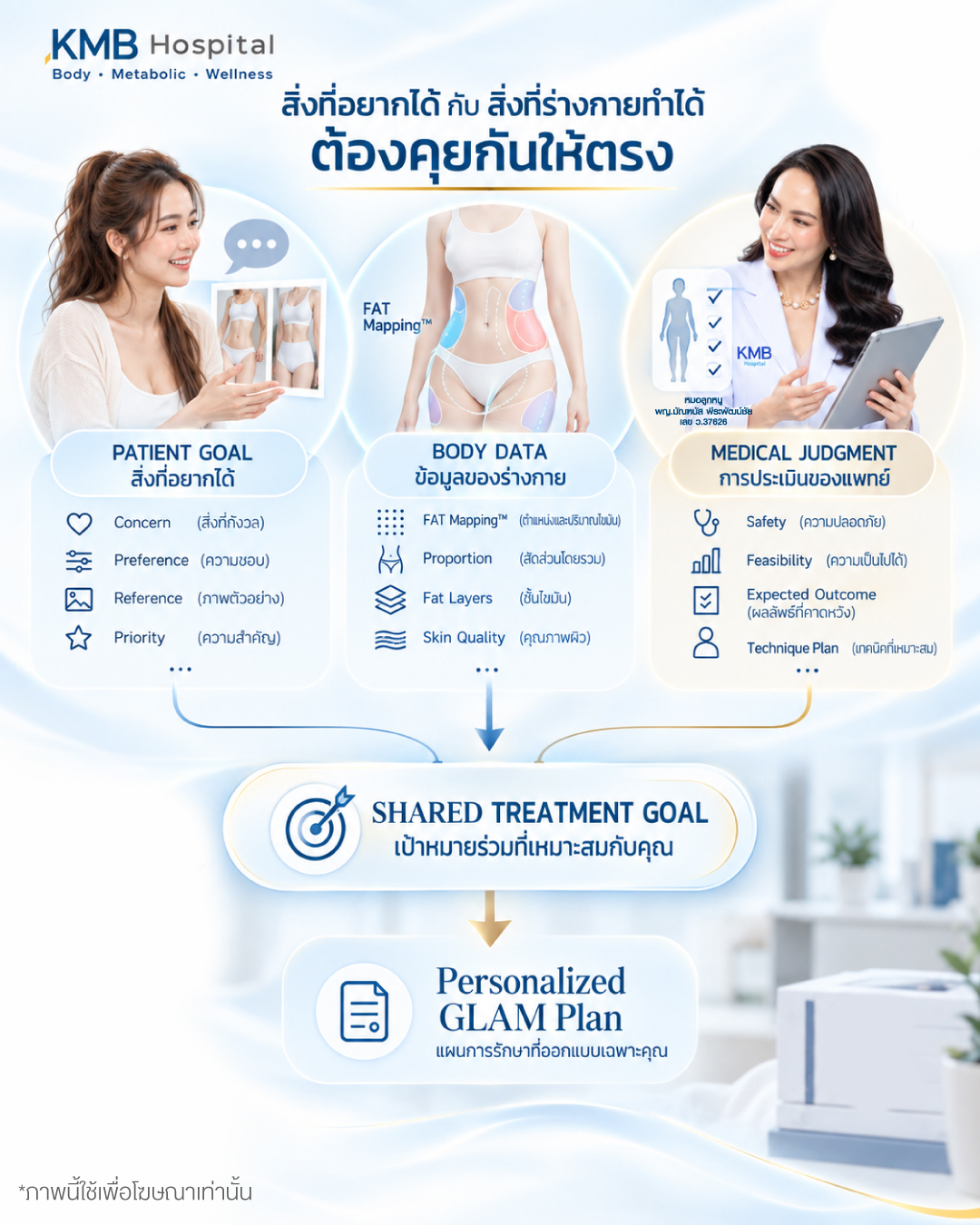
Patient goals are as important as FAT Mapping™ data
FAT Mapping™ helps doctors understand body data.
But body data alone doesn't tell us the outcome the patient wants.
This is why pre-liposuction consultation is crucial.
The doctor needs to know:
- Which area concerns the patient most?
- What kind of changes do they want to see?
- What is their priority?
- Do they want a dramatic result or a natural, gradual one?
- Are there any images or shapes being used as a reference?
These data points are considered alongside FAT Mapping™ and physical exams so that the liposuction plan isn't based solely on the "doctor's data."
Reference photos can be used, but shouldn't be a "template"
Many people have images they like from Instagram, TikTok, or someone else's Before-After results to show their doctor.
This is fine, and actually very helpful, as it helps the doctor understand "what the patient likes."
However, reference photos should be used as a communication aid, not an order for an identical shape.
Because the person in the photo and the patient have:
- Different bone structures.
- Different proportions.
- Different fat layers.
- Different skin quality.
- Different weights and heights.
So, instead of asking, "Can you make me look like this?"
a more useful conversation is, "Doctor, I like 'this' in this photo. Given my body, what direction can we design my shape in?" This helps clarify communication significantly.
A good goal needs "prioritization"
Some people want to change many things at once.
Wanting a flat abdomen.
Wanting an hourglass waist.
Wanting a thinner back.
Wanting smaller upper arms.
Wanting balanced thighs.
These are all understandable goals.
But in actual planning, the doctor and patient should help define what is most important, what is the primary goal, and what is secondary.
Because when the priority is clear, the plan is clearer.
And it helps the doctor define the Primary Area, Connecting Areas, and the Treatment Journey. This is exactly where this section links back to Chapter 30.
A good result isn't just "following requests"
In Personalized Body Design, "getting a good result" does not mean the doctor does everything the patient asks for without analysis.
It means understanding the patient's needs and having them undergo medical assessment before creating an appropriate plan.
Sometimes, what the patient thinks is the main problem might not be the area that has the most impact on Body Contour.
Sometimes, what the patient wants might require adjusting expectations to align with their actual structure.
These discussions before liposuction are crucial because they help the doctor and patient understand the "desired outcome" in the same way before starting treatment.
GLAM doesn't design the same for everyone
This is the most important sentence of Domain E.
GLAM Liposculpt™ does not have a standard "ideal" shape and try to make everyone fit into it.
Because Personalized Body Design means designing the outcome to suit that specific person.
Some may suit a sharply curved waist.
Some may suit a natural, continuous waistline.
Some may prioritize reducing torso thickness.
And some may just want fine-tuning in certain areas.
Therefore, a good goal is not "I want to be like someone else," but:
And letting the doctor assess how that version should be designed to suit the actual body data.
From Personalized Planning to Shared Goal
Looking back at Domain E, we arrived here through several questions.
This is where Personalized Planning is complete because a good plan doesn't stem from medical data alone, nor from the patient's needs alone, but from:
And subsequently becomes:
of the doctor and patient together.
Key Points to Know
- Before liposuction, patients should clearly communicate concerns and desired changes.
- FAT Mapping™ helps doctors understand body data, but patient goals are also critical for planning.
- Reference photos serve as communication aids, not templates for identical results.
- Appropriate goals should emerge from the intersection of Patient Goals, Medical Assessment, and individual structural limitations.
- Prioritization helps clarify the direction for multi-area liposuction.
- GLAM Liposculpt™ does not aim to give everyone the same shape, but focuses on Personalized Body Design suitable for each individual.
"I want this" must be translated into a plan suitable for the real body
Imagine a patient bringing a reference photo to the doctor and saying, "Doctor, I want this waist."
This sentence is useful because it helps the doctor understand the direction of what the patient likes.
But the next step is not to copy the shape from that image.
The doctor must look back at the patient's own data, including FAT Mapping™, torso proportions, fat distribution, skin quality, hip structure, and adjacent areas.
Then, discuss what is the primary goal within that reference.
It could be a more cinched waist.
It could be the continuity of the abdomen and hips.
Or it could be the overall sense of a balanced figure.
By separating "what is liked" from "someone else's body," the doctor can turn the reference into a Treatment Goal suitable for the patient's real body. This is how to effectively use reference photos in Personalized Planning.
Clear goals don't have to be numbers
Before liposuction, some try to define goals with numbers, such as:
Wanting to lose X inches off the waist.
Wanting to extract X cc of fat.
Or how much weight to lose.
But Body Contouring goals don't need to be described by numbers alone.
Saying "I want my waist to look clearer when wearing fitting clothes" or "I want my upper arms to look more harmonious with my shoulders" might help the doctor understand the direction of Body Design better than setting rigid numbers.
GLAM Liposculpt™ prioritizes Visual Goals and Proportion Goals alongside medical data.
When goals and data don't align, discuss before starting
Sometimes, patients may want results that don't align with their body structure or expect changes beyond what liposuction alone can provide.
In such situations, what matters is not rushing into treatment, but ensuring both parties understand each other first.
The doctor should explain what data from FAT Mapping™ and physical examination reveals.
What is a feasible goal?
What might need an adjustment of expectations?
And what are the limitations to know before deciding?
Discussing this before the liposuction program helps the Treatment Goal become clearer and more aligned with the real data.
Shared Goal doesn't mean thinking the same from the start
The term Shared Treatment Goal does not mean that both parties must have the same perspective from the beginning.
The patient may start with what they see and feel.
The doctor starts with medical data and body structure.
What matters is bringing these two perspectives together until a shared goal emerges that both parties understand.
This is the heart of Personalized Care.
Because the plan is not determined solely by the patient, nor solely by the doctor, but by a joint decision based on real data.
Frequently Asked Questions
What should I tell my doctor before the GLAM Liposculpt™ liposuction program?
Clearly state which areas concern you, what kind of changes you wish to see, and what the most important outcomes are to you.
The doctor will use this information alongside FAT Mapping™, physical examination, proportions, skin quality, and health to create a liposuction plan suitable for each individual patient.
Can I show my doctor reference photos before the GLAM Liposculpt™ liposuction program?
Yes, and it is helpful for communicating the shape or proportions you prefer.
However, a reference photo should be used as a guide for discussion, not a template for identical results.
The doctor must always consider the goals from the photo alongside FAT Mapping™ and the patient's actual structure.
Why can't the GLAM Liposculpt™ liposuction program give everyone the same shape from a reference?
Because everyone has different bone structures, proportions, fat distribution, skin quality, and bodily limitations.
GLAM Liposculpt™ uses references to understand the direction of results but must be redesigned to suit the patient's actual data.
The goal is Personalized Body Design, not copying someone else's shape.
Do I need to set my result goal as a number before the GLAM Liposculpt™ liposuction program?
Not necessarily.
Goals can be described by shape characteristics, such as wanting a clearer waist, a more balanced abdomen, or arms that flow more seamlessly with the shoulders.
The doctor will use these Visual Goals alongside FAT Mapping™ and medical data to determine the appropriate plan without strictly adhering to numbers.
What should I do if my desired result doesn't align with what the doctor assessed from FAT Mapping™?
Discuss it until you both understand each other before starting the liposuction program.
The doctor should explain what the data from FAT Mapping™ and the physical examination shows and why some goals might need adjustment to suit your structure.
A good goal is common ground between what you want and what the doctor assesses to be suitable.
What is the purpose of the discussion before the GLAM Liposculpt™ liposuction program?
The purpose is to ensure the doctor and the patient understand each other regarding what changes we are attempting to make and what results are suitable for that individual.
When Patient Goals are integrated with FAT Mapping™, physical exams, and Medical Judgment, a Shared Treatment Goal is created, serving as the direction for ongoing Personalized Body Design.
Article Summary
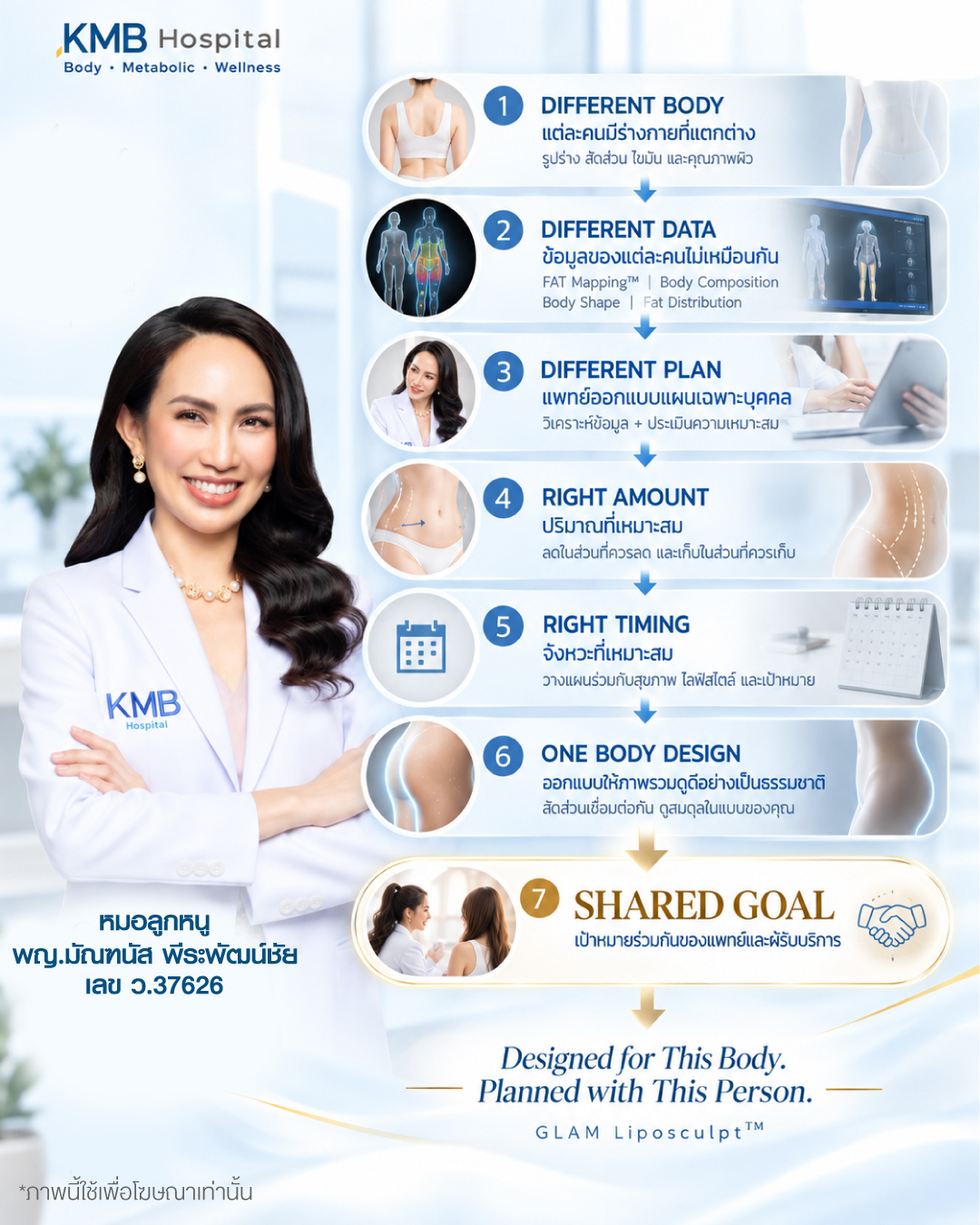
Before undergoing the GLAM Liposculpt™ liposuction program, discussing desired outcomes is a key part of planning.
Patients should clearly state their concerns,
what changes they want to see,
and what the most important outcomes are to them.
The doctor will then consider these goals alongside FAT Mapping™, physical examinations, health, skin quality, and body structure.
Because Personalized Body Design does not stem from Body Data alone, nor from Patient Wish alone, but from:
And consequently becomes:
that both the doctor and patient understand together before starting the liposuction program.
This is where Domain E — Personalized Liposuction Planning is complete.
From understanding why plans differ for everyone, to determining volume, timing, number of areas, and finally agreeing on:
"What is the result we are designing together?"

Read more at DoctorLooknuu.com
About this article
This article explains the importance of discussing goal-setting before the GLAM Liposculpt™ liposuction program, by integrating Patient Goals with FAT Mapping™, physical exams, health, skin quality, proportions, and Medical Judgment to create a Shared Treatment Goal suitable for each individual.
This concept is part of Personalized Liposuction Planning, which emphasizes both body data and patient needs before determining the direction of Body Design.
The information in this article is for educational purposes and cannot replace medical examination, diagnosis, or personalized medical advice from a doctor.
Article Review Information
First published:27/9/2026 Last updated:27/9/2026
Medical References
The original manuscript does not list additional medical references; therefore, no external references were added.
Understanding and Personalized Planning Information
The information in this article is for educational purposes and cannot replace medical examination, diagnosis, or personalized medical advice from a doctor. Actual planning should consider FAT Mapping™, physical examination, health, skin quality, proportions, structure, and individual patient goals together.
Want to discuss how "desired results" suit your body?
Before starting the liposuction program, understanding Patient Goals alongside FAT Mapping™, physical exams, and individual limitations helps doctors and patients set a Shared Treatment Goal in the same direction.