
What are the layers of body fat?
KMB KNOWLEDGE BLUEPRINT™
DOMAIN B — THE SCIENCE BEHIND FAT MAPPING™ | Article Code: FM-B-K03
Category: FAT Mapping™ | Science of Fat | Pre-Liposuction Program Assessment
What Are the Body Fat Layers? What Doctors Use to Assess Before Liposuction Programs
First Published: August 1, 2026 | Last Updated: August 1, 2026 | Reading Time: 9 minutes
Author: Medical Content Team, KMB Hospital
Medically Reviewed By: Dr. Mantanas Piraepatthanachai (Dr. Looknouu), License No. W.37626
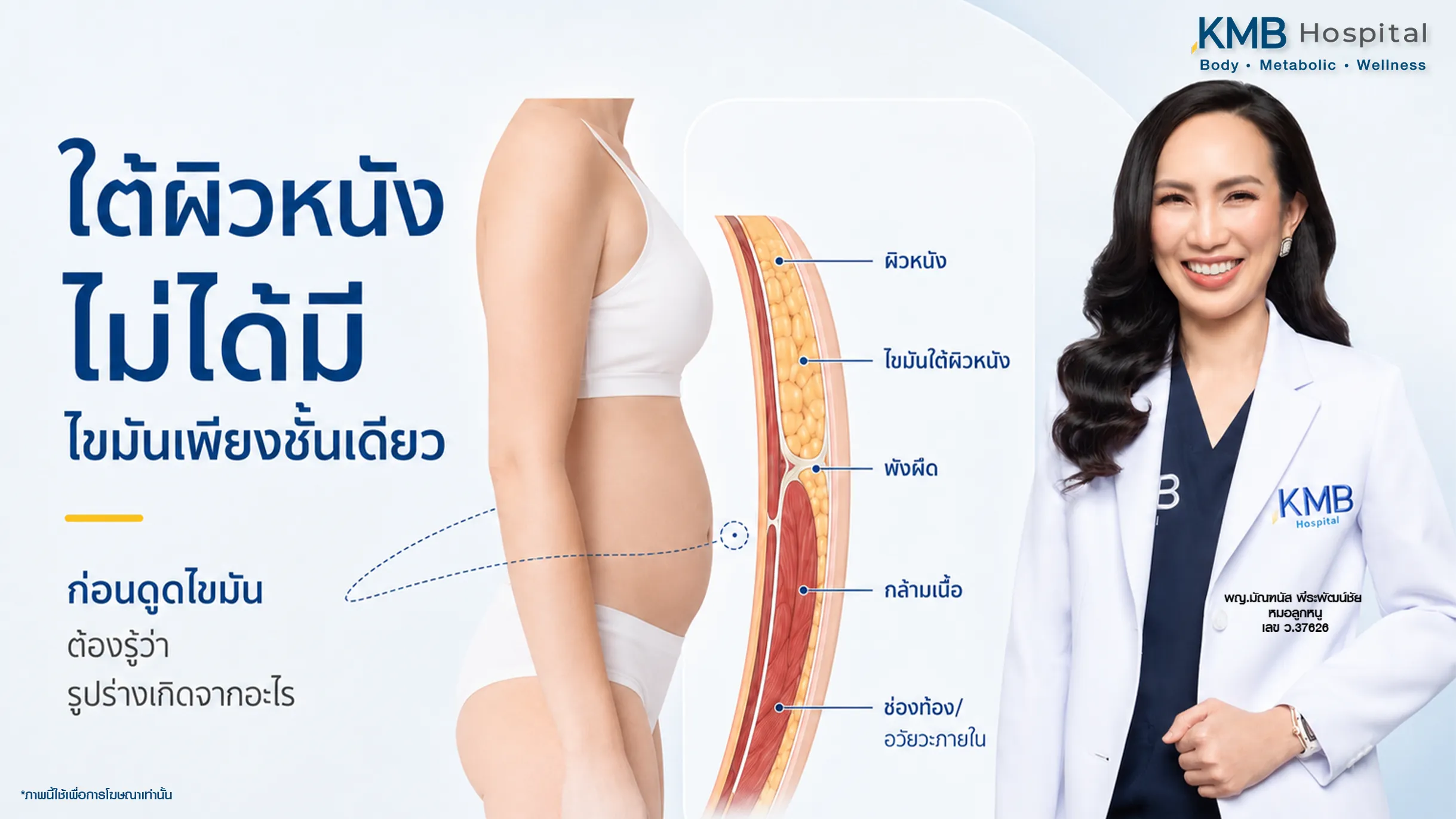
Body fat layers are not a single continuous mass of fat. When viewing from the outside inward, the body consists of skin, subcutaneous tissue, fascia, muscles, and in some areas, fat located deeper within the body cavity or around organs.
Most fat affecting external body shape is subcutaneous fat, which in many areas can be divided into superficial and deep parts supported by a fascial system. However, the pattern of these layers is not uniform across all locations and may vary between individuals.
Before performing FAT Mapping™ and planning a liposuction program, doctors must assess which layer causes visible thickness or protrusion—whether related to skin, fascia, muscles, or visceral fat—and to what degree. While liposuction programs access subcutaneous fat, they cannot remove fat located around internal organs.
Under Skin Is Not Just One Fat Layer
When viewing body shape from the outside, we may see only thickness, protrusion, bulging, or sagging of various areas, but beneath the skin consist multiple tissue layers with different structures and functions.
From the outer side moving inward, generally, skin, subcutaneous adipose tissue, fascial systems, muscles, and deeper internal structures are found. In the torso, especially the abdomen, fat located within the abdominal cavity and around organs may also exist, which are in different positions from subcutaneous fat.
Subcutaneous adipose tissue itself is not a single uniform layer. Anatomical studies describe that in many areas of the torso, superficial and deep fat portions can be found with a fascial or connective tissue system separating and linking these tissues together. However, the details of structural descriptions and terminology may vary depending on location and the anatomical approach used for study.
Therefore, terms like "abdominal fat," "arm fat," or "back fat" merely identify broad locations but are insufficient to indicate the level of fat, its thickness, or how it relates to skin, fascia, and muscles.
What Structures Are From Outside Inward?
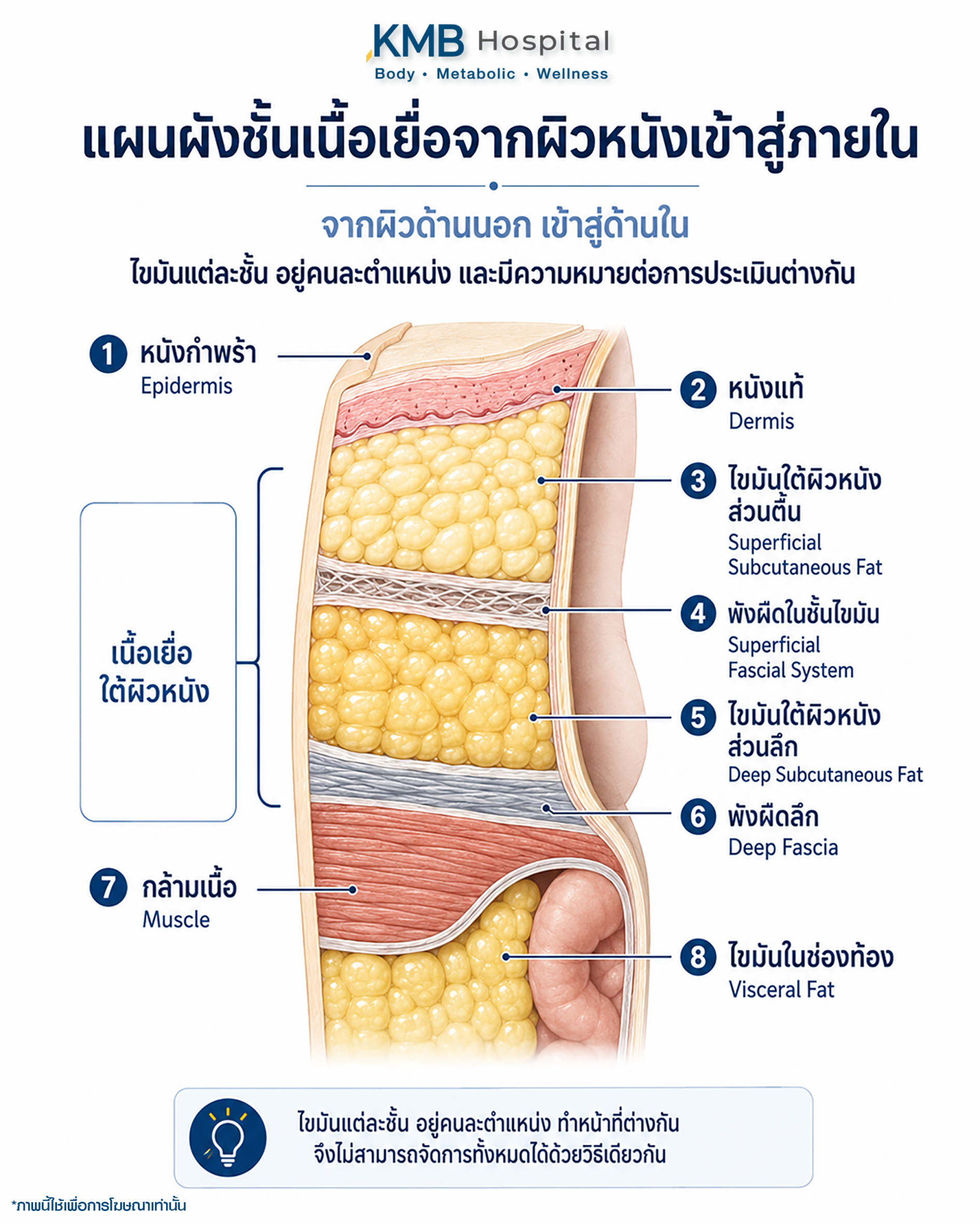
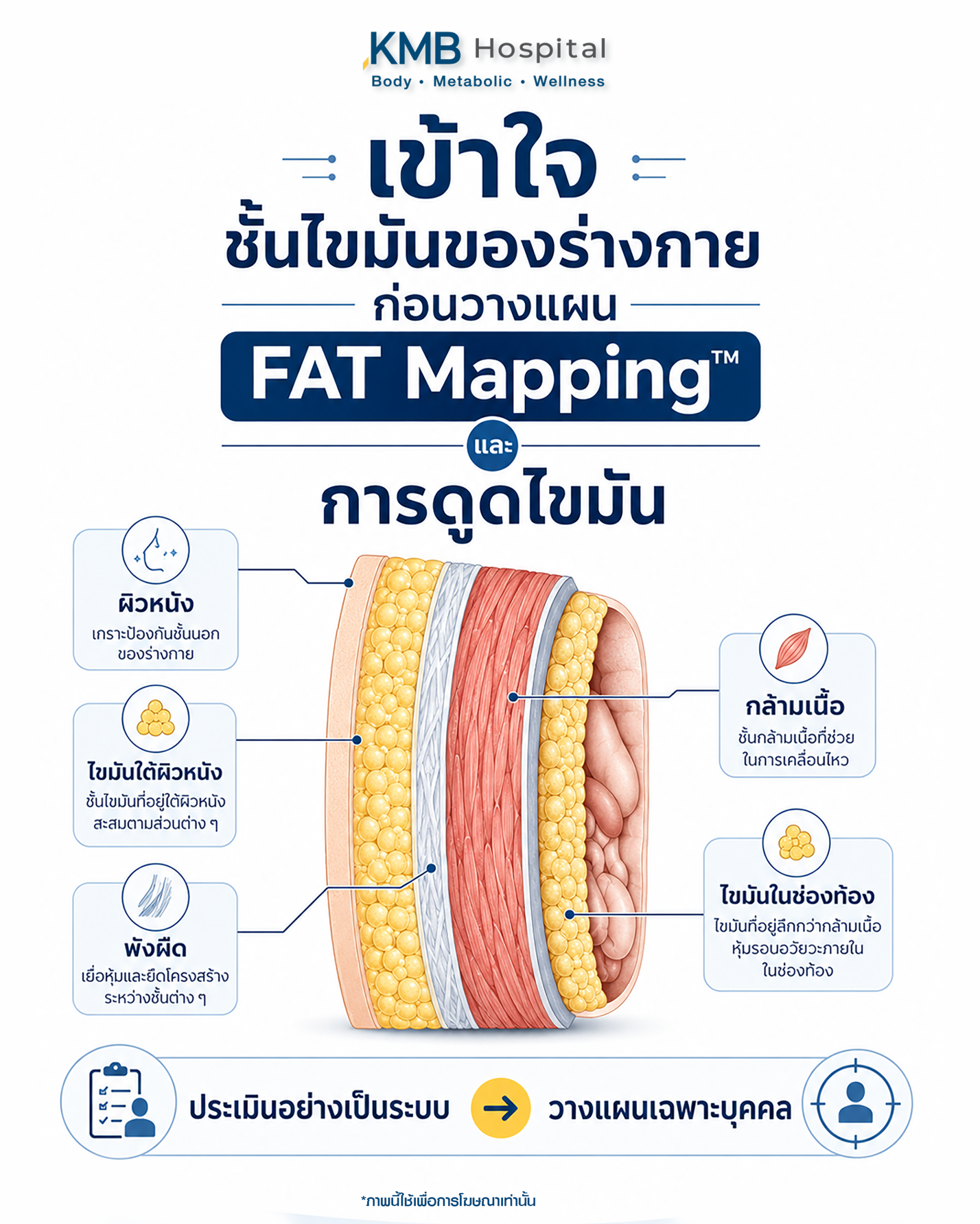
To better understand body fat layers, structures can be viewed from the outer skin inward in the following basic sequence.
1. Skin
Skin is the outermost body covering structure composed of the epidermis, dermis, and many other subsurface structures. It functions to protect the body, reduce water loss, receive sensation, and regulate temperature.
Although skin is not fat, it is extremely important to external shape because it wraps around and adapts according to the volume of tissue below.
Skin quality varies among individuals. Some have thick, flexible skin while others may have thin skin, stretch marks, sagging, or reduced elasticity due to age, weight changes, pregnancy, or other factors.
Therefore, assessment before a liposuction program must consider skin quality alongside fat quantity and position, as reducing fat volume does not mean everyone's skin will tighten or adapt similarly.
2. Subcutaneous Fat
Subcutaneous Adipose Tissue is fat tissue under the skin and above the muscle layer. It contributes significantly to visible external thickness, bulging, curves, and proportions.
Subcutaneous fat is the layer directly involved in planning liposuction programs in suitable areas, but this does not mean all subcutaneous fat should be removed, or that all can be managed by the same method entirely.
In many areas, subcutaneous fat may divide into superficial and deep parts, separated and suspended between skin and lower structures by fascia and connective tissue fibers.
Thickness, firmness, and subcutaneous fat layering patterns may vary by area, age, sex, body composition, history of weight changes, and individual characteristics.
3. Fascia Within Fat Layers
Fascia is connective tissue distributed throughout the body, playing a role in connecting, supporting, dividing layers, and transmitting forces between tissues. Fascia is not merely a sheet of tissue between fat and muscle but also includes fibers linking through fat layers to skin and other structures.
Within fat layers, fascia may appear as sheets or fibers dividing fat into groups and small compartments. These structures contribute to firmness, movement, and tissue adhesion.
Some areas may have finer, uniform fascia, while others may have denser fascial lines or stronger adhesion, causing differences in pinch feel, movement, and surface smoothness.
Details regarding fascia and effects on liposuction program planning will be explained further in Article 20 to prevent duplication with subsequent topics.
4. Muscles and Deep Fascia
Muscles lie deeper than the subcutaneous fat layer, wrapped and grouped separately by deep fascia.
Muscle shape and strength can affect body curves and bulging. For example, a protruding abdomen may not result solely from subcutaneous fat but could involve muscle components, abdominal wall posture, or pressure from internal structures.
Liposuction programs do not directly correct muscles or abdominal wall abnormalities. Therefore, doctors must distinguish whether what is seen externally comes primarily from subcutaneous fat or involves other structures significantly.
5. Visceral Fat in Abdominal Cavity
Abdominal fat or organ-surrounding fat lies deeper than the abdominal wall muscle and surrounds internal structures or organs. This differs from subcutaneous fat in position, function, and health relationships.
When visceral fat volume is high, the abdomen may appear protruding or tight from within, even if the palpable subcutaneous fat layer outside is not very thick.
Liposuction programs work with subcutaneous fat and cannot remove fat located under muscles or around internal organs. Therefore, abdomens protruding from visceral fat cannot be expected to change via liposuction programs in the same way as those caused primarily by subcutaneous fat.
Details of visceral fat, limitations of liposuction programs, and methods to differentiate from subcutaneous fat will be explained further in Article 19.
What Is Superficial Subcutaneous Fat?
Superficial subcutaneous fat is the portion of fat tissue located closer to the skin, connected between skin and deeper structures by fascial fibers and connective tissue.
In some areas, superficial fat appears in groups or small compartments divided by fascial fibers. Thus, it relates to skin adhesion, surface smoothness, and force transmission between skin and underlying tissues.
However, superficial fat should not be assumed to have uniform shape or thickness throughout the body, as fascial systems and fat compartment divisions vary by position. For instance, abdominal structures may differ from arms, legs, back, or chin areas.
These differences are reasons why doctors must assess regionally rather than applying principles or depths equally to all body locations.
What Is Deep Subcutaneous Fat?
Deep subcutaneous fat lies deeper than the superficial part and above the muscle, with a fascial system helping separate superficial from deep fat in areas where layer division is clearly visible.
Studies of torso and abdominal wall regions find that deep subcutaneous fat can contribute to overall tissue thickness and may have anatomical features distinct from superficial fat, though proportions and clarity of each layer vary between individuals.
In some cases, bulging shapes may relate significantly to deep fat layers, while others may combine superficial fat, fascia, skin, or other components.
Doctors therefore cannot conclude based on sighted shape or single-position palpation which fat layer is the primary cause but must jointly assess distribution, depth, firmness, and relationship with surrounding tissues.
Are Fat Layers Uniform Throughout the Body?
Fat layers are not uniform in thickness, firmness, or division throughout the body. Each area has different fascial structures, mobility, skin adhesion, and anatomical functions.
Abdominal areas may show clear division between superficial and deep fat layers, while facial and neck areas may have fat divided into specific compartments or groups according to facial structures. Areas such as the back, arms, hips, and thighs also have different distribution patterns and adhesion.
Even within the same area, service recipients may have different fat layer characteristics. Some have relatively thick subcutaneous fat, some have firm tissue from fascia, some have little fat but sagging skin, or others combine muscle and internal structure components.
How Does Subcutaneous Fat Differ From Visceral Fat?
After understanding that subcutaneous regions comprise multiple layers, a common question arises: "Is external visible fat the same type as visceral fat in the abdominal cavity?" The answer is no.
Although both types are fat tissue, they differ distinctly in position, function, and relationship with liposuction programs. Separating this distinction is one of the key foundations for assessing before FAT Mapping™ and planning liposuction programs.
Subcutaneous Fat
Subcutaneous fat lies between the skin and muscle layers, creating thickness, bulging, and external body shape curves.
This type of fat is found in many body areas such as the abdomen, flanks, arms, thighs, hips, jowls, and back. When we pinch or grab tissue in various body parts, most of it is subcutaneous fat combined with skin and fascia.
However, although called subcutaneous fat, thickness, firmness, and layer division may differ significantly between areas, so uniform assessment methods cannot be applied to all body locations.
Visceral Fat
Visceral fat lies deeper than muscle layers, surrounding internal organs such as intestines, liver, and various organs within the abdominal cavity. This fat type cannot be felt directly from the outside.
In some people, even when external subcutaneous fat is minimal, the abdomen may still protrude clearly because visceral fat is a significant component.
A large abdomen does not always mean high subcutaneous fat, conversely, some people have relatively thick subcutaneous fat but low visceral fat, resulting in different abdominal appearances.
| Comparison Point | Subcutaneous Fat | Visceral Fat |
|---|---|---|
| Position | Located between skin and muscle | Located deeper than muscle and around internal organs |
| Effect on External Shape | Directly affects thickness, bulging, and curves | May cause abdomen to protrude or feel tight from inside |
| Palpability from Outside | Can be pinched or grabbed with skin and fascia | Cannot be felt directly from the outside |
| Relationship with Liposuction Program | Part assessed by doctors before planning suitable areas | Not fat removed by standard liposuction programs |
Understanding this difference helps reduce misunderstandings that "protruding abdomen means liposuction will reduce it completely," because in reality, visceral fat may also be a contributing component.
Why Does a Protruding Abdomen Not Result From Just One Fat Layer?
The abdomen is an area where multiple components work together. Abdominal bulging may result from several factors simultaneously, such as:
Therefore, two service recipients with similar-sized abdomens may have entirely different underlying causes, and planning approaches may also differ.
What Are The Limitations Of Viewing From Outside Only?
Observing shape from the outside is helpful to a degree but cannot reveal all internal components, such as:
Two service recipients may have equal weight, height, BMI, and waist circumference, yet detailed evaluation may reveal very different internal compositions.
This is the reason why doctors should not judge based solely on single photographs or weight numbers.
How Do Doctors Assess Fat Layers Before Liposuction Programs?
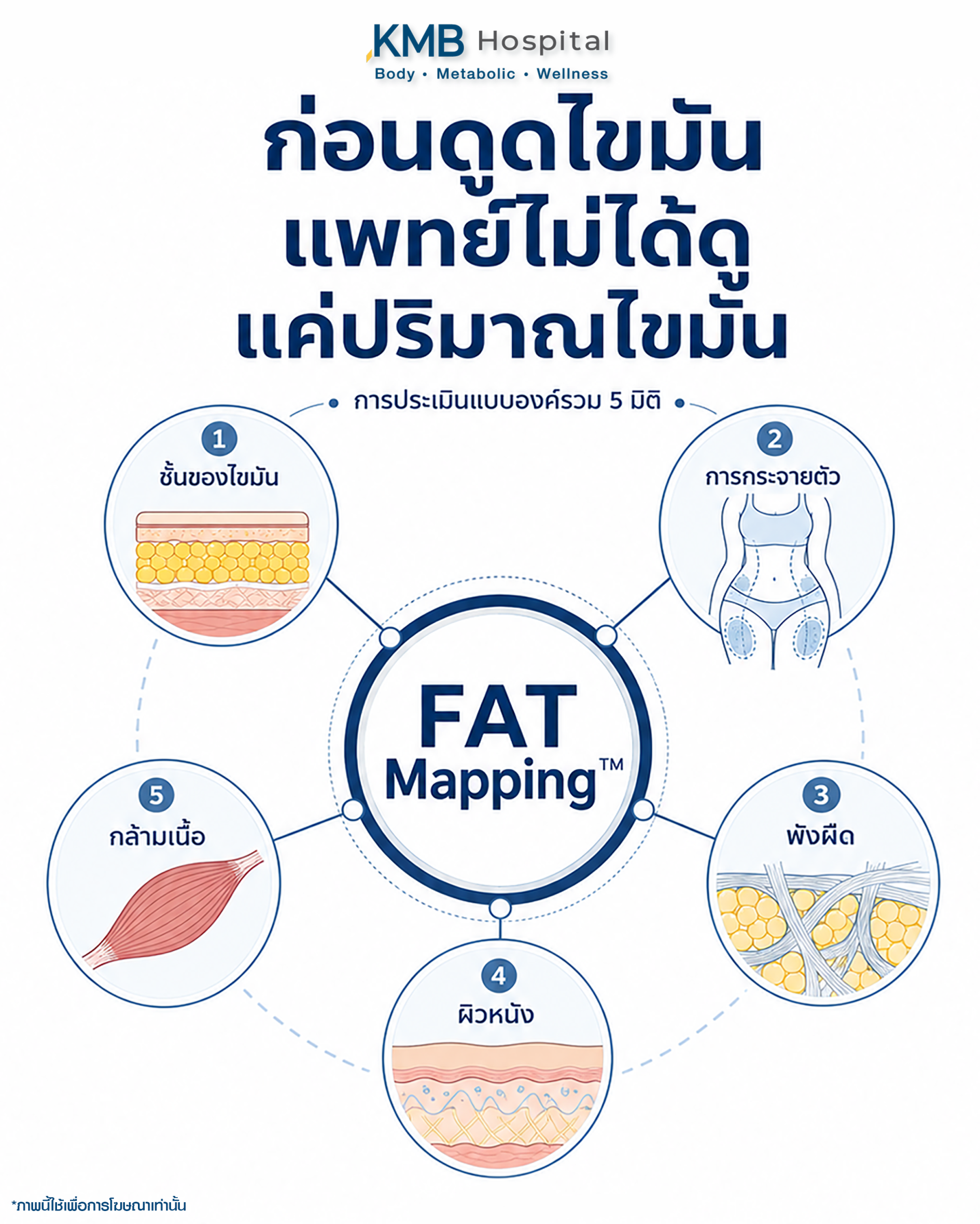
Before planning a liposuction program, doctors do not assess merely "how much fat there is," but consider various aspects jointly.
| Component Assessed | Doctor Considerations | |
|---|---|---|
| Fat Location | Where fat is located; is it subcutaneous fat or combined with visceral fat components? | |
| Fat Layer Thickness | Is thickness uniform per area? Is symmetry between left and right sides maintained? | |
| Fat Distribution | Is fat distributed uniformly or accumulated only in specific positions? | |
| Skin Quality | Does skin retain elasticity? Is sagging present? | |
| Fascia Characteristics | How firm is the tissue? How extensive is fascia presence? Are there previous treatments that may alter structures? | |
| Other Body Components | Muscles, body structure, posture, and overall proportions. |
All these data points will be considered together, not relying on single variables.
Why Is Understanding Fat Layers Important For FAT Mapping™?
Understanding that the body comprises multiple fat layers is the key reason doctors cannot plan liposuction programs based solely on external appearance.
Service recipients with similar-sized abdomens may have vastly different internal compositions, such as:
FAT Mapping™ thus plays a role in gathering information about fat layers, fat distribution, and body composition to aid planning before liposuction programs alongside physical exams, health history, and clinical judgment.
Article Summary
Body fat layers do not consist of a single fat layer alone but are structures comprising skin, subcutaneous fat, fascia, muscles, and in some areas, visceral fat, each layer having different positions, functions, and shape relationships.
Even if two service recipients have similar external shapes, underlying tissues may differ greatly. Some have subcutaneous fat as a primary component, some have accompanying visceral fat, some have dense fascia, or loose skin as major factors.
Thus, pre-liposuction program assessment cannot rely on visual inspection alone but must consider each layer's components together to properly understand shape causes in each area.
FAT Mapping™ plays a role in gathering data on fat distribution, tissue structure, and body composition to support pre-liposuction program planning alongside physical exams, health history, and clinical judgment.
Key Points To Know
Body fat layers consist of skin, fat, fascia, muscles, and deeper structures.
This fat layer relates to liposuction program planning in suitable areas.
It is not fat removed by standard liposuction programs.
Fascia, skin, muscles, and body structures all impact shape.
Those with similar shapes may have different internal structures, so one approach does not suit all.
Understanding fat layers supports personalized liposuction program planning.
Frequently Asked Questions
1. Are subcutaneous fat and visceral fat the same?
No, they are not the same. Although both are fat tissue, subcutaneous fat lies between skin and muscle, while visceral fat is deeper than muscle and surrounds internal organs. Thus, their roles and treatment limitations differ.
2. Do everyone's protruding abdomens come from subcutaneous fat?
Not always. Protruding abdomens may arise from subcutaneous fat, visceral fat, abdominal walls, muscles, or multiple factors combined. Professional assessment before treatment planning is recommended.
3. How do doctors assess fat layers and what role does FAT Mapping™ play?
Visual observation of shape is only part of the assessment and cannot reveal all components. Doctors must utilize data from interviews, physical exams, and additional assessments jointly.
FAT Mapping™ assists in gathering data regarding fat distribution and body composition to support pre-liposuction program planning alongside physical exams and clinical judgment, not used to conclude or prescribe treatment independently.
4. Can all fat layers be removed via liposuction programs?
No. Liposuction works on subcutaneous fat in suitable areas but is not used to remove visceral fat or fat surrounding internal organs.
5. Why do people with the same weight have different shapes?
Because shape depends not only on weight but also on fat distribution, skin quality, fascia, muscles, body structure, and other varying factors per individual.
Related Articles Within KMB Hospital Website
Website team links when destination articles are published.
Read More From DoctorLooknuu.com
Website team links when destination articles are published.
References
- Standring S, Tubbs RS, editors. Gray's Anatomy: The Anatomical Basis of Clinical Practice. 43rd ed. Elsevier; 2025.
- Hall JE, Hall ME. Guyton and Hall Textbook of Medical Physiology. 15th ed. Elsevier; 2025.
- Lancerotto L, Stecco C, Macchi V, Porzionato A, Stecco A, De Caro R. Layers of the abdominal wall: anatomical investigation of subcutaneous tissue and superficial fascia. Surg Radiol Anat. 2011;33(10):835-842. doi:10.1007/s00276-010-0772-8.
- Cook A, Cowan C. Adipose. In: StemBook. Harvard Stem Cell Institute; 2009. doi:10.3824/stembook.1.40.1.
- Harvey I, Boudreau A, Stephens JM. Adipose tissue in health and disease. Open Biol. 2020;10(12):200291. doi:10.1098/rsob.200291.
- Hammoudeh DNS, Dohi T, Cho H, Ogawa R. In vivo analysis of the superficial and deep fascia. Plast Reconstr Surg. 2022;150(5):1035-1044. doi:10.1097/PRS.0000000000009631.
- American Society of Plastic Surgeons. Liposuction risks and safety; patient education resources.
About KMB Hospital
KMB Hospital provides body care, weight management, and liposuction programs, prioritizing systematic pre-treatment assessment to help support appropriate care planning for each service recipient under medical data, physical examination, and clinical judgment.
Author and Reviewer Information
Licensed Physician No. W.37626
Article Review Information
Understand Fat Layers Before Planning Body Care
If unsure whether concerning thickness, bulging, or protrusion relates to subcutaneous fat, skin, fascia, muscles, or visceral fat, doctor assessment helps clarify body components and limitations of each approach more clearly.