What causes hard lumps or nodules after liposuction, and how should they be managed?
What causes hard lumps or firmness after liposuction and how to manage them
Feeling firmness, tightness, or lumps after liposuction can be caused by many factors during the tissue recovery phase. You should not assume every hard area is fibrosis. It is essential to have a doctor or medical team assess the area before choosing a management method.
First Published: 30/9/2026 Last Updated: 30/9/2026
Feeling firmness, tightness, or lumps after liposuction can be caused by several factors during the tissue recovery phase, such as swelling, fluid changes in the tissue, temporary hardening of the treated area, or fibrosis during the tissue repair process. You should not conclude on your own that every lump is fibrosis.
Care should begin with a doctor or medical team assessing “what the lump is and what stage of recovery it is in” before choosing a management method. Do not rush to massage, press, or use devices on the hardened area yourself just because you want the lumps to disappear faster.
“Doctor, why do I feel hard, lump-like sensations after liposuction?”
This is one of the most frequently asked questions during the recovery period.
Some patients say, “It was swollen at first, but now it feels hard.”
Others feel that “the tissue under the skin doesn’t feel as soft as before.”
Some feel lines, firm lumps, or solid spots under the skin.
The most important thing to remember is do not immediately call every hard area “fibrosis.”
What we feel from the outside is only the sensation of the tissue at that moment, but the underlying causes can differ.
A doctor must evaluate the time elapsed since the procedure, the location, the nature of the firmness, other concurrent symptoms, and any changes compared to the previous period.
Therefore, the first question shouldn't be “How can I make this go away as fast as possible?”, but rather:
Firmness after liposuction does not have just one cause
After liposuction, tissue does not return to a stable state immediately.
The body is in the process of recovery and tissue repair, so many changes can occur in the treated area.
Feelings of firmness, tightness, or lumps may be related to several factors, such as:
For this reason, palpation with your own hands cannot definitively determine what it is.
What is “post-liposuction fibrosis”?
When tissue is injured from the procedure, the body begins its natural repair process.
Part of this process involves the formation of connective tissue and collagen.
During certain stages, the tissue may feel firm, tight, or not as smooth as before.
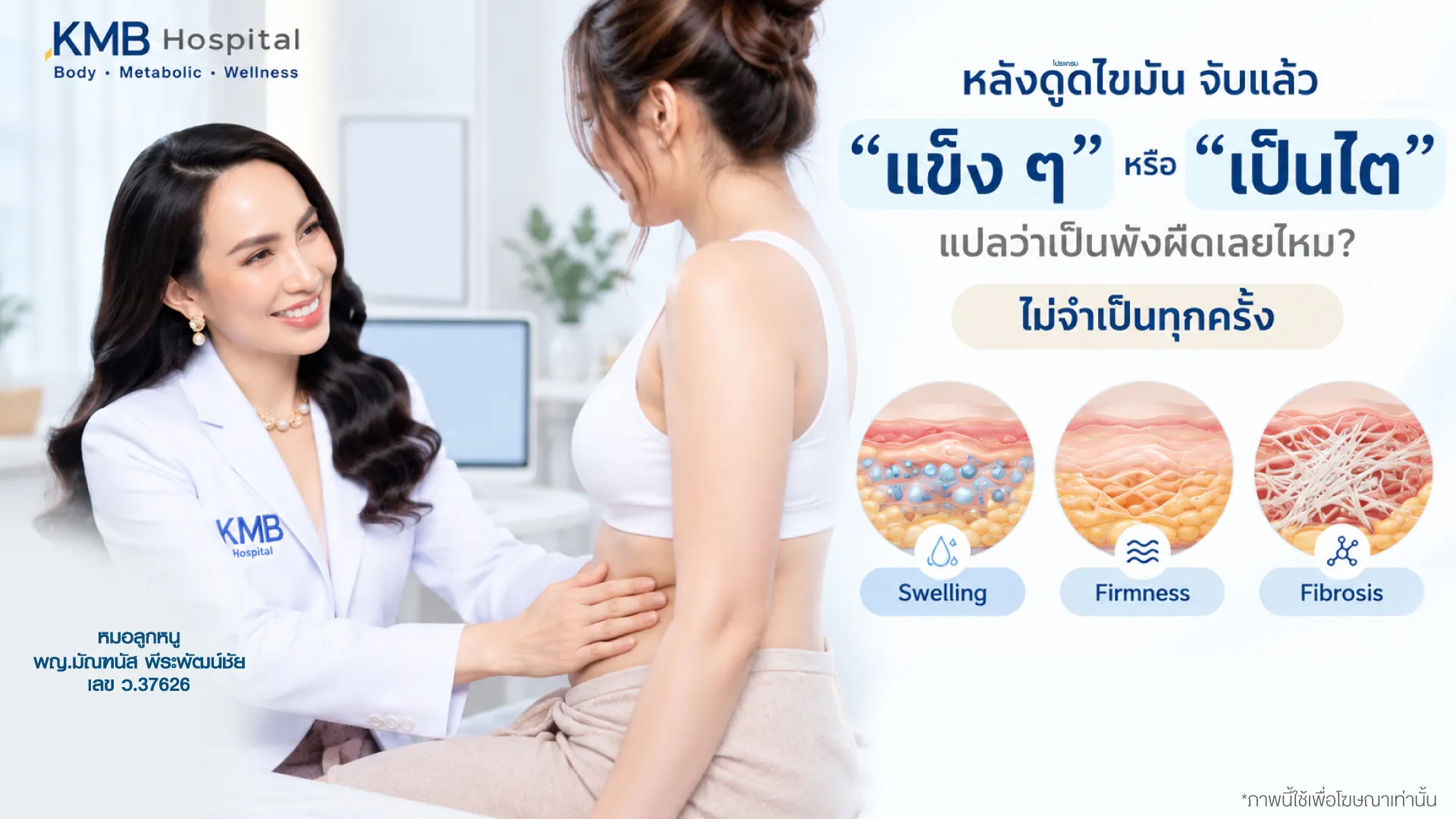
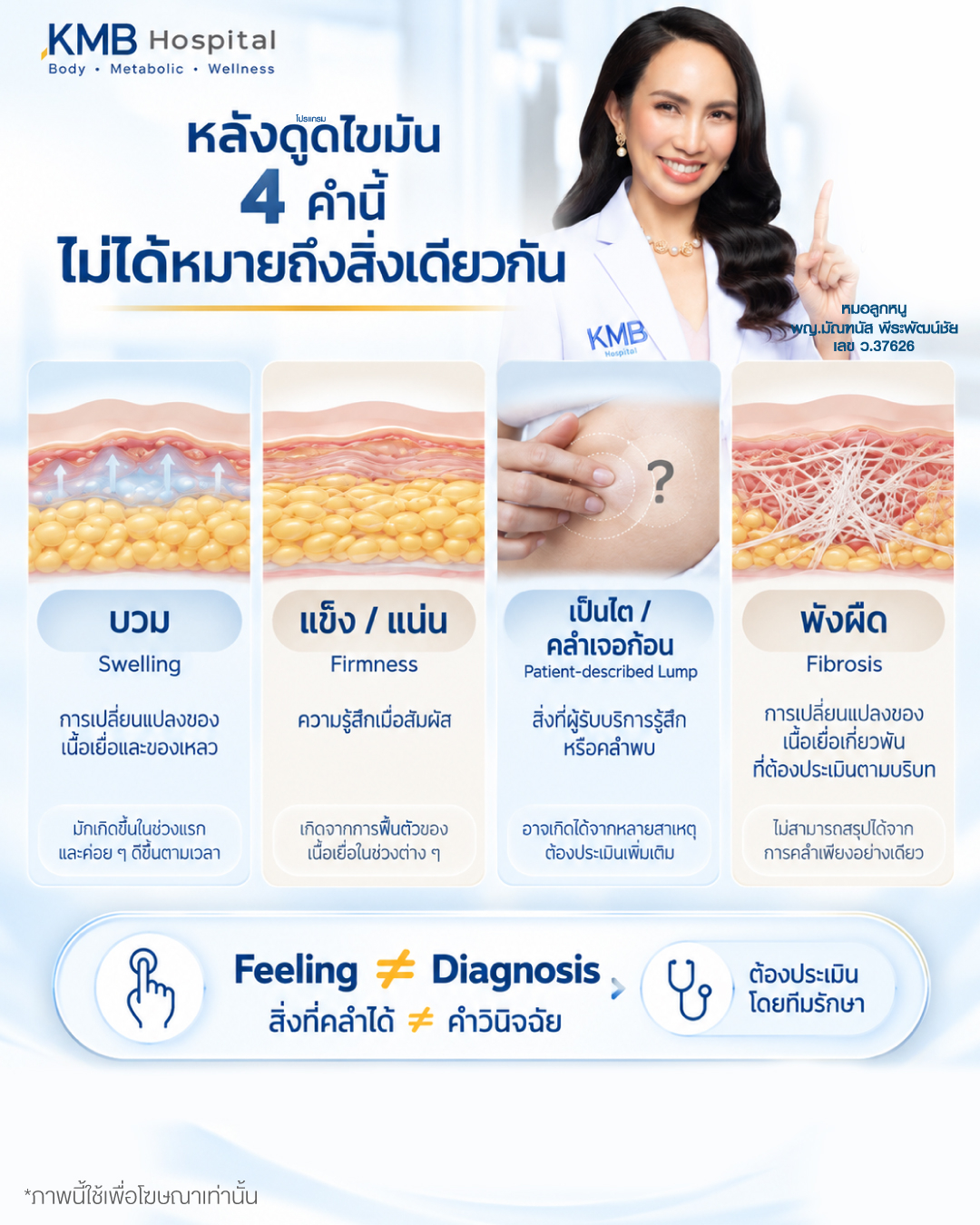
The term Fibrosis describes the formation and organization of connective tissue occurring during the repair process, but the firmness patients feel after liposuction does not mean it is always fibrosis.
Difference between swelling and firmness
In reality, these two can occur together, making it difficult for patients to distinguish them.
Swelling is related to fluid changes and tissue response during the recovery phase.
Firmness or tightness is what patients perceive when touching the tissue, which can have multiple causes and must be viewed in the context of the recovery stage.
Therefore, an area can be both swollen and firm, or swelling may begin to decrease, but the area still feels firm.
This is why post-liposuction care should track changes over time rather than using a single term to explain every symptom.
Why are some areas harder than others?
Even if a patient has liposuction in multiple areas at once, the tissue in each area does not necessarily respond in the same way.
Therefore, the fact that the abdomen feels firmer than the waist, or that one side changes faster than the other, cannot be used to decide if there is a complication or fibrosis. A doctor must assess the entire context together.
Why you shouldn't rush into aggressive massage
When encountering a hard spot, many people immediately feel: “I need to massage it until it breaks.”
However, this concept may be misleading.
Before choosing a management method, we must know what that lump is.
If the tissue is still in the recovery phase, the appropriate care may be different from other periods.
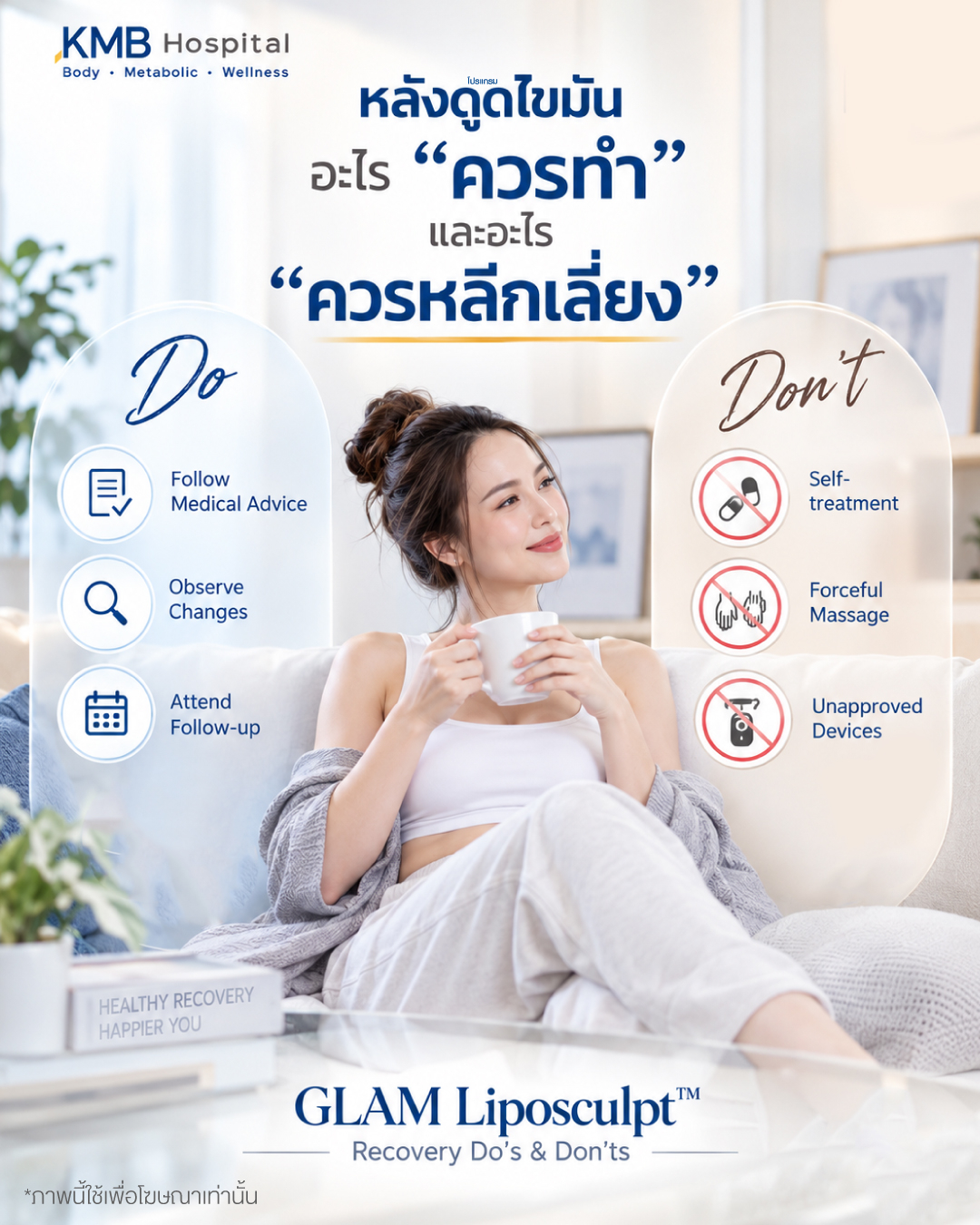
Aggressive massage, pressing, applying heat, cold, or using tools on treated areas without professional assessment may not be suitable for everyone or every recovery stage.
Care for firmness or fibrosis must account for “time”
Recovery is a process that changes over time.
What is suitable for tissue in the early stages is not necessarily what is suitable in later stages.
Doctors must consider:
Once the recovery stage is understood, a suitable care plan can be defined. This is why follow-ups after liposuction are more important than just sending the patient home and waiting for everything to resolve on its own.
The goal isn't just to “make the lump disappear as fast as possible”
Similar to the issue of swelling mentioned earlier, post-liposuction care shouldn't be a competition of who softens faster or who has no lumps at all.
Because everyone's recovery journey is different.
What matters more is tracking how the tissue is changing and whether anything else needs attention.
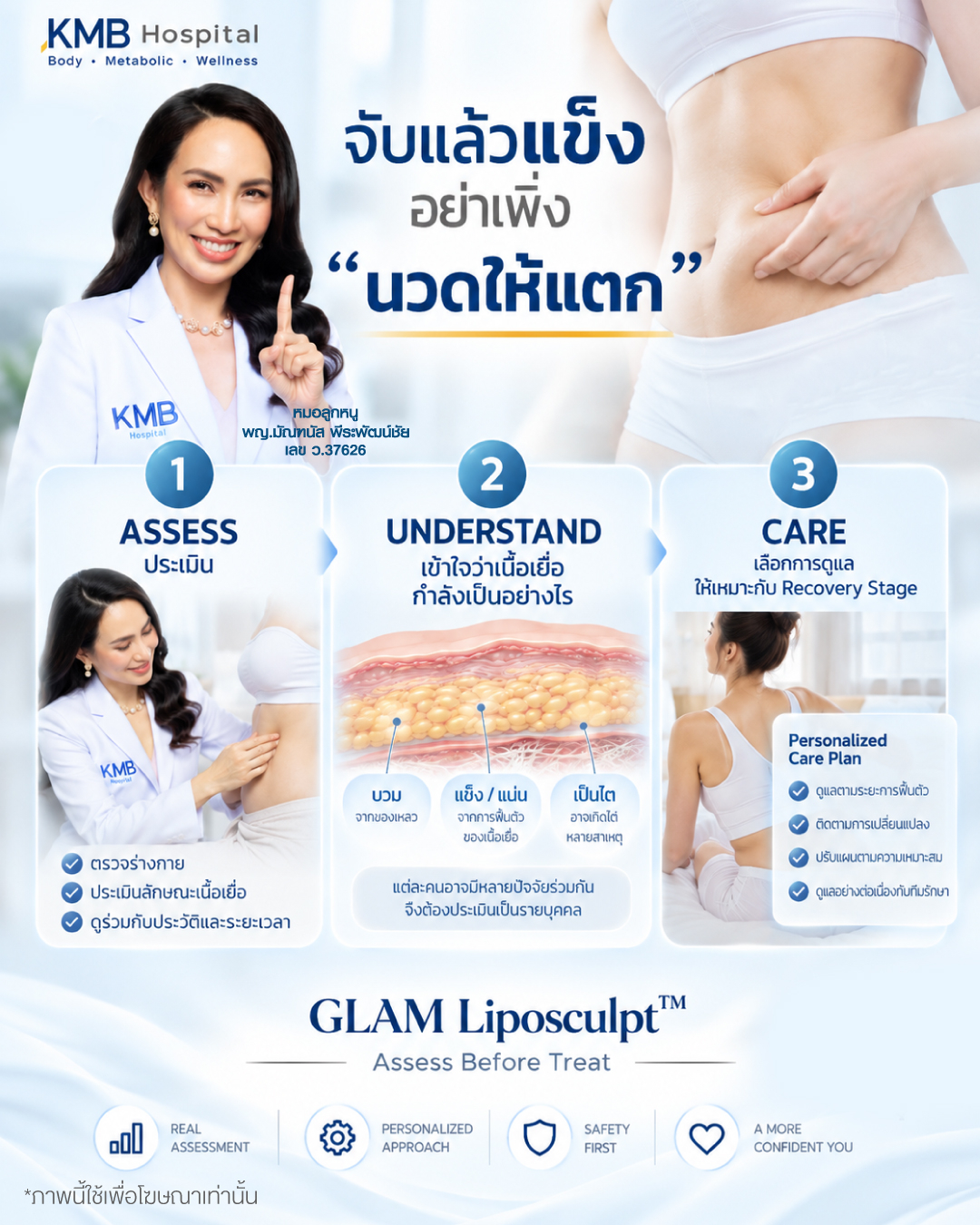
Assess Before Treat
Not Feel a Lump → Treat Immediately
Because terms like “lump” or “firmness” are just what we feel from the outside; proper care must begin by understanding what is happening underneath.
Key points you should know
- Feeling hardness, firmness, or lumps after liposuction does not mean it is always fibrosis.
- Firmness may be related to swelling, fluid changes, or the tissue repair process; it should be assessed based on its characteristics and the timing.
- The terms swelling / firm / lump / fibrosis should not be used interchangeably.
- Proper care depends on the recovery stage and the doctor's findings, not the same method for everyone.
- Do not massage, press, apply heat/cold, or use devices on the hardened area yourself just to make it go away faster.
- If the firmness or lump changes in a way contrary to the team's advice, or if there are other concerning symptoms, contact the treatment team for an assessment.
“Similar lumps” do not mean the same thing
Imagine two patients calling the treatment team and saying, “Doctor, I feel a lump.”
The sentence is the same, but the reality could be completely different.
The first person might be in the early stage after liposuction with swelling and tissue tension, while the other might be in a different recovery stage, and the characteristics of the lump could differ entirely.
Doctors must ask follow-up questions:
And when an examination is necessary, it must be evaluated based on the actual characteristics of the tissue.
Therefore, “feeling a lump” is just a symptom observed by the patient, not a medical diagnosis.
Swelling, Firmness, Fibrosis — A Simple Breakdown
These terms are often used interchangeably, leading to patient confusion.
Hard ≠ Fibrosis Every Time
Why assessment before treatment is important
If we call everything hard “fibrosis” from the beginning, we might choose the wrong care method for what the tissue actually needs at that time.
For example, tissue that is still in the swollen and early recovery phase may not be suitable for the same type of care as tissue that a doctor has determined to be firm in a different stage.
Therefore, the core concept of GLAM Liposculpt™ post-treatment care is: See what is happening before deciding what to do next.
Follow-ups play a key role because they allow the team to observe tissue changes at each stage, rather than deciding based on a single instance of symptoms.
Care may change according to Recovery Stage
Post-liposuction care does not necessarily have to be the same from day one until the end of recovery.
In each stage, the doctor may provide different advice based on findings, such as movement, care for the treated area, or additional therapies as appropriate.
If massage, tissue treatments, or certain devices are considered, they should follow the plan established by the treatment team for that specific patient.
You should not use someone else's protocol just because you have the same “hard lump” symptom, because what feels the same may actually be happening in a different recovery stage.
When not to wait and see
Certain types of firmness or unevenness may be monitored along the recovery journey as recommended by the treatment team.
However, if symptoms change rapidly, differ from recommended guidance, or if there are other symptoms like increasing pain, noticeable increase in swelling, redness, heat, fever, abnormal discharge from the wound, or unusual discomfort, you should contact the treatment team for an assessment.
Don't wait for a certain number of days you read about on the internet.
Details about post-liposuction symptoms that require urgent medical contact are in a dedicated section in Chapter 38.
Frequently Asked Questions
Is it abnormal to feel hard lumps after GLAM Liposculpt™?
It cannot be determined by firmness alone. During recovery, tissue can swell, feel tight, firm, or change in texture when touched.
The key is to track when it happened, where, how it changes, and if there are other symptoms. If unsure, have the treatment team assess it rather than self-diagnosing.
Is post-GLAM Liposculpt™ firmness always fibrosis?
No.
“Firmness” is a descriptive term for the sensation felt; hardness can be related to many aspects of tissue change.
Fibrosis is one process of connective tissue involved in healing, but you should not assume it is fibrosis every time just because it feels hard.
If I feel a lump after GLAM Liposculpt™, should I massage it until it breaks?
You should not start aggressive massage or press the area yourself just because you feel a lump.
The doctor or team should assess the nature of the lump and the recovery stage first, then choose appropriate care.
The idea that “if there is a lump, you must massage it until it breaks” is not a principle that should be applied in every case.
What is the difference between swelling and fibrosis after GLAM Liposculpt™?
Swelling relates to tissue and fluid changes during recovery, while fibrosis relates to the formation and organization of connective tissue during repair.
However, they can occur together, so do not try to distinguish them just by touching. If in doubt, have the treatment team assess.
When will firmness or fibrosis after GLAM Liposculpt™ go away?
There is no single timeline for everyone because what you call “firmness” may have different causes and everyone has a different recovery journey.
The doctor must assess what is happening and monitor changes to determine the care needed for each individual.
What types of hard lumps after GLAM Liposculpt™ require medical contact?
If the lump or firmness changes rapidly, increases significantly, or is accompanied by concerning symptoms such as increased pain, excessive swelling, redness, heat, fever, or abnormal wound discharge, contact the treatment team for assessment.
Do not self-diagnose as fibrosis or try various treatments before identifying the cause.
Summary
Feeling firmness, tightness, or lumps after liposuction is normal during the recovery journey, but these terms do not indicate the cause on their own.
The sensations may relate to swelling, fluid changes, the tissue repair process, fibrosis, or other conditions requiring examination to differentiate.
Therefore, the most important thing is not to ask, “How can I make the lump go away?”, but to ask first:
The GLAM Liposculpt™ philosophy during recovery is:
Assess → Understand → Care
Not Feel a lump → Rush to massage
Because appropriate care must be aligned with what the doctor finds and the patient's individual recovery stage.
Read more at DoctorLooknuu.com
About this article
This article explains feelings of hardness, firmness, or lumps during post-liposuction recovery, including the differences between swelling, firmness, and fibrosis, to help patients understand that external sensations alone cannot diagnose the cause.
Post-GLAM Liposculpt™ care should begin by assessing tissue characteristics and the recovery stage before choosing individualized care.
The information in this article is for educational purposes and cannot replace professional examination, diagnosis, or personalized medical advice. If your symptoms differ from those recommended or you have concerns, contact the treatment team for an assessment.
Medical References
The original manuscript did not provide additional medical references; therefore, no new references were added.
Understanding and Personalized Assessment
The information in this article is for educational purposes and cannot replace professional examination, diagnosis, or personalized medical advice. Firmness or lumps after liposuction can have various causes depending on the recovery stage and tissue characteristics. If symptoms change rapidly, differ from advice, or cause concern, contact the treatment team for assessment.
Feeling a hard lump after liposuction and not sure what it is?
Don't rush to diagnose it as fibrosis or try to massage, press, or use devices yourself. Have the treatment team assess the tissue characteristics and your recovery stage before choosing the right management path.