
When multiple problems are encountered simultaneously, how do doctors use FAT Mapping™ to prioritize the planning of the liposuction program?

KMB KNOWLEDGE BLUEPRINT™
DOMAIN E — KMB HOSPITAL | Article Code: FM-E-K02
Category FAT Mapping™ | Personalized Liposuction Program Planning | Medical Knowledge
How Doctors Use FAT Mapping™ to Prioritize Liposuction Program Planning When Multiple Issues Arise Simultaneously
Reading Date and Time
First Published: August 22, 2026
Last Updated: August 22, 2026
Reading Time: Approximately 8 minutes
Category
FAT Mapping™ | Personalized Liposuction Program Planning | Medical Knowledge
Author and Reviewer
Author: Medical Content Team, KMB Hospital
Medical Review: Dr. Mardanath Peerapattanchai (Dr. Luk Nunu), License No. 37626
Key Answer
When a client has concerns in multiple areas simultaneously, the doctor will not decide solely based on the area of greatest concern, but will use information from FAT Mapping™, physical examination, medical history taking, and the client's goals to prioritize before planning the liposuction program.
Such prioritization does not mean choosing to treat all areas at once, but rather analyzing which area to start with to ensure the treatment plan is appropriate and aligns with each individual client's data.
When Clients Are Concerned About Multiple Areas, Where Does the Doctor Begin?
Many clients are concerned about more than just one area.
Some are concerned about the abdomen, flanks, upper arms, and thighs simultaneously, leading to the question: "Where should the doctor start first?"
For doctors, the answer does not depend on the number of areas for the liposuction program, but depends on all the information obtained from the assessment.
FAT Mapping™ helps doctors see the overall distribution of fat, while physical examination and history taking help understand the client’s limitations, readiness, and goals.
Prioritization Is Not Based on the Largest Area
Many believe the area with the most fat should be planned first, but in practice, doctors may consider multiple factors together.
Consequently, two clients with similar concerns may receive different planning sequences for the liposuction program.
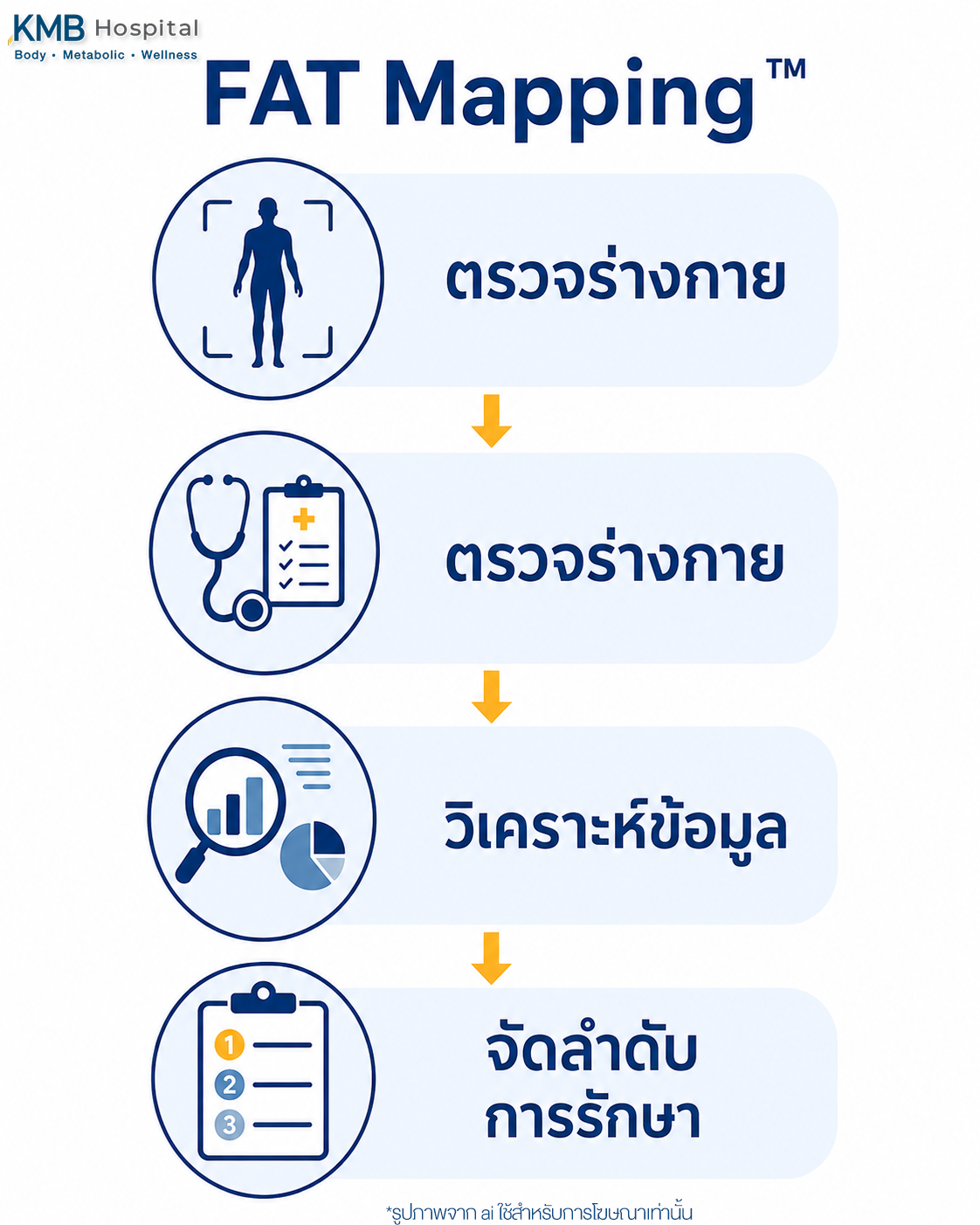
FAT Mapping™ helps physicians visualize the connections across all areas
FAT Mapping™ does not merely serve to identify fat locations, but also assists physicians in viewing the relationships among the abdomen, waist, back, upper arms, thighs, and other areas comprehensively
When all data is analyzed together, physicians can systematically prioritize the liposuction program planning and clearly explain the rationale for each step to patients
Does not replace physical examination
FAT Mapping™ is a tool assisting in data collection, but physicians still require physical examinations, medical history taking, and clinical evaluations together before prioritizing the liposuction program plan
Adjustable based on latest data
If FAT Mapping™ data, health status, or patient goals change, physicians can adjust the prioritization of the liposuction program planning to align with the latest information
Helps make the plan systematic
Prioritization helps physicians select approaches suitable for each individual, making liposuction program planning more systematic and enabling clear explanation of the rationale for each step
The goal of prioritization is appropriateness, not speed
Initiating treatment in one area before another does not imply the remaining areas are unimportant
Rather, it involves selecting the best approach from all available data to ensure the liposuction program planning is safe, aligned with goals, and suitable for each individual patient
Key Points to Know
Clients with concerns in multiple areas do not necessarily need to begin the liposuction program plan starting with the largest area.
FAT Mapping™ enables physicians to visualize the relationship of body proportions throughout the body before sequencing the liposuction program plan.
Treatment sequencing relies on data from FAT Mapping™, medical history, physical examination, and client goals combined.
Clients with similar concerns may receive different liposuction program planning sequences because their clinical data is not identical.
The goal of sequencing is appropriateness, safety, and balance of treatment outcomes.
Frequently Asked Questions
1. When multiple issues arise simultaneously, how do physicians use FAT Mapping™ to sequence the liposuction program plan?
Physicians will analyze FAT Mapping™ data along with history taking, physical examination, health status, and client goals to determine the liposuction program plan sequence appropriate for each individual.
2. Why don't physicians always start with the area containing the most fat first?
Because liposuction program planning does not consider only fat volume; physicians must also evaluate proportion relationships, body shape continuity, safety, and client goals collectively.
3. What role does FAT Mapping™ play in treatment sequencing?
FAT Mapping™ allows physicians to see data for each area and the connectivity of the entire body shape, enabling liposuction program sequencing based on data rather than visual observation alone.
4. Will two clients with the same problems receive the same liposuction program plan?
Not necessarily. Although some FAT Mapping™ results may be similar, data from physical exams, health, expectations, and limitations for each person may differ, which can lead to different treatment plans.
5. Does treatment sequencing mean undergoing the liposuction program in all areas?
No. Sequencing means selecting the most appropriate approach from all data, without necessarily treating all areas at the same time.

Article Summary
When clients have concerns in multiple areas simultaneously, liposuction program planning does not always start with the largest area.
Doctors will analyze FAT Mapping™ data alongside medical history, physical examinations, safety assessments, and client goals to establish treatment priorities suited to each individual.
Proper prioritization does not focus on speed, but helps ensure the liposuction program plan is logical, systematic, and aligned with client data.

Related Articles
Read more at KMB Hospital
About This Article
This article is prepared to explain the principles of sequencing the liposuction program planning when the client has concerns in multiple areas simultaneously. It explains the role of FAT Mapping™ in supporting decision-making together with history taking, physical examination, and other clinical data.
Article Author Information
Written by: Medical Content Team, KMB Hospital
Medically reviewed by:
Dr. Mandonus Pirapattanachai
Dr. Looknoo
Medical License No. W.37626
Article Review Information
First Published: 22 August 2026
Last Updated: 22 August 2026
Medical Disclaimer
Information in this article is intended for public education and cannot replace examination, diagnosis, or individual advice from a physician. The suitability of the liposuction program and treatment sequence requires an individual assessment.
Sources and Review
Content references medical data specified in the original document and has been reviewed by licensed physicians. The original document does not list external reference materials, so no new sources outside the original are added.
Start Planning From Your Information
If you have concerns in multiple areas, you can schedule an appointment for an individual assessment. The physician will consider data, health, goals, limitations, and safety before planning the liposuction program.