Who is the GLAM Liposculpt™ calf liposuction program suitable for? | KMB Hospital

Who is the GLAM Liposculpt™ Calf Liposuction Program Suitable For?
Author: Medical Content Team, KMB Hospital
The GLAM Liposculpt™ calf liposuction program is suitable for those who have been evaluated and found to have subcutaneous fat as a significant component of their calf size or thickness, and whose skin condition, health, and leg structure are appropriate for the liposuction program.
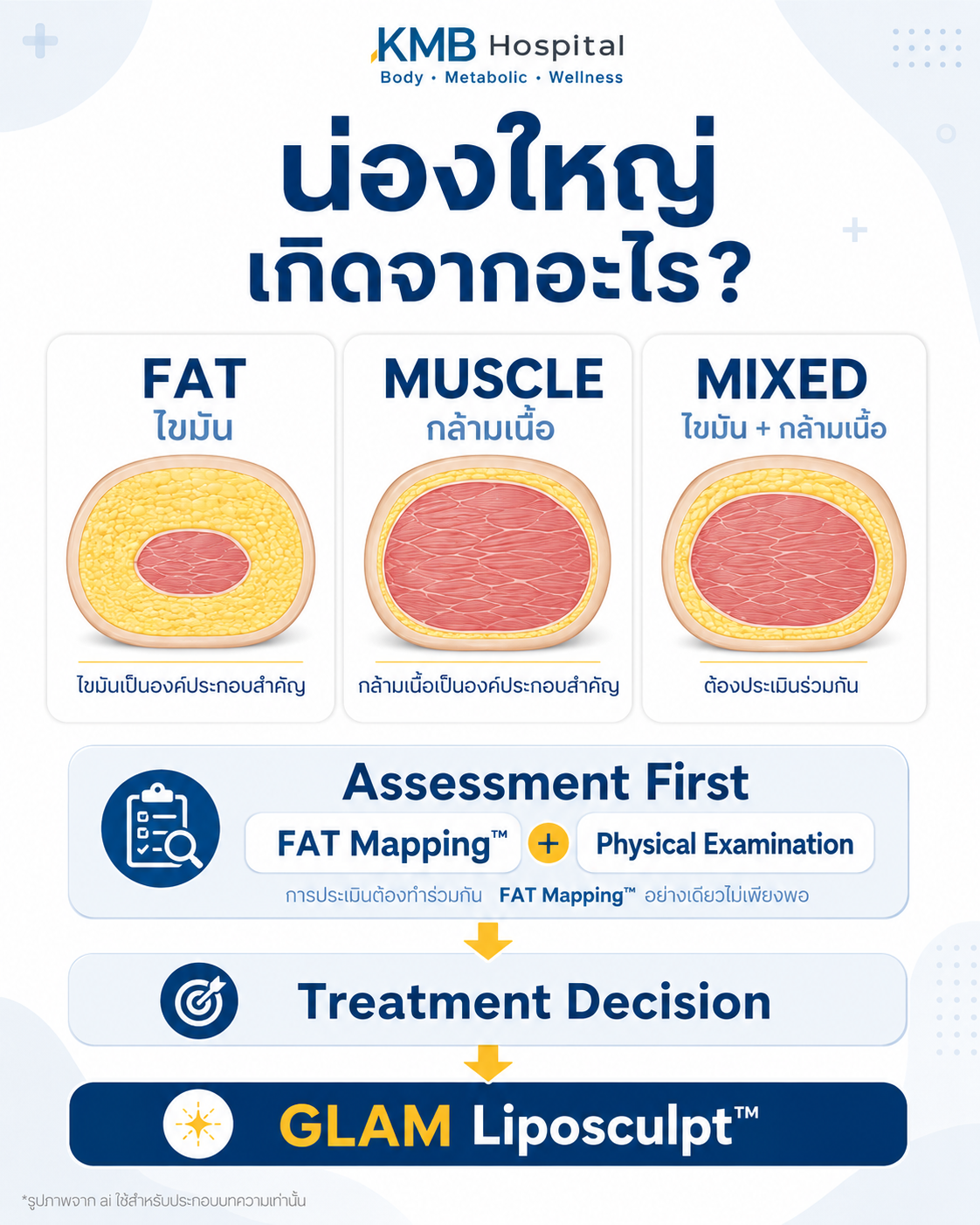
However, "big calves" do not always mean that liposuction is the answer. Calf shape is also related to muscle, leg structure, and other factors. If calf size is primarily due to muscle, liposuction cannot reduce the muscle size; therefore, the cause must be clearly evaluated before planning treatment.
“Big calves” do not always mean “a lot of fat”
This is a very important point regarding the calf liposuction program.
Because when viewed from the outside, the calves of two people might look similar in size, but what makes them look big might be completely different.
Therefore, if you see big calves and immediately conclude, "Liposuction should make them smaller," it might not be the answer for everyone.
Plastic surgery information also states that liposuction can be used on fat deposits in the calf and ankle area for suitable candidates. However, there are more limitations to achieving slimmer legs through liposuction in the lower leg area, and a number of big calves are related to the size of the calf muscles, which liposuction does not reduce.
This is why GLAM Liposculpt™ must start with “assessing what the size is caused by.”
FAT Mapping™ helps answer essential questions before calf liposuction
Before planning calf liposuction, the doctor will use information from FAT Mapping™ in conjunction with a physical examination to understand the areas of fat accumulation and their relationship to the shape of the legs.
But for the calves, we must look at more than just fat.
The doctor must consider:
Because liposuction is for targeted fat reduction and body contouring, not for reducing muscle or a substitute for weight loss.
Who might be suitable for the GLAM Liposculpt™ calf liposuction program
Primarily, those who may be suitable for the calf liposuction program are those whom the doctor has evaluated as having significant subcutaneous fat accumulation in the calf area, and that fat has an impact on the shape or continuity of the leg line.
In addition, overall health, skin quality, and expectations must also be considered because liposuction is for localized body contouring, not for treating obesity, and results depend on the individual's body characteristics.
Therefore, the word “suitable” in GLAM does not just mean “having fat.”
Who might not be a candidate for the calf liposuction program
This is just as important as asking who is suitable.
If the doctor assesses and finds that the calf size is primarily due to muscle, then liposuction might not be the answer because liposuction removes fat but does not reduce muscle size.
The same applies to those with significant excess skin or health factors that need further evaluation; you should not make a decision based on appearance alone.
And the fact that a doctor can say, “this area is not suitable for liposuction,” is also part of designing a good treatment plan.
The calf does not stand alone, but is part of the Leg Line
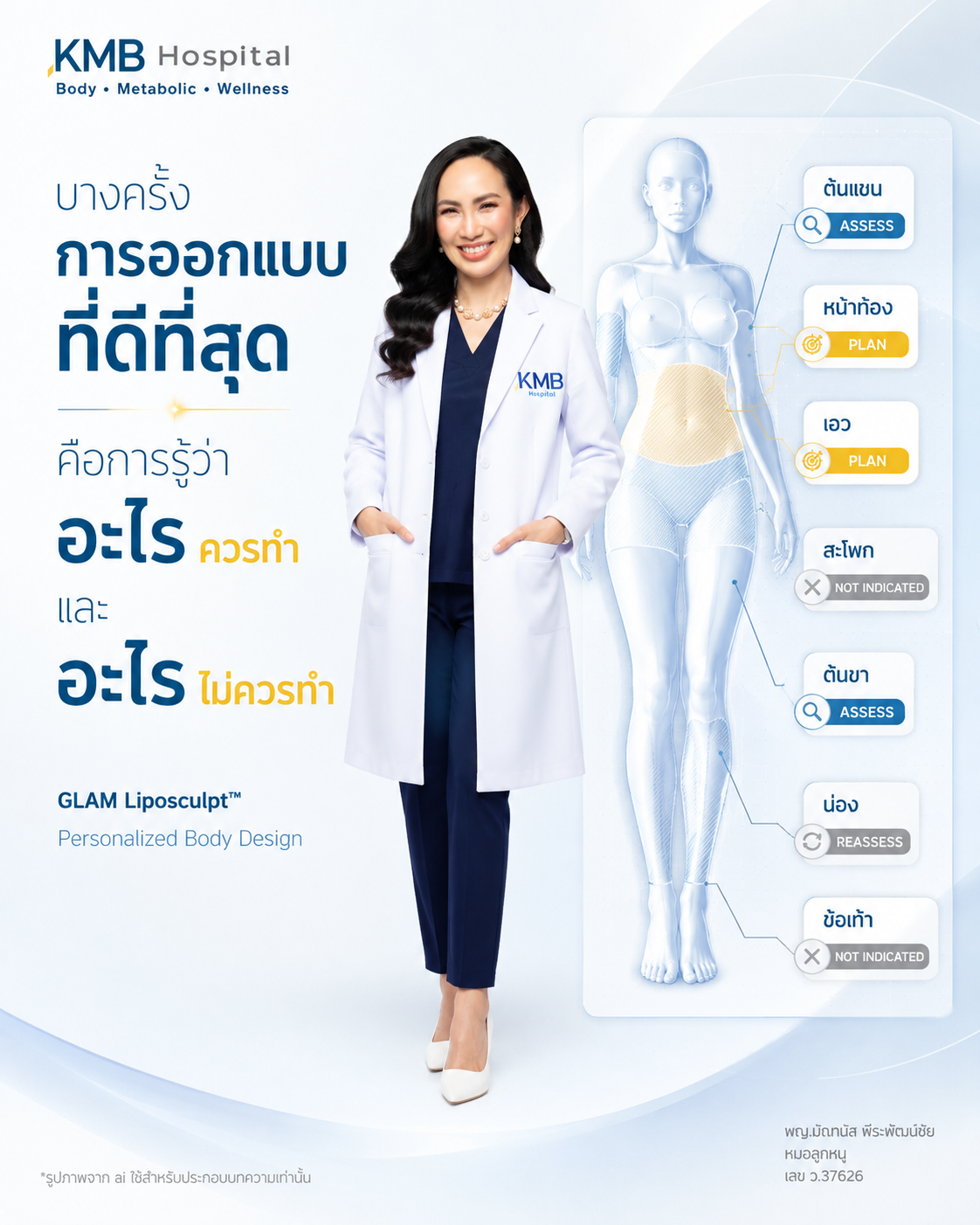
Even if a client comes in with the question, “Doctor, I want to reduce my calves,” GLAM Liposculpt™ does not just look at the calves.
The doctor looks at everything from:
Thigh → Knee → Calf → Ankle
Because every area is connected as a single leg line.
If we reduce only the calf without considering the areas above and below it, the resulting shape might not be in harmony with the original proportions.
Therefore, the goal is not “how to make the calf as small as possible,” but rather:
“If this client is a candidate for liposuction, how should we design the calf to make the entire leg line look as balanced as possible?”
GLAM doesn't start with “Can we do it?” but rather “Should we do it?”
This is a very important difference.
In general, the calf is one of the areas where liposuction can be considered, but it doesn't mean that everyone who feels their calves are big is a candidate for the same treatment.
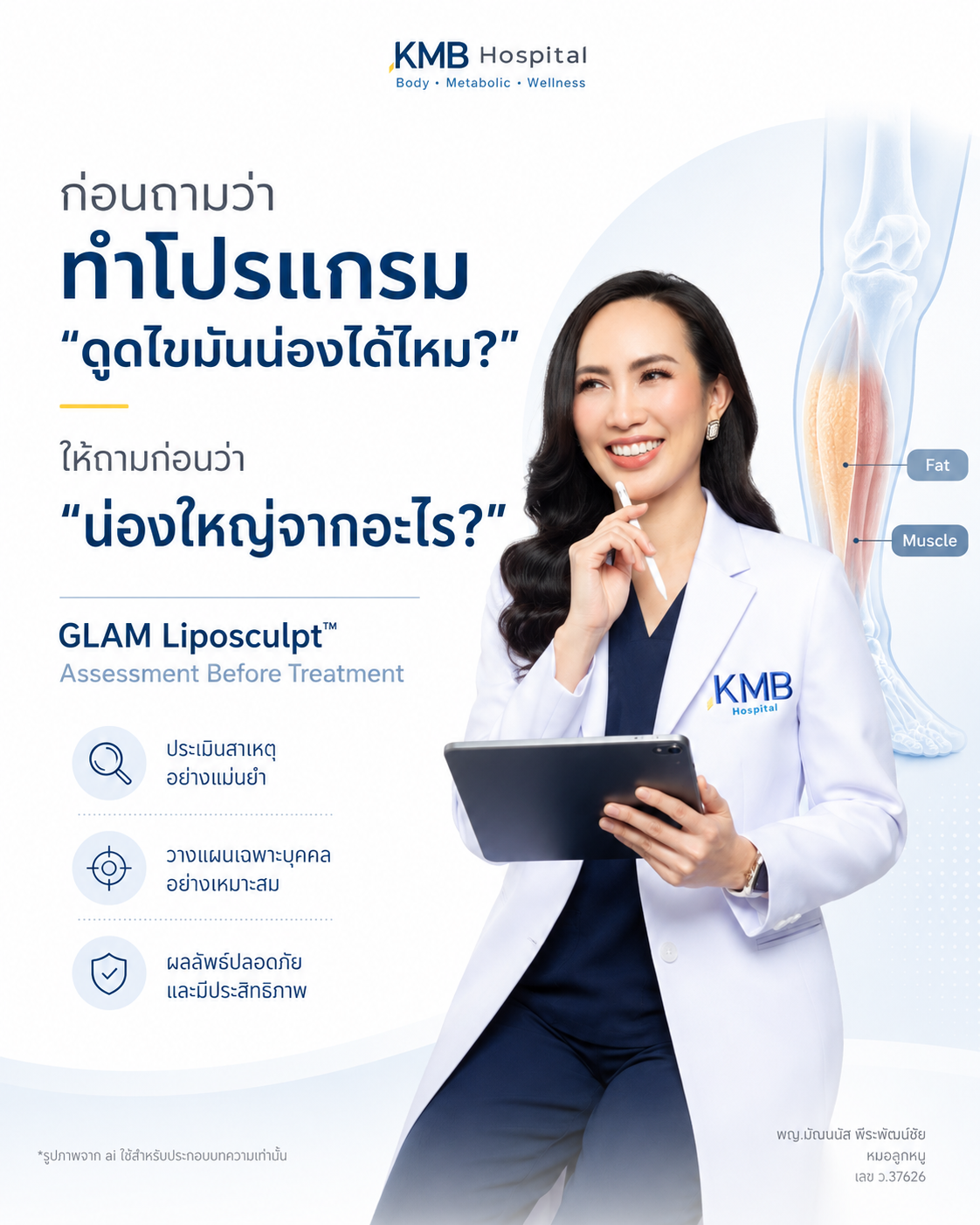
For GLAM Liposculpt™, the first question is not, “Can you do calf liposuction?” but, “Why are this person’s calves big, and is liposuction really the right answer for them?”
When we can answer this first, the subsequent planning becomes meaningful.
Summary
The GLAM Liposculpt™ calf liposuction program is not for everyone with big calves.
The key is to first determine the proportions of fat, muscle, skin, and leg structure that make up the calf’s shape, using FAT Mapping™ combined with physical exams and doctor assessment.
If fat is a significant component and the client is a suitable candidate, then calf liposuction can be considered as part of the leg line design.
But if the primary cause is not fat, then choosing not to undergo liposuction might also be the appropriate answer.
This is the GLAM concept.
We do not start by finding a way to perform liposuction on everyone, but by finding the answer that is most suitable for that person’s body.
Key points to know
Having similar big calves doesn't mean the treatment will be the same.
Think of two people standing next to each other with similar calf circumference.
At a glance, we might feel, "Their calves are about the same size, so they should be able to get the same liposuction."
But when actually assessed, one person may have significant subcutaneous fat, while the other may have very prominent calf muscles.
Therefore, what we see on the outside is not enough to make a decision.
This is why GLAM Liposculpt™ places importance on the word "Analysis."
Because before thinking about how to treat, we must first understand what gives the calf its shape.
If calf liposuction is possible, it does not mean every spot should be treated.
Another important point is that finding fat in the calf area does not mean the doctor must remove fat from every position.
In GLAM Liposculpt™, the doctor will consider the continuity of the shape from the knee to the calf to the ankle.
Some positions may need more adjustment than others.
Some positions may need to preserve the softness of the original curves.
Because the goal is not to make the calf "flat."
But to make the leg line look balanced with that owner's body.
Frequently Asked Questions
1. What kind of "big calf" might be suitable for the GLAM Liposculpt™ program?
Candidates who might be suitable for calf liposuction are those whom the doctor has evaluated as having subcutaneous fat as a significant component that makes the calf look thick or affects the leg line, and who have the appropriate health and tissue condition for the treatment.
However, looking with the naked eye alone cannot tell everything about who is suitable for calf liposuction, so FAT Mapping™ must be used along with a physical exam and health information before personalized planning.
2. How are fat-induced big calves and muscle-induced big calves different in terms of liposuction?
The key difference is that liposuction manages fat and does not reduce the size of the muscle.
Therefore, if the doctor evaluates and finds that the calf shape is caused mainly by prominent muscle, liposuction might not be the answer for that problem.
Conversely, if there is significant subcutaneous fat, the doctor will further consider whether calf liposuction is appropriate for the client’s structure and goals.
3. How does FAT Mapping™ help in assessment before the GLAM Liposculpt™ program?
FAT Mapping™ helps the doctor have information regarding fat distribution in the area to be assessed, but this information is not used in isolation.
The doctor will take it into consideration along with the physical exam, muscle characteristics, skin quality, and the relationship between the knee, calf, and ankle to see an overview of the leg line before making a decision about liposuction.
4. If the calf is big from both fat and muscle, can calf liposuction still be done?
It might be considered in some cases if the doctor assesses that the fat is a component that can be adjusted and that liposuction has a chance to appropriately meet the client’s goals.
But the client should understand before treatment that liposuction will only change the fat portion that is suitable for treatment and will not make the part caused by muscle disappear. Therefore, results depend on each individual's calf composition.
5. How much can the calf be reduced by the GLAM Liposculpt™ program?
There is no single number that applies to everyone because results depend on the volume and location of the fat, muscle structure, skin quality, and each person’s leg proportions.
GLAM Liposculpt™ does not aim to reach a target of "how many centimeters smaller," but instead starts by assessing which areas can be adjusted appropriately and which proportions should be maintained to ensure the leg line looks natural.
Why must the knees and ankles be assessed before the GLAM Liposculpt™ calf liposuction program?
Because the calf does not exist separately from other parts of the leg.
The top of the calf connects to the knee, while the bottom is continuous with the ankle; therefore, changing the shape of the calf will naturally affect the overall Leg Line.
GLAM Liposculpt™ therefore looks at the entire Thigh → Knee → Calf → Ankle line before designing the liposuction program so that the treated area remains in harmony with the surrounding areas.
Sometimes the most appropriate answer is “not to do liposuction.”
This is another thing I want readers to remember from this chapter.
A good assessment does not have the duty of finding a way to make every client undergo liposuction.
But it has the duty of finding the answer of what is suitable for that person’s body.
If after assessing, it is found that fat is not a main component of the problem or that liposuction is unlikely to meet what the client wants, choosing not to undergo liposuction is also a meaningful medical decision.
For GLAM Liposculpt™, the term Personalized Treatment does not just mean “each person gets a different liposuction procedure.”
But also includes “each person may not necessarily need to undergo the same liposuction either.”
Summary
The GLAM Liposculpt™ calf liposuction program is suitable for those who have been evaluated and found that subcutaneous fat is a significant component of their calf shape, and who have the appropriate physical and health factors for the treatment.
FAT Mapping™, physical exams, muscle and skin assessment, as well as the relationship between the knee, calf, and ankle, will be analyzed together before planning the liposuction program.
Because not everyone has big calves due to fat, and liposuction does not reduce muscle.
For GLAM, the important question is not only, “Can we do calf liposuction?” but, “Why are this person’s calves big, and is liposuction really suitable for them?”
When the answer is that it is suitable, we then design which areas to care for and how, so that the entire leg line looks balanced and natural.
The connection between FAT Mapping™ and GLAM Liposculpt™
The calf topic is a clear example of the relationship between FAT Mapping™ and GLAM Liposculpt™.
FAT Mapping™ helps answer, “What are we seeing?”
While GLAM Liposculpt™ takes that information and continues to answer, “Then how should we care for it?”
And for some, the answer may be, “You should not do liposuction yet.”
Assessment and treatment are therefore the same process, not two separate steps.
About this article
This article explains the principles of assessing suitability before the GLAM Liposculpt™ calf liposuction program by connecting FAT Mapping™, physical exams, fat, muscle, and skin assessment, as well as leg lines to help doctors plan personalized treatment.
Information in this article is for public educational purposes and cannot replace medical examination, diagnosis, or personalized advice from a doctor.
Medical References
Article Preparation Information
Written by
Medical Content Team, KMB Hospital
Medically reviewed by
Dr. Mantanas Peerapatchai
Dr. Looknuu
Medical License No. 37626
Assess “what causes big calves” first
The suitability of calf liposuction should be considered based on fat, muscle, skin quality, health, and the relationship between the knee, calf, and ankle so that the doctor can plan according to the data and limitations of each individual client.
Medical Disclaimer
Information in this article is for public educational purposes and cannot replace medical examination, diagnosis, or personalized advice from a doctor. Suitability, limitations, safety, and treatment guidelines should be considered based on the evaluation of each client, and expectations should be set in line with the calf composition and information obtained from the individual assessment.