
Why is GLAM Liposculpt™ liposuction planning different for each individual?
DOMAIN E · PERSONALIZED LIPOSUCTION PLANNING
Why GLAM Liposculpt™ Liposuction Planning Differs for Every Individual
First Published September 24, 2026 | Last Updated September 25, 2026
Category: Personalized Liposuction Planning with GLAM Liposculpt™ | Approx. 8-minute read
Medically Reviewed by Dr. Mantanas Peerapatchai (Dr. Looknuu) Lic. No. 37626
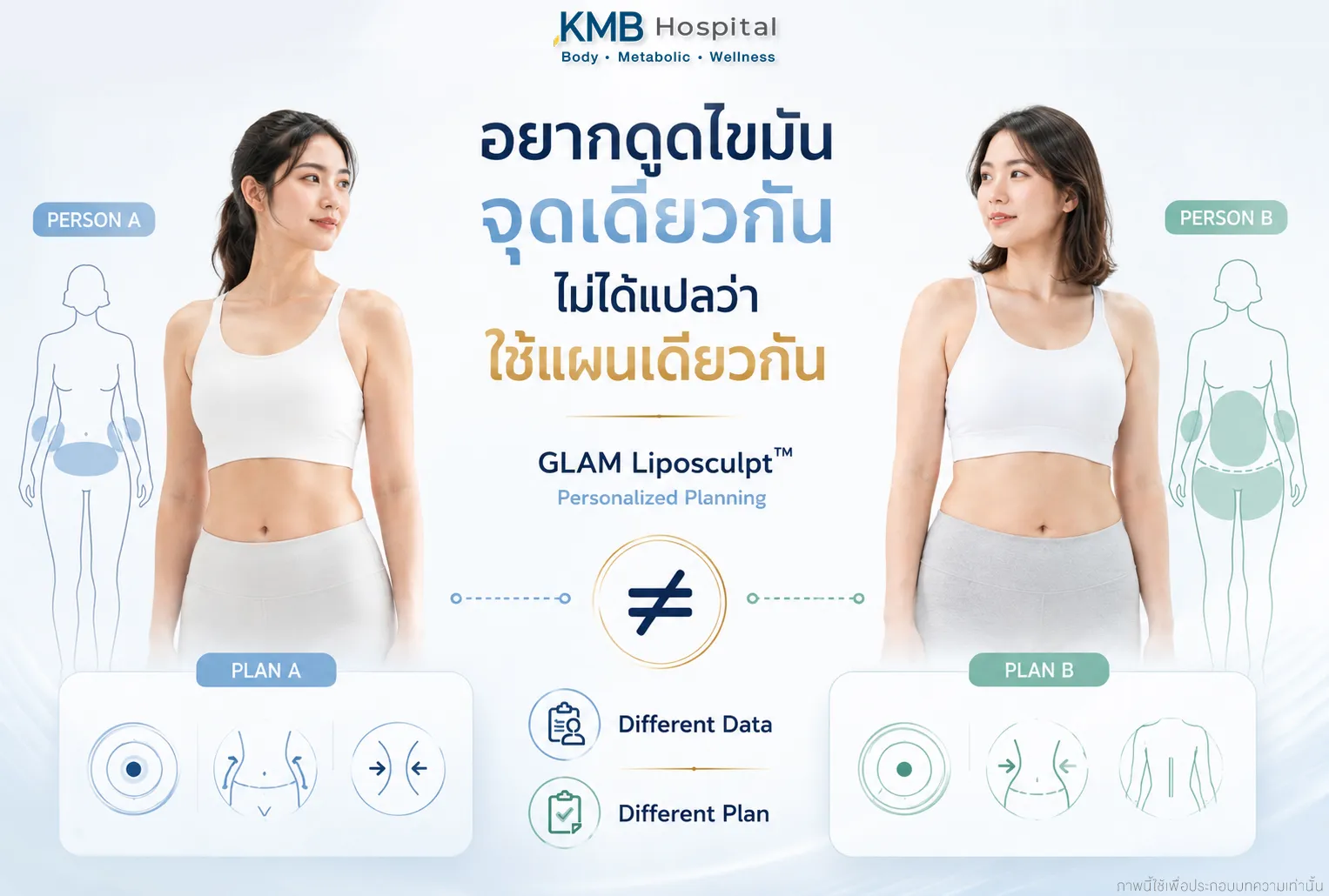
GLAM Liposculpt™ liposuction planning differs for everyone because even if concerns are in the same area, the distribution of fat across layers, skin quality, body proportions, health, and client goals may vary. Doctors must analyze data from FAT Mapping™ and physical examinations before creating a personalized plan.
Therefore, just because two people want abdominal liposuction does not mean they should receive the same program regarding location, volume, or scope. What doctors are designing is not just the “treated area,” but the overall balance of that person’s physique.
Table of Contents
Same Name Problems Are Not Always the Same
Terms like “big belly,” “big upper arms,” or “double chin” are simple words we use to describe what we see from the outside.
However, for doctors, these terms are not the complete answer.
Two clients might say they want abdominal liposuction, but one might have prominent fat in the lower abdomen, while another has fat extending around the waist and flanks.
Alternatively, two clients might feel their arms are big, but the fat distribution, skin quality, and proportion of the shoulders to the torso may be completely different.
The names of the problems may be the same, but the structures beneath do not have to be.
And this is the first reason why each person's liposuction plan differs.
1. Different Fat Locations
Fat is not distributed the same way in everyone.
Even if body weight or external shape appears similar, some may have fat clearly concentrated in one spot, while others have fat spread continuously into adjacent areas.
FAT Mapping™ helps doctors gather information about where fat is located and how it relates to other parts of the body.
When the “map of the fat” is different, the liposuction plan naturally should not be made the same.

2. Differences in Fat Layers
Another very important aspect of GLAM Liposculpt™ is the term Layer.
Fat is not just one layer.
In the assessment, doctors must understand the superficial, intermediate, and deep fat layers in the relevant areas to plan how to manage each layer appropriately.
Superficial Layer
Intermediate Layer
Deep Layer
This is one of the core meanings of the L — Layer in GLAM.
Because the goal is not to address only one layer for everyone, but to understand the differences in each fat layer and use that information to design the liposuction plan in detail.
3. Different Skin Quality
Two people with similar amounts of fat can have vastly different skin quality.
Some have good skin elasticity
Some have more laxity
Some may have skin changes from age, weight fluctuations, or pregnancy
Therefore, doctors cannot look only at what is under the skin and ignore what is on top.
Skin quality is another piece of information that must be combined with FAT Mapping™ before planning GLAM Liposculpt™.
4. Different Body Proportions
This is something that clients sometimes overlook.
Assume there are two people with similar waist flanks. One might already have quite distinct hips, while the other might have a relatively straight torso structure.
If we look only at the waist flanks and use the same liposuction plan, the results on their body shapes could be very different.
GLAM Liposculpt™ focuses on Proportion rather than Area.
Because what makes a body shape look balanced is not the size of any one area, but the relationship between those areas.
5. Individual Health and Readiness
Personalized Planning is not only about aesthetics.
Health information, medical history, related test results, scope of treatment, and the client's readiness all play a part in determining the plan.
Some people may be suitable for one plan, while others, even if they desire similar results, may be better suited for another approach.
Therefore, the word “Personalized” in GLAM implies both Body Design and Medical Appropriateness at the same time.
6. Individual Goals Vary
Ultimately, even if physical data is similar, two people may desire different results.
Some want their shape to look smaller
Some want to see a clearer hourglass waist
Some do not want to change their shape much, but want proportions to look more balanced
These goals are data that doctors must listen to before considering them alongside what FAT Mapping™ and physical exams tell us.
Because a good liposuction plan should not result from the doctor's data alone.
Body data must meet the client's goals.
Different Bodies Require No “Standard Formula”
This is what GLAM Liposculpt™ wants to convey in this chapter.
Personalized does not mean changing package names for each person.
But it means recognizing from the start that each person has different data.
When data is different, the analysis is different.
And when the analysis is different, the liposuction plan should not be forced to be the same.
This is why FAT Mapping™ and GLAM Liposculpt™ must work in tandem.
FAT Mapping™ helps reveal the differences.
While GLAM Liposculpt™ takes that difference to design a personalized plan.
Two People Wanting the Same Thing May Not Need the Same Approach
Imagine two clients coming to the doctor and saying exactly the same thing:
“I want abdominal liposuction and I want an hourglass waist.”
If we look at their request alone, we might think the treatment plan should be the same.
But when assessed with FAT Mapping™ and an actual physical examination, the picture may change completely.
The first person might have prominent fat in the abdominal and waist flank areas, while their hip proportions are already quite clear.
The other person, however, might have fat continuing from the abdomen and waist flanks all the way to the back, with a relatively straight torso structure.
Even if both people say they “want an hourglass waist,” creating balance for their two bodies does not require the same logic.
GLAM Liposculpt™ therefore does not start from “what do you want” alone, but must follow up with, “how is this person’s body, and how does what they want suit their structure?”
Personalized Planning Does Not Mean Doing Everything You Find
When FAT Mapping™ and assessments show us more information, it does not mean we must treat everything we see.
Some areas may have fat but do not significantly affect the proportions the client is concerned about.
Some areas might be considered together because they affect the continuity of the body shape.
And some matters might not be problems that liposuction alone can solve.
More information is not meant to “do more,” but to help the doctor decide what should be done, what is unnecessary, and what should be approached with caution.
This, in fact, is the meaning of Personalized Planning in GLAM Liposculpt™.
Difference Does Not Mean One Plan is Better Than Another
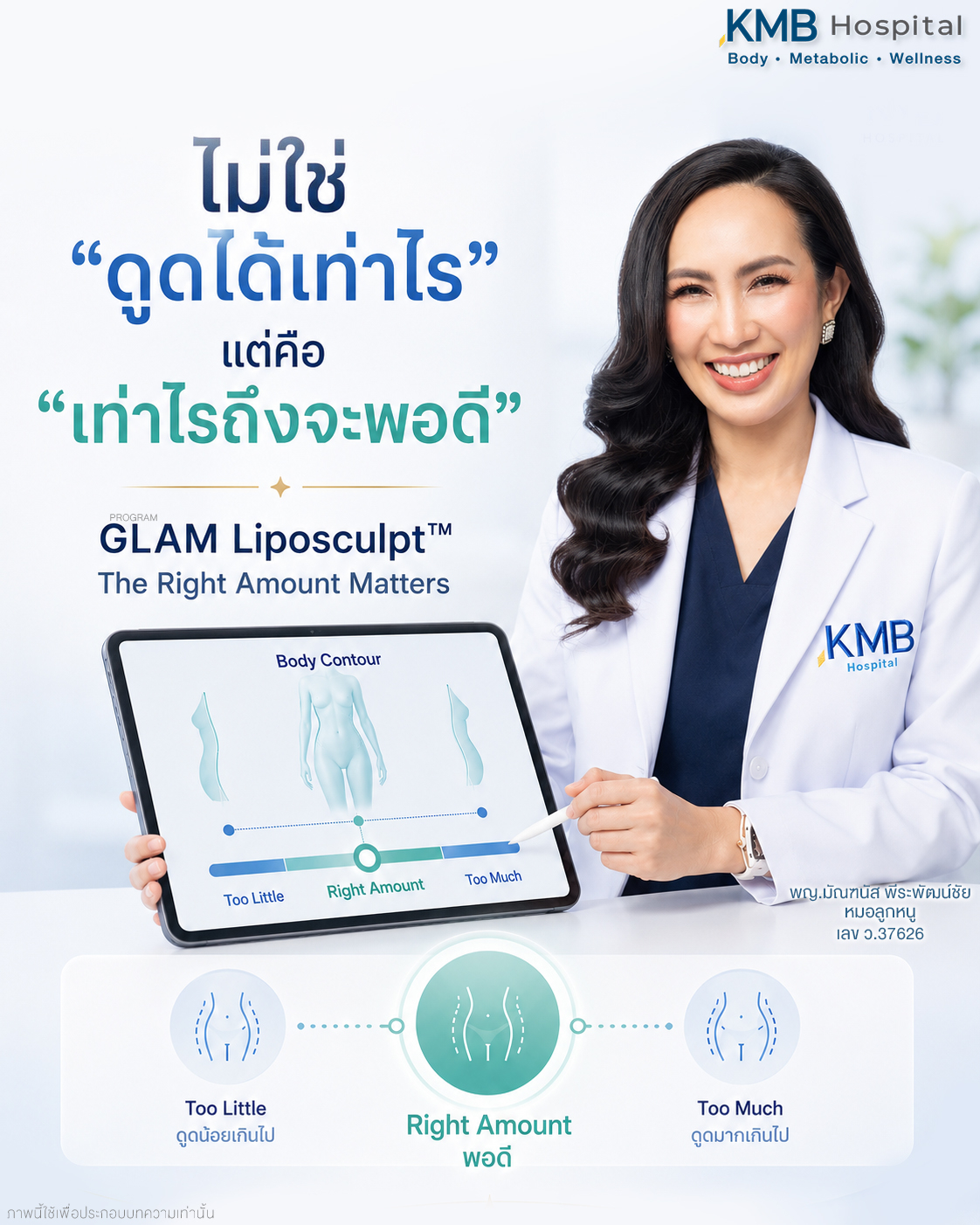
Different liposuction plans do not mean one person received “more” or “better” treatment than another.
One plan might cover multiple areas, while another might focus on only one area.
But if both plans are designed based on each individual’s information, both can be the most appropriate plans.
The term “Personalized” is not measured by the number of areas, the number of tools, or the quantity of things put into the plan, but by the question: “Is this plan right for this person?”
Key Points to Know
How can clients participate in GLAM Liposculpt™ liposuction planning?
Participation begins right at the start. What the client is concerned about, the shape they want to see, and expectations for the results are important data for the planning process.
Doctors will consider these goals alongside FAT Mapping™, physical exams, health, and individual structural limitations to find the right point between what is desired and what the body can appropriately be designed for.

Frequently Asked Questions
Why do two people wanting liposuction in the same area have different GLAM Liposculpt™ plans?
Because the name of the area requiring liposuction is only the beginning of the assessment. Two people wanting abdominal liposuction may have different fat distribution by layer, different skin quality, different waist and torso proportions, as well as different goals. GLAM Liposculpt™ uses data from FAT Mapping™ and physical exams to analyze before creating a personalized plan, rather than using the same formula for everyone.
How does FAT Mapping™ make GLAM Liposculpt™ liposuction plans different?
FAT Mapping™ helps doctors gather information about fat distribution and the relationship of the area being assessed to other parts of the body. Since each client's data is different, what the doctor analyzes differs accordingly. Therefore, FAT Mapping™ does not create the liposuction plan for the doctor, but provides more information for the doctor to design GLAM Liposculpt™ to suit each individual.
Do superficial, intermediate, and deep fat layers affect GLAM Liposculpt™ planning?
Yes. Because one of the core principles of GLAM is L — Layer. Doctors must understand the superficial, intermediate, and deep fat in the relevant areas and consider how each layer relates to body shape. GLAM Liposculpt™ does not view all fat as a single mass, but uses data from each layer to incorporate into a detailed design.
If weights are similar, should the GLAM Liposculpt™ liposuction plan be the same?
Not necessarily. Weight is only one piece of data and cannot tell the whole story of where fat is distributed, what skin quality is like, or what the body proportions are. Clients with similar weights may have different results from FAT Mapping™ and physical exams, and may receive different liposuction plans.
If I want to do liposuction in multiple areas, will GLAM Liposculpt™ do everything at once?
Not necessarily. The number of areas a client is concerned about does not dictate that all liposuction must be performed at once. Doctors will consider the treatment scope, health, readiness, the relationship between areas, and assessment data before determining what is appropriate for that individual. In some cases, splitting the care plan may be another option the doctor considers based on appropriateness.
Summary
The reason why GLAM Liposculpt™ liposuction planning differs for each individual is quite simple.
Because our bodies are not the same.
Different fat locations
Different superficial, intermediate, and deep fat layers
Different skin quality
Different proportions
Different health and readiness
Individual goals also vary
FAT Mapping™ therefore acts as a tool to help us see and understand these differences before doctors put all the information into the analysis and planning process of GLAM Liposculpt™.
Because ultimately, Personalized Body Design does not mean getting everyone to the same body shape.
But it means finding “what body shape is right for this person,” and then designing a liposuction program from that answer.
Start with Body Data, Before Designing a Personalized Plan
FAT Mapping™, physical exams, health, proportions, and client goals are information that doctors consider together before determining the appropriate direction for each individual.
Related Articles
KMB Hospital Articles
More from DoctorLooknuu.com
About This Article
This article explains why GLAM Liposculpt™ liposuction planning differs for each individual by connecting data from FAT Mapping™, fat layers, skin quality, proportions, health, and client goals, ensuring an understanding that liposuction planning should not use a one-size-fits-all formula.
Article Preparation Information
Written by
Medical Content Team, KMB Hospital
Medically Reviewed by
Dr. Mantanas Peerapatchai
Dr. Looknuu
Medical License No. 37626
Important Note Regarding Article Content
The information in this article is for educational purposes for the general public and cannot be used as a substitute for examinations, diagnoses, or specific personal advice from a doctor. The appropriateness of a treatment plan, its scope, results, and limitations may vary by individual and should be assessed before deciding.
Article Review Information
First Published September 24, 2026 | Last Updated September 25, 2026