
Fat in certain areas hard to reduce? Assess before the liposuction program.
KMB KNOWLEDGE BLUEPRINT™ · DOMAIN B · FM-B-K22
Why Is Fat Hard to Lose in Certain Areas, and Why Should Evaluation Be Done Before the Liposuction Program?
First Published: August 2, 2026
Last Updated: August 8, 2026
Reading Time: Approximately 8 minutes
Category: FAT Mapping™ · Stubborn Fat · Pre-Liposuction Program Evaluation
Author: Team Medical Content, KMB Hospital
Medically Reviewed By: Dr. Mandaan Peerapatthanachai (Dr. Looknuu), License No. W37626
Many can lose weight but still retain fat accumulation in areas such as the lower abdomen, love handles, arms, thighs, or double chin. This is because different fat regions respond differently to energy changes.
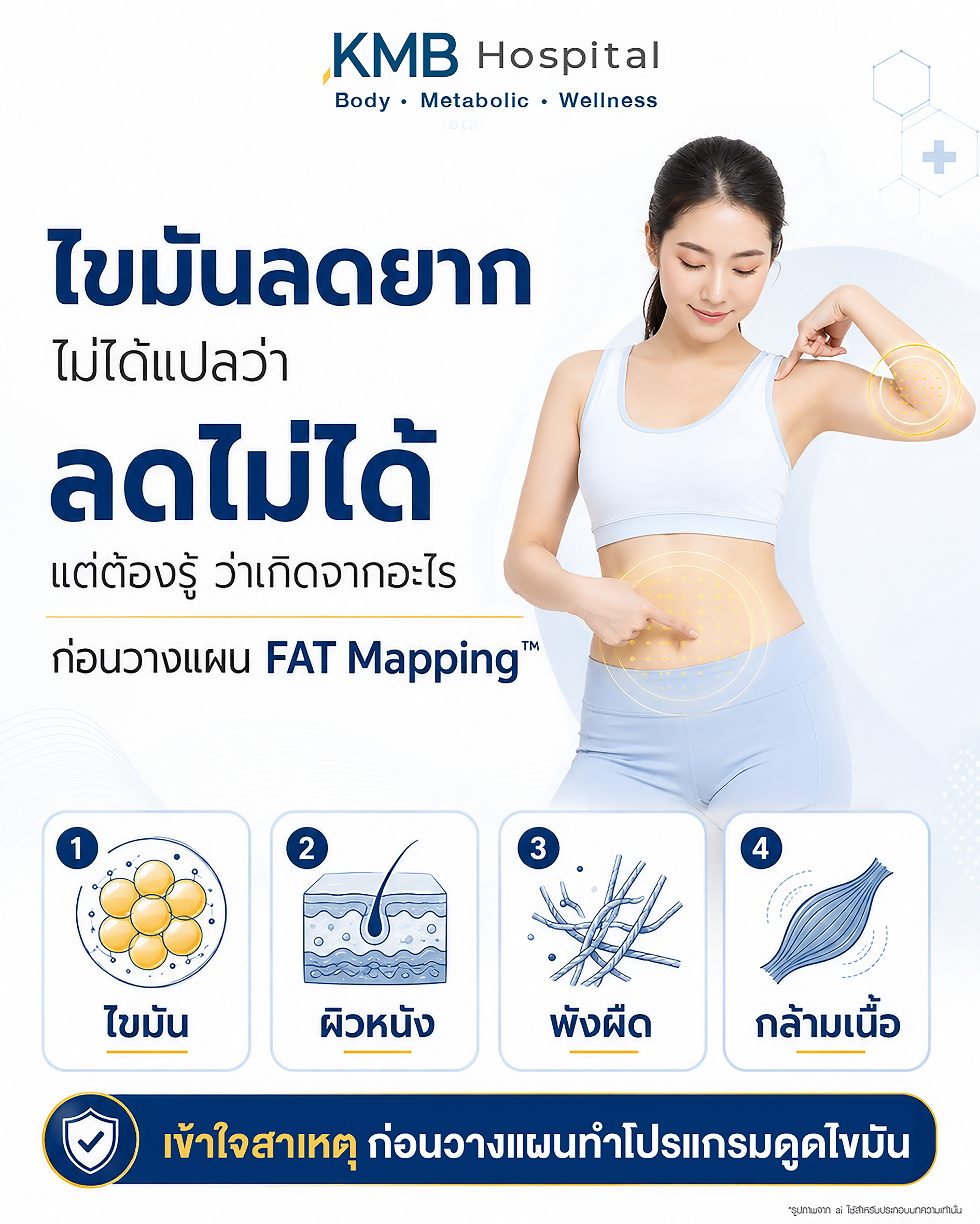
Before planning a liposuction program, physicians must evaluate whether the difficult-to-reduce area consists solely of subcutaneous fat, or if skin, adhesions, muscles, or other components are involved. FAT Mapping™ supports the systematic evaluation of these factors.
What Does 'Stubborn Fat' Mean?
The term "stubborn fat" does not mean fat that cannot be reduced at all; rather, it refers to areas that respond more slowly to diet control and exercise compared to other parts of the body.
Many people find that their weight decreases, clothes become looser, and body measurements shrink, yet they feel the lower belly hasn't flattened, waist flanks remain defined, arms are still large, thighs are still tight, or the double chin remains.
Why Is Fat Reduced More Slowly in Some Areas Than Others?
Fat in each location has different biological properties. The following factors cause the body to mobilize energy from each area not simultaneously.
This explains why some people see their faces slim down first while the belly doesn't change, or some see their waists shrink while arms still hold fat accumulation.
Is Stubborn Fat the Same for Everyone?
No. The locations of difficult-to-reduce fat vary per individual. Some notice it in the lower abdomen, others in arms, thighs, flanks, or multiple areas simultaneously.
These differences result from genetics, hormones, age, and individual variations in fat distribution.
Which Body Areas Do Many People Feel Are Hard to Reduce?
Although everyone has different fat accumulation patterns, there are certain areas clients often worry about and feel reduce more slowly than others.
However, fat accumulating in these positions does not mean everyone has the same cause. Some have subcutaneous fat, some have loose skin, or some have adhesions and other structures combined.
Does Spot Exercise Help Reduce Fat Locally?
This is a common misconception. Many try sit-ups to lose belly fat or arm exercises to slim arms.
Exercise helps strengthen muscles and uses overall body energy, but there is no evidence supporting that spot exercise can selectively burn fat at specific sites clearly.
When the body uses energy, it draws from multiple storage sites together. You cannot choose to draw from the belly, arms, or hips first.
Thus, many find muscles becoming stronger, but subcutaneous fat still covers the original areas.
Why Must Physicians Evaluate Before the Liposuction Program?
When clients say "I tried losing weight myself, but this area won't go down," physicians do not immediately conclude it is stubborn fat, but will evaluate first.

| Factors to Evaluate | Reason for Consideration |
|---|---|
| Subcutaneous Fat | Whether the concerned area is indeed subcutaneous fat |
| Skin | Whether there is looseness or sufficient elasticity |
| Adhesions and Tissue | Whether there is firmness, adhesion, or history of previous treatment combined |
| Intra-abdominal Fat | Whether the bulge or proportions of concern have components from deeper fat |
| Muscles and Structure | Whether other structures contribute to the shape alongside |
Because the area the client feels is "hard to reduce" may not be caused by fat alone.
Does Stubborn Fat Mean Suitable for Liposuction Immediately?
No. A slow reduction in one area does not indicate that a liposuction program should be done immediately.
Before planning, physicians must still evaluate if it is indeed subcutaneous fat, if intra-abdominal fat is also present, if skin has sufficient elasticity, if there are adhesions or history of previous treatment, and if overall health is suitable.
Why Do Results Differ After Some Undergo Liposuction Programs?
Even if liposuction is performed on the same area, results may differ because each person has different body components.
These factors all affect planning and outcome prediction, so it cannot be compared to other clients from photos alone.
How Does FAT Mapping™ Help Evaluate Stubborn Fat?
When clients worry that some fat areas will not reduce, physicians do not look at that area alone but will evaluate together across several aspects.
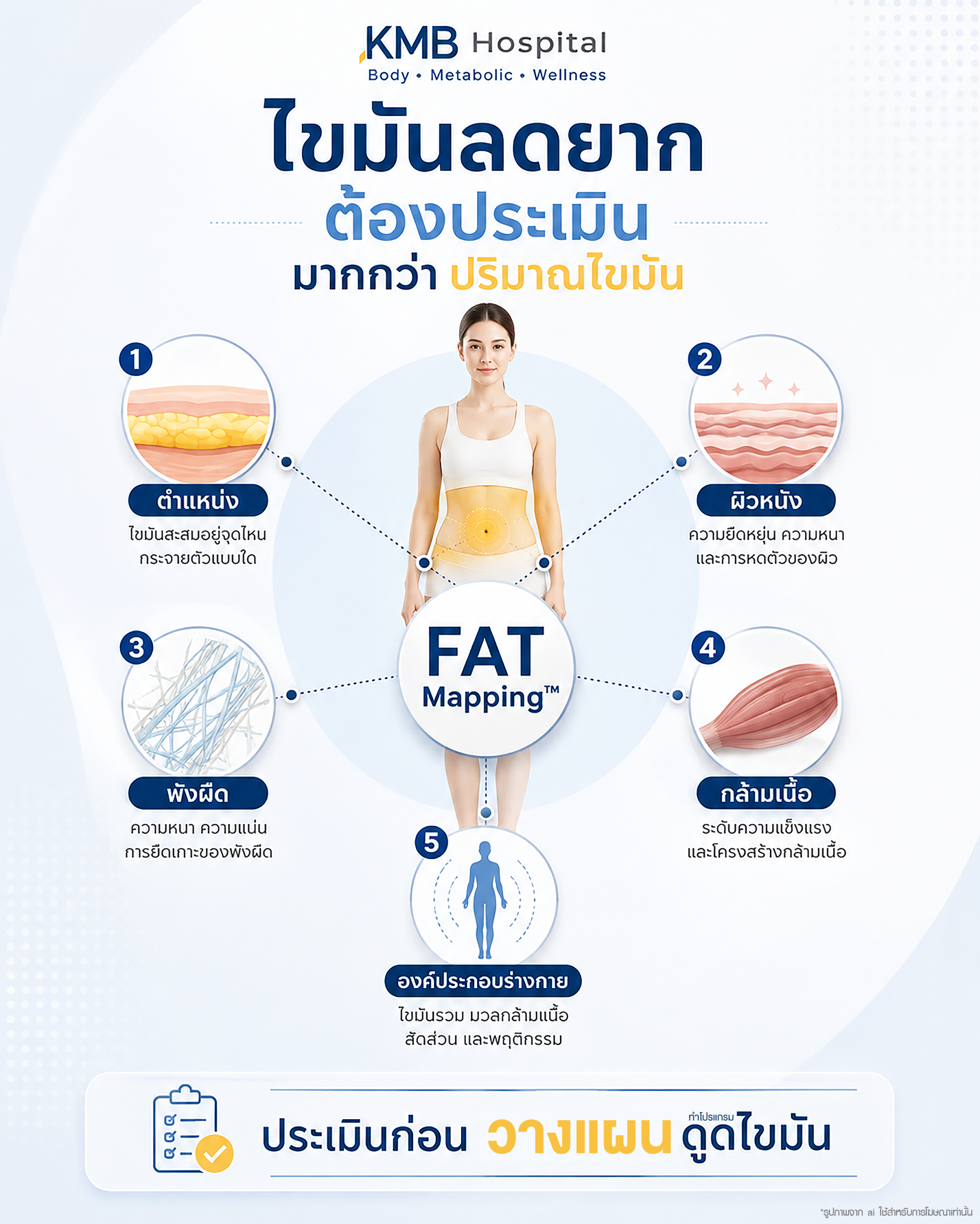
Fat Location
See where fat accumulates and how it relates to nearby areas.
Fat Layer Thickness
Evaluate whether the fat layer is evenly thick or accumulates in specific spots.
Skin Quality
Check if skin has elasticity or is accompanied by looseness.
Adhesions and Tissue
Evaluate firmness, adhesion, and tissue movement.
Body Composition
Consider muscles, intra-abdominal fat, body proportions, and client goals together.
All these evaluations help physicians understand what causes the area of client concern and how to plan accordingly.
Why Is Stubborn Fat a Reason to Perform FAT Mapping™?
Many clients often visit doctors asking "Why didn't this area go down after losing weight?" The answer isn't just about fat quantity but may relate to fat location, adhesions, skin quality, muscle, or other body components.
FAT Mapping™ collects this data so physicians can evaluate along with physical exams and plan appropriate liposuction programs for each client, not relying solely on external appearance.
Summary
Fat in some areas reducing slowly is a characteristic found in the natural body, and does not always mean weight loss failure or lack of exercise effect, as each position responds differently to energy changes.
Before planning a liposuction program, physicians must evaluate whether the area of concern is solely due to subcutaneous fat or if skin, adhesions, muscles, or other components are involved. FAT Mapping™ supports data collection to aid personalized planning alongside physical exams and physician judgment.
Important Points to Know
Frequently Asked Questions
1. What is Stubborn Fat?
Refers to areas where fat reduces slower than other parts of the body, even if overall weight has decreased.
2. Why Is the Lower Abdomen Hard to Reduce?
The lower abdomen is an area many find changes more slowly than other positions due to fat distribution and tissue component differences among individuals. However, the cause of a protruding belly may not be solely subcutaneous fat.
3. Can Spot Exercise Help Reduce Localized Fat?
Current scientific evidence does not support that spot exercise can directly select burning fat at specific sites, even though it helps build muscles and increase overall body energy usage.
4. If I Lost Weight But Fat Remains, What Should I Do?
Start with an evaluation to determine if the concerned area is truly subcutaneous fat or if other components are involved, such as skin, adhesions, muscles, or intra-abdominal fat.
5. Is Stubborn Fat in All Positions Suitable for Liposuction Programs?
Not always. Suitability depends on fat location, skin quality, adhesions, overall health, and physician evaluation per individual.
Medical Sources
- Hall JE. Guyton and Hall Textbook of Medical Physiology. Latest Edition.
- Gray's Anatomy. The Anatomical Basis of Clinical Practice. Latest Edition.
- Karpe F, Pinnick KE. Biology of Upper-Body and Lower-Body Adipose Tissue. Nature Reviews Endocrinology. 2015.
- American College of Sports Medicine. Position Stand: Appropriate Physical Activity Intervention Strategies for Weight Loss and Prevention of Weight Regain for Adults.
- American Society of Plastic Surgeons. Patient Education Resources.
- Endotext. Adipose Tissue Biology and Body Fat Distribution.
About KMB Hospital
KMB Hospital provides services in body contouring, weight loss, and liposuction programs, prioritizing systematic pre-treatment evaluation to help physicians understand fat locations, tissue quality, and body composition before planning treatment suitable for each client.
Medical Disclaimer
This article is compiled to provide knowledge about slow-reducing fat and evaluation before liposuction programs. Data cannot replace examination, diagnosis, or specific advice from a physician. Care approach suitability depends on health, body composition, goals, and physician judgment per individual.
Lost Weight, But Some Areas Have Not Changed?
Start with an evaluation to determine if the concerned area results from subcutaneous fat, skin, adhesions, muscles, or other components combined, so physicians can use data to plan what suits each person.