FAT Mapping Upper Arm Before Liposuction FAT Mapping™ Upper Arm: What Needs to Be Assessed Before Planning Around-Arm Liposuction?
KMB KNOWLEDGE BLUEPRINT™
DOMAIN D — REGIONAL FAT MAPPING™ | Article Code: FM-D-K03
Category: FAT Mapping™ | Science of Fat | Pre-Liposuction Program Assessment
FAT Mapping™ Upper Arm: What Needs to Be Assessed Before Planning an Arm Liposuction Program
First Published: 15 August 2569 | Last Updated: 15 August 2569 | Reading Time: 7 minutes
Author: Medical Content Team, KMB Hospital
Medically Reviewed By: Dr. Mandanas Peerapatthanachai (Morn Luknuu) License No. W.37626
FAT Mapping™ Upper Arm helps physicians assess fat distribution around the upper arm, the balance between the inner and outer sides, including the relationship with shoulders, armpits, and torso before planning the arm liposuction program
Assessing the upper arm does not consider solely the area that looks largest but uses information from history taking, physical examination, and FAT Mapping™ together to choose the appropriate liposuction program pathway suitable for each client's body shape
Why Assessment of the Upper Arm Doesn't Just Look at the Largest Area
The upper arm is an area where many people easily notice changes, especially when wearing short-sleeved shirts or raising their arms.
When clients come to consult regarding the upper arm liposuction program, many often point to the area they feel is largest, but for physicians, assessment does not start from just that single point.
Physicians will assess the entire upper arm circumference to view body contour continuity, fat distribution, and balance of each side before planning the liposuction program.
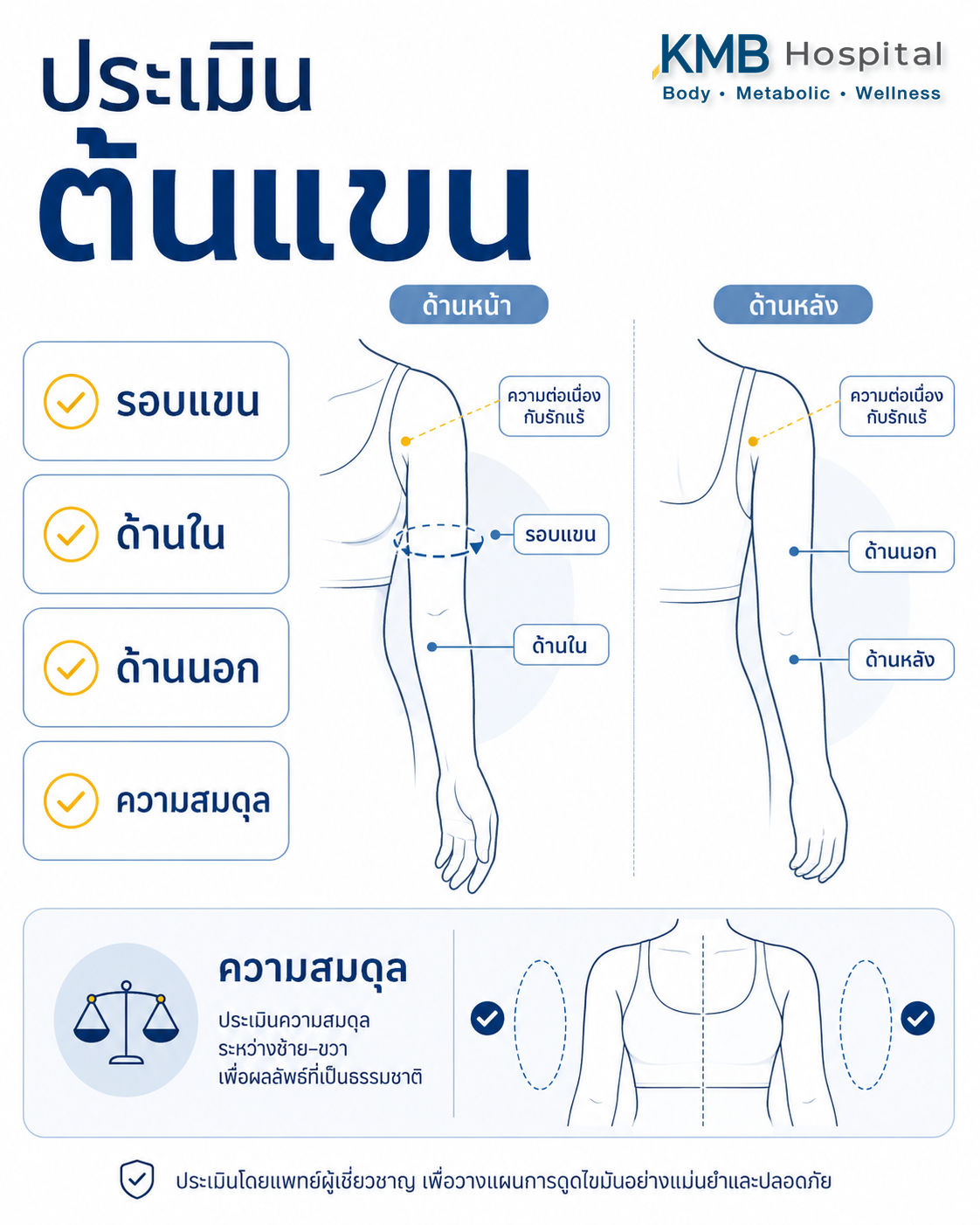
FAT Mapping™ Upper Arm: What Does the Assessment Evaluate?
FAT Mapping™ Upper Arm helps gather important information to be used alongside physical examinations and planning for arm liposuction programs.
| Assessment Data | What Helps the Physician Understand |
|---|---|
| Distribution of Fat Around the Upper Arm | Where significant fat accumulates and how it distributes continuously around the arm. |
| Inner and Outer Balance | Whether the proportions and continuity differ on each side of the upper arm. |
| Relationship with Shoulders and Underarms | How the upper arm shape connects with the shoulders, underarms, and torso. |
| Shape from Multiple Angles | Overview of the upper arm when viewed from the front, side, and back. |
| Data for Physical Examination Reference | Information that must be taken into consideration alongside history taking, physical examination, skin quality, and client goals. |
View Around Upper Arm
Evaluate inner, outer, and back aspects, not limited to areas that look largest.
View Continuity
Consider the relationship between upper arm, shoulders, underarms, and torso.
View Overall Balance
Use multi-angle data together to plan according to each individual's body shape.
Why Similarly-Looking Upper Arms Should Not Follow the Same Liposuction Program Plan
Even if clients have similarly looking upper arms, assessment results may differ.
Therefore, physicians use FAT Mapping™ combined with physical examinations to evaluate each individual's data before planning liposuction programs, without using comparisons with other clients.
FAT Mapping™ helps make arm liposuction program planning more systematic
FAT Mapping™ is not merely for indicating where fat is located, but also helps doctors see a holistic view of the upper arm, its relationship with nearby areas, and information used for liposuction program planning.
When used in conjunction with history taking and physical examination, doctors can explain treatment directions more clearly and select appropriate plans for each client.
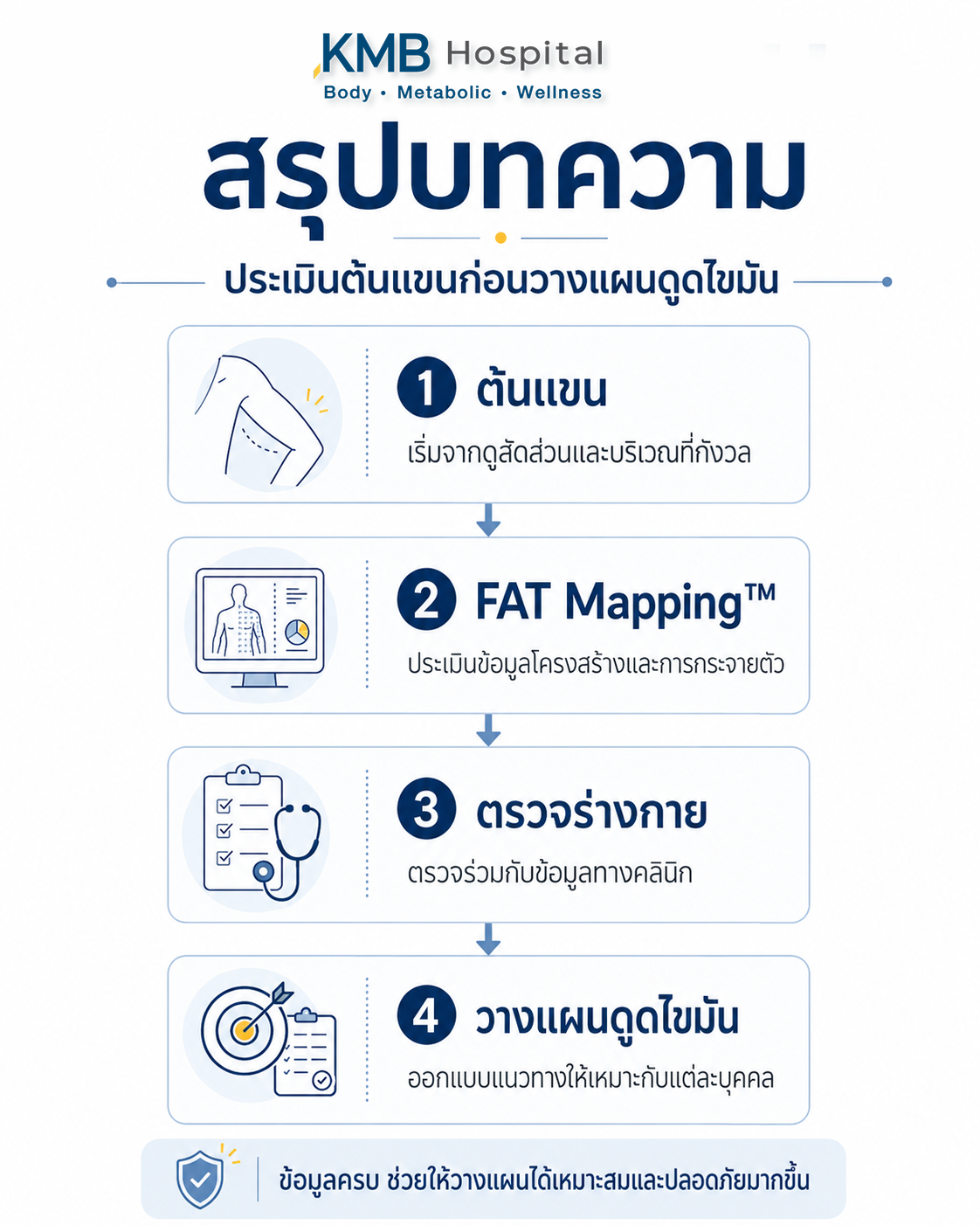
History taking and understanding goals
Understand what the client worries about, body shape change history, and care goals.
Collect data with FAT Mapping™
Evaluate distribution, balance, and relationship of the upper arm with nearby areas.
Physical examination and linking data
Consider data along with tissue characteristics, skin quality, and doctor's assessment.
Individualized planning
Explain options, limitations, and approaches suitable for each client's body shape and goals.
Key Points to Know
Upper arm FAT Mapping™ helps collect data before liposuction program planning; it is not used solely to view upper arm size
The evaluation is not limited to just the inner or outer side of the upper arm
Doctors use history taking, physical examination, and FAT Mapping™ before planning
Body composition, skin quality, and goals can differ for each individual
The goal is to plan so the upper arm is balanced and consistent with other body parts
Frequently Asked Questions
1. What is Arm FAT Mapping™, and why should it be evaluated before a liposuction program?
Arm FAT Mapping™ is the process of collecting data regarding fat distribution, proportions, and arm characteristics to assist in evaluation before planning a liposuction program, combined with physical examinations and patient history.
Arms that appear large may result from varying fat distributions among individuals. Thus, FAT Mapping™ provides physicians with additional information and helps assess the continuity of the arms with the shoulders, underarms, and torso.
2. Can FAT Mapping™ determine whether an arm liposuction program is necessary, and can it replace a physical examination?
FAT Mapping™ is data used to aid in evaluation before a liposuction program but cannot replace a physical examination or the physician's consideration.
Physicians will gather information from FAT Mapping™, history taking, physical examinations, and other related data to evaluate comprehensively before selecting a treatment direction.
3. Why do arms that look similar receive different liposuction program plans?
Even if external appearances are similar, fat distribution, skin quality, arm proportions, and client goals may differ. Therefore, physicians use FAT Mapping™ combined with physical examinations to create personalized plans.
4. Is it possible to perform a liposuction program specifically on the inner part of the arm?
This depends on the evaluation results for each case. In some instances, physicians may consider the inner area along with the back, outer, or underarm areas to achieve more continuous arm proportions.
5. Does FAT Mapping™ improve the results of an arm liposuction program?
Related Articles at KMB Hospital

Read More from DoctorLooknuu.com
Why Doesn't Dr. Looknuu Focus Solely on Large Arm Areas Before Planning a Liposuction Program?
Medical Sources
- American Society of Plastic Surgeons. Liposuction Consultation. Discusses evaluation of goals, health, treatment history, risk factors, options, expected outcomes, and complications before treatment planning.
- American Society of Plastic Surgeons. Liposuction Risks and Safety. Provides information on risks, asymmetry, body contour irregularities, skin laxity, and the importance of consulting with a doctor before making a decision.
- Chia CT, Neinstein RM, Theodorou SJ. Evidence-Based Medicine: Liposuction. Plast Reconstr Surg. 2017;139(1):267e-274e. doi:10.1097/PRS.0000000000002859.
Article Author Information
Doctor LukNoo
Medical Practitioner License No. W.37626
Proper Upper Arm Assessment Begins by Viewing the Entire Arm
If you are unsure whether the upper arm concern relates to fat distribution, skin quality, or continuity with the shoulders and underarms, a physician's evaluation helps clarify the information, limitations, and appropriate recommendations for each individual's body shape.