
How does fat accumulate in the body? Understand before FAT Mapping™ and the liposuction program.

KMB KNOWLEDGE BLUEPRINT™
DOMAIN B - THE SCIENCE BEHIND FAT MAPPING™ | Article ID : FM-B-K16
Category: FAT Mapping™ | Science of Fat | Pre-Liposuction Program Assessment
How Body Fat is Accumulated and How It Affects Liposuction Program Planning
First Published: August 01, 2026 | Last Updated: August 07, 2026 | Reading Time: Approximately 10 minutes
Author: KMB Hospital Medical Content Team
Medical Review: Dr. Mandonas Pirapatsunchai (Dr. Look Nu), License No. W.37626
Body fat accumulation occurs when the body receives more energy from food than it uses. Excess energy is converted into triglycerides and stored within fat cells to be used as energy reserves for the future.
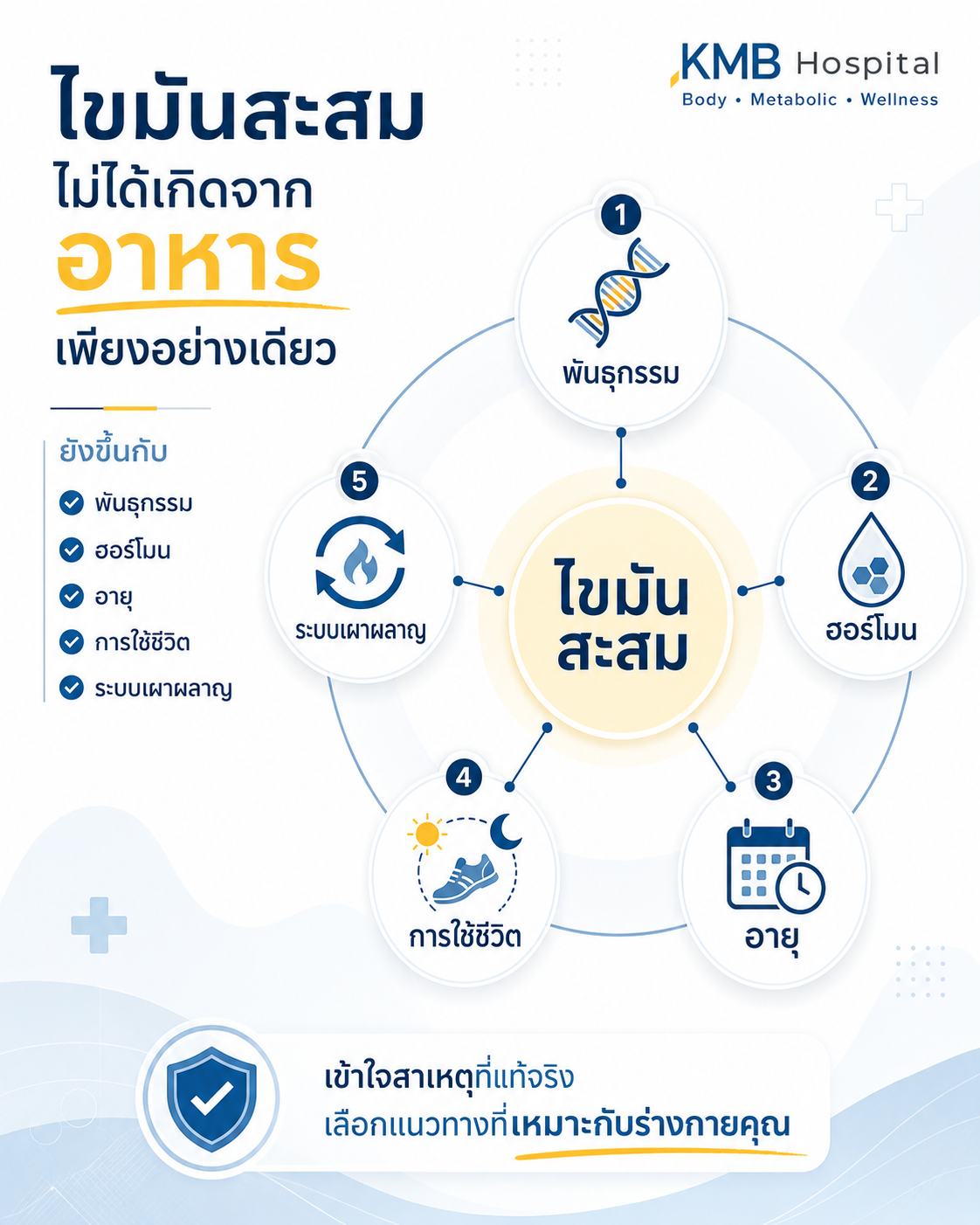
However, fat accumulation does not depend solely on food intake but is also influenced by genetics, hormones, age, sex, sleep, stress, exercise, and each individual's metabolism.
Before undergoing FAT Mapping™ or planning a liposuction program, understanding the mechanism of fat accumulation helps explain why two people with similar weights may have different fat locations and characteristics, and why treatment planning must be evaluated on a per-individual basis.
Fat Accumulation is a Normal Process of the Body
Many people believe that having accumulated fat means eating too much. In reality, fat accumulation is a physiological process that happens to everyone and is one of the important systems that helps the body have energy reserves for use during critical times.
Every time we eat, the body digests and converts nutrients into energy. If the energy received is more than the body needs for the day, the remainder does not disappear but is converted into triglycerides and stored within fat cells.
During times when the body needs energy, such as during exercise, fasting, or periods of insufficient energy intake, the body can draw upon the stored fat for use again.
Therefore, fat accumulation is not an abnormality but a natural energy reserve system of the body.
How Excess Energy Turns Into Fat?
After eating, carbohydrates, proteins, and fats are digested and absorbed into the bloodstream.
The body immediately uses some of this energy for brain function, muscles, organs, and basic metabolic processes. However, if there is still excess energy, the body begins to convert the excess into triglycerides and stores it within fat cells.
Fat cells thus function like the body's "energy storage warehouse," capable of storing energy during times of abundance and releasing it when the body needs it.
This process happens every day and to everyone, whether they are slim or larger. The difference lies in the volume of energy received, the volume used, and other factors influencing fat accumulation.
1. Energy Intake
Nutrients from food undergo digestion and absorption
2. Energy Usage
Brain, muscles, organs, and metabolism use the energy
3. Storing Excess Energy
Remaining energy is stored as triglycerides within fat cells
Fat Cells Can Expand
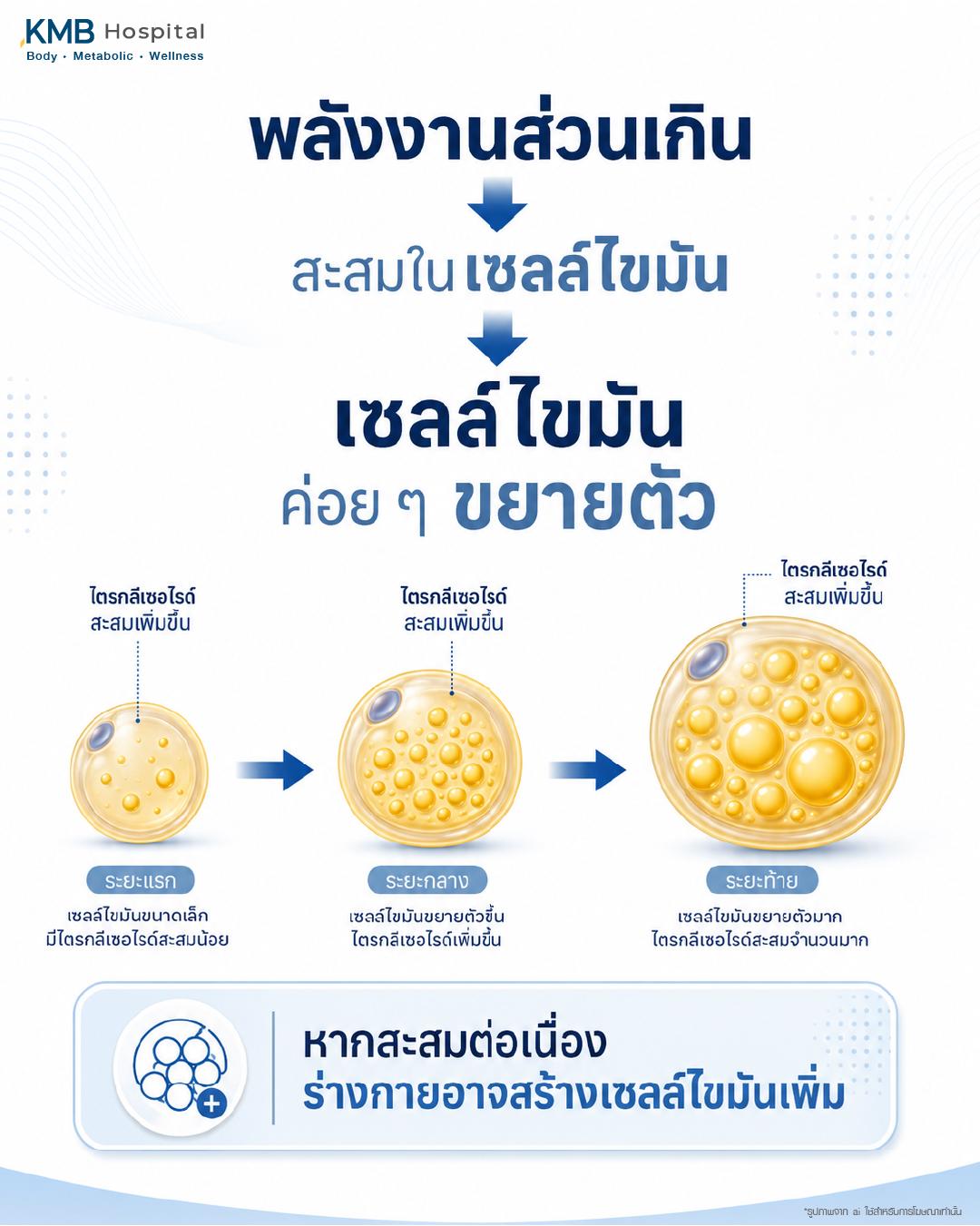
When there is a continuous excess of energy, fat cells begin to accumulate more triglycerides, causing the cells to increase in size.
In the initial stage, the body often chooses to "expand the size" of existing fat cells first. But when accumulation continues for a long time, the body may create new fat cells to accommodate further energy storage.
This change is one of the reasons why some people find it harder to lose weight than others and is a topic related to fat cells and fat distribution.
Why Does Everyone Accumulate Fat Differently?
Many people may have noticed that even when eating similar foods or having similar body weights, fat positions differ significantly.
Some accumulate fat in the abdomen, some in the hips and thighs, while others have more fat in the upper arms or neck area than elsewhere.
These differences do not result from food alone but are the outcome of multiple factors working together, including genetics, hormones, age, sex, lifestyle, sleep, stress, and each individual's metabolism. Therefore, there is no single formula to explain fat accumulation for everyone alike.
How Does Genetics Affect It?
Genetics is one of the factors determining fat distribution patterns from birth. Some people are prone to accumulating fat mainly in the abdomen, while others tend to accumulate it in the hips, thighs, or throughout the body.
Genetics also affects the number of fat cells, fat cell size, sensitivity to hormones, and energy metabolism rate.
However, genetics is merely a "tendency," not a fixed rule. Lifestyle behaviors still play a significant role in long-term changes to body composition.
How Do Hormones Affect It?
Hormones play a role in determining where the body stores fat and when to release fat for use.
For example, the estrogen hormone contributes to many women having a tendency to store fat in the hips and thighs, while male hormones are associated with fat accumulation in the torso more.
Hormones related to stress, sleep, and metabolism, including changes after childbirth, menopause, or hormonal imbalances, may cause changes in fat accumulation locations from the original state.
Does Age Affect It?
As age increases, body composition tends to change naturally. Muscle mass may decrease while fat mass may increase, even if overall body weight changes little.
In some people, fat may begin to accumulate more in the abdominal area after age increases, which is related to hormonal changes, physical activity, and metabolism.
| Factor | Relevant Aspects | Key Principle |
|---|---|---|
| Genetics | Tendency of distribution, number and size of fat cells, hormone sensitivity, and metabolic rate. | It is a tendency, not a fixed rule. |
| Hormones | Location where the body stores fat and the timing of releasing fat for use. | May vary by life stage and individual conditions. |
| Age | Muscle mass, fat mass, activity, and metabolism. | Changes vary for each individual. |
| Lifestyle and Metabolism | Food, exercise, sleep, stress, and energy usage. | Must be considered with other factors; do not conclude from just one aspect. |
Why Does Fat Accumulate in Specific Areas?
Fat accumulation does not occur at the same time in all locations. Each area of the body has different numbers of fat cells, responses to hormones, and blood circulation.
Therefore, some areas accumulate fat more easily than others, such as the abdomen, flanks, upper arms, neck, inner thighs, and hips.
Abdomen and Flanks
Upper Arms and Neck
Inner Thighs and Hips
Conversely, some areas may respond better to weight loss, resulting in uneven shape changes in different parts of the body.
This is the reason many clients feel that although their weight has decreased, some areas have not changed as expected.
Link to Clinical Assessment
Why is Knowledge About Fat Accumulation Important to FAT Mapping™?
Understanding the mechanism of fat accumulation is a major reason why doctors cannot plan a liposuction program based solely on viewing external body shape.
Two clients may have the same body weight, similar BMI, or similar waistline measurements, but their fat accumulation patterns may be completely different.
Some have fat accumulation primarily under the skin
Some have fat accumulation combined with dense scar tissue
Some have fat in the abdominal cavity as an important component
Some have loose skin accompanying fat
All of these affect the direction of planning before the liposuction program.
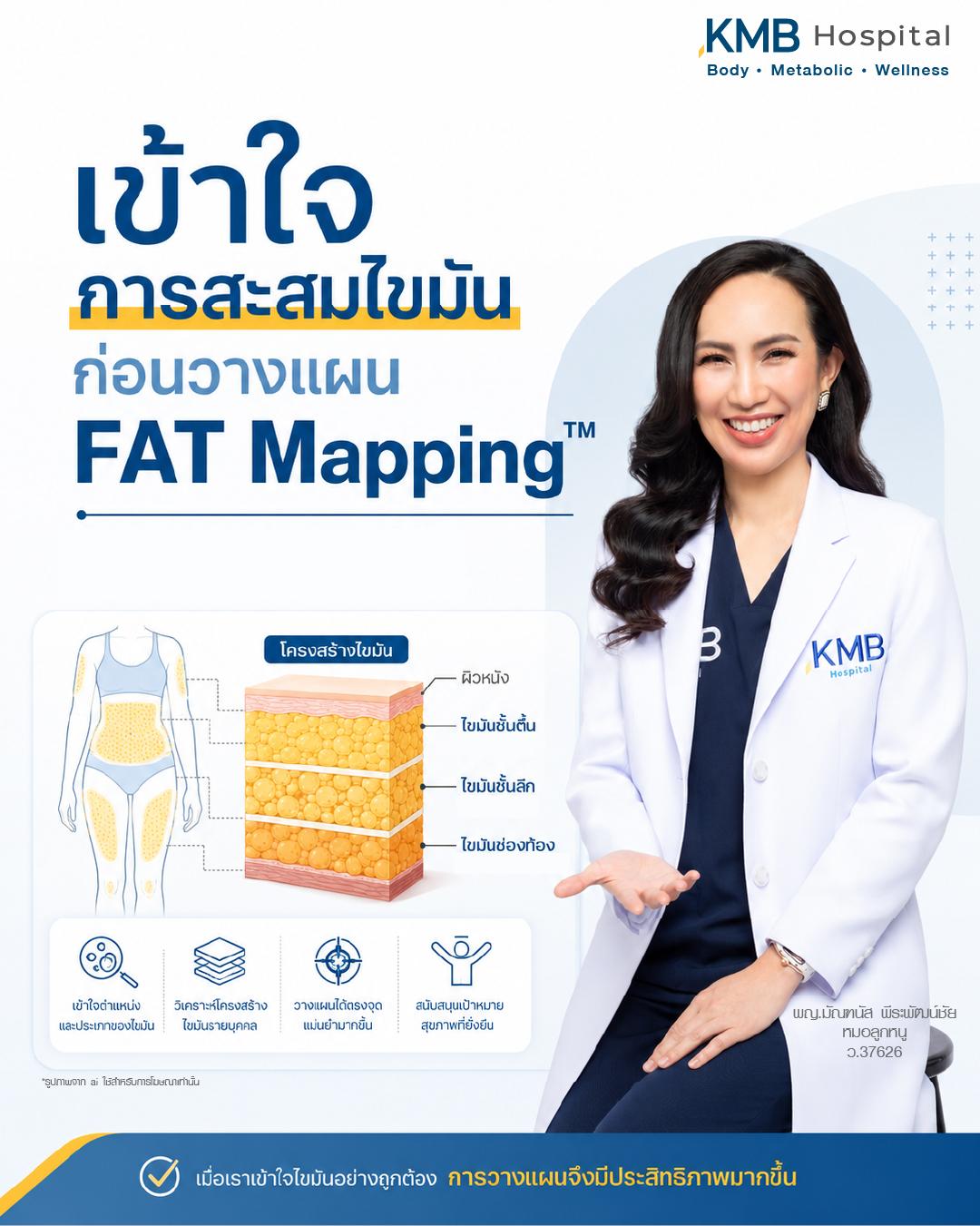
FAT Mapping™ therefore does not assess only "fat volume," but evaluates "fat characteristics" and its relationship with other body components to ensure planning is most appropriate for each individual.
How Does Fat Accumulation Relate to Weight Loss?
When the body uses more energy than received from food, it begins to draw on stored energy, part of which comes from fat stored in fat cells.
However, weight loss does not mean fat will decrease simultaneously in all areas because each body location has different characteristics of response to metabolism.
Thus, it is common for some people to experience noticeable weight loss but still retain fat in certain areas such as the abdomen, upper arms, neck, or hips.
Why Does Fat Not Decrease Equally in All Areas?
Fat in each position differs in structure, blood circulation, response to hormones, and other biological factors.
Because of this, some areas may respond better to diet control and exercise, while some may change slower.
Detailed assessment of fat location and characteristics is important information that helps doctors plan care appropriate for each individual.
Article Summary
Fat accumulation is the result of interaction between multiple factors, including genetics, hormones, age, lifestyle, and metabolism of each individual.
Even if clients have similar body weights, the fat accumulation pattern may differ significantly, resulting in different assessment and planning directions before the liposuction program.
Understanding the nature of fat is thus an important foundation for FAT Mapping™ assessment, helping doctors see body components in greater detail and choose appropriate care directions for each individual.
Important Points to Know
Fat accumulation arises from multiple factors, not just food.
Genetics, hormones, age, and lifestyle all affect fat accumulation patterns.
Fat in each position responds differently to weight loss.
People with similar shapes may have different fat characteristics.
Pre-liposuction program assessment should consider fat characteristics along with other body components.
FAT Mapping™ supports pre-liposuction program planning to be appropriate for each individual.
Frequently Asked Questions
1. Why does weight drop but the abdomen is still not flat?
Because fat in each area responds differently to metabolism, it may decrease at different paces.
2. Does genetics affect fat accumulation?
It affects the tendency of fat distribution, but lifestyle behaviors also play an important role.
3. Do hormones affect body shape?
Many hormones are involved in fat accumulation and body composition.
4. Does increasing age always lead to fat gain?
As age increases, body composition may change, but results vary for each individual.
5. Why do people with similar shapes require different assessments?
Because fat characteristics and locations, as well as body components, may differ even if the external appearance looks similar.
What is the role of FAT Mapping™?
FAT Mapping™ helps gather information about fat accumulation characteristics and body components to facilitate planning for liposuction programs according to the physician's discretion.
Related Articles
On the KMB Hospital Website
Read More from DoctorLooknuu.com
Medical References
- World Health Organization. Obesity and overweight. Updated 8 December 2025. Available from: WHO.
- Edwards M, Mohiuddin SS. Biochemistry, Lipolysis. In: StatPearls. Treasure Island (FL): StatPearls Publishing. Available from: NCBI Bookshelf.
- Cook A, Cowan C. Adipose. In: StemBook. Harvard Stem Cell Institute. Available from: NCBI Bookshelf.
- Sun C, Kovacs P, Guiu-Jurado E. Genetics of Body Fat Distribution: Comparative Analyses in Populations with European, Asian and African Ancestries. Genes (Basel). 2021;12(6):841. doi:10.3390/genes12060841.
- LiuLi A, Zhang T, Feng Z. Adipose tissue distribution in metabolic disease: depot-specific biology, clinical assessment, and therapeutic remodeling. Front Endocrinol (Lausanne). 2026;17:1822659. doi:10.3389/fendo.2026.1822659.
About KMB Hospital
KMB Hospital is a hospital providing body care, weight loss, and liposuction programs, focusing on systematic pre-treatment assessment to support planning care that is suitable for each client under the medical professional's discretion.
Article Information
Author
KMB Hospital Medical Content Team
Medical Reviewer
Dr. Mandonas Pirapatsunchai
Dr. Look Nu
Medical Practice License No. W.37626
Article Review Information
First Published: August 01, 2026
Last Updated: August 07, 2026
Version: 1.0
Understand Fat Accumulation Before Planning Care
The shape and fat accumulation of each person have unique details. Assessment by a doctor helps link information on fat, skin, structure, and goals to facilitate appropriate individualized planning.