
What is subcutaneous fat and how does it relate to FAT Mapping™ before the liposuction program?
DOMAIN B — THE SCIENCE BEHIND FAT MAPPING™ | Article Code: FM-B-K18
The Science of Fat for Pre-Liposuction Program Assessment
Category: FAT Mapping™ | Subcutaneous Fat | Pre-Liposuction Program Assessment
What is Subcutaneous Fat and How Does It Relate to FAT Mapping™ Before Liposuction?
First Published: August 2, 2026 | Last Updated: August 2, 2026 | Estimated Reading Time: 17 Minutes
Author: Medical Content Team, KMB Hospital
Medically Reviewed by: Dr. Mathanun Pirapattanchai (Molooknu), License No. V.37626
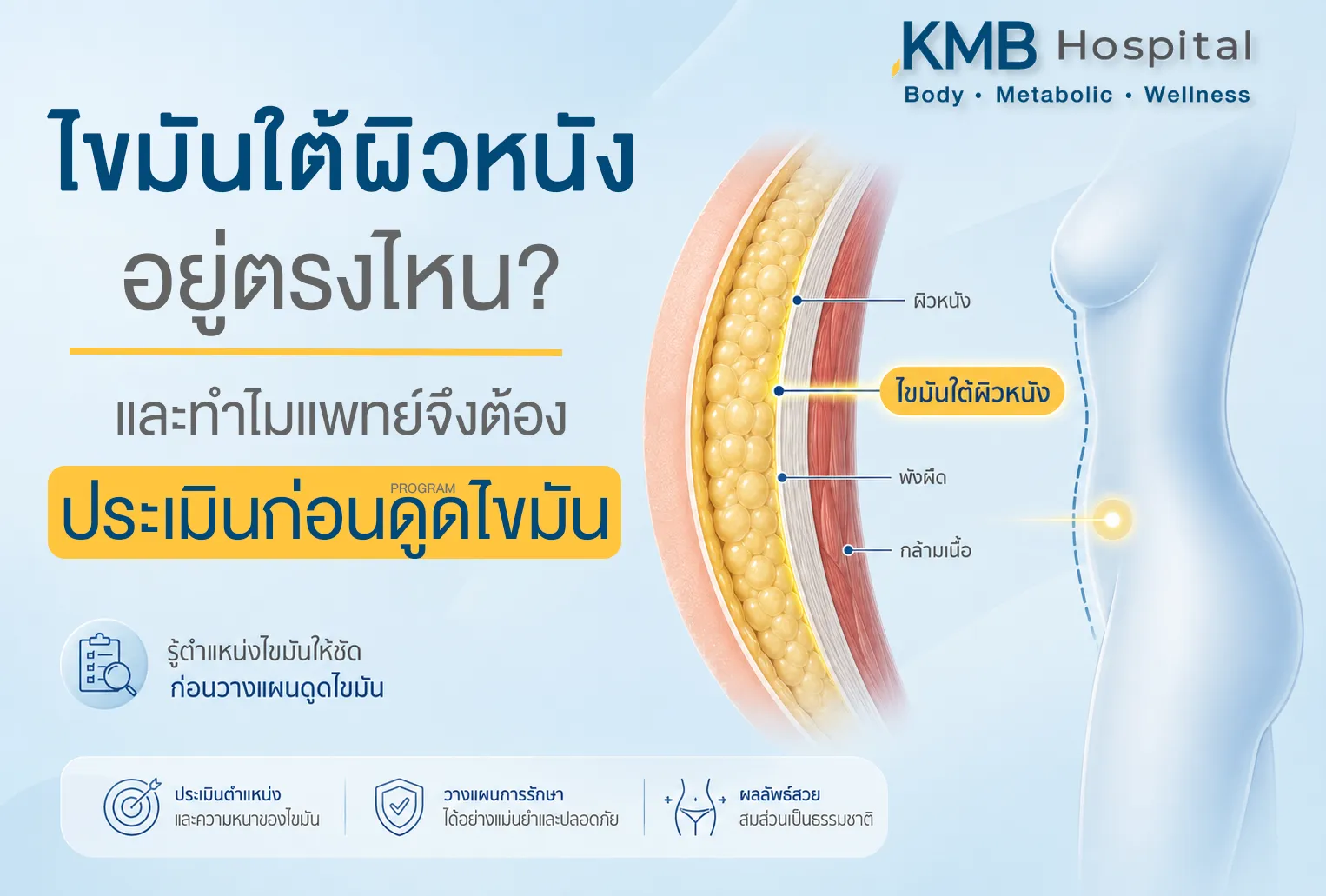
Subcutaneous Fat (Subcutaneous Fat) is fatty tissue located between the skin and the muscle layer. It plays a role in external body shape, tissue softness, shock absorption, and the body's energy storage.
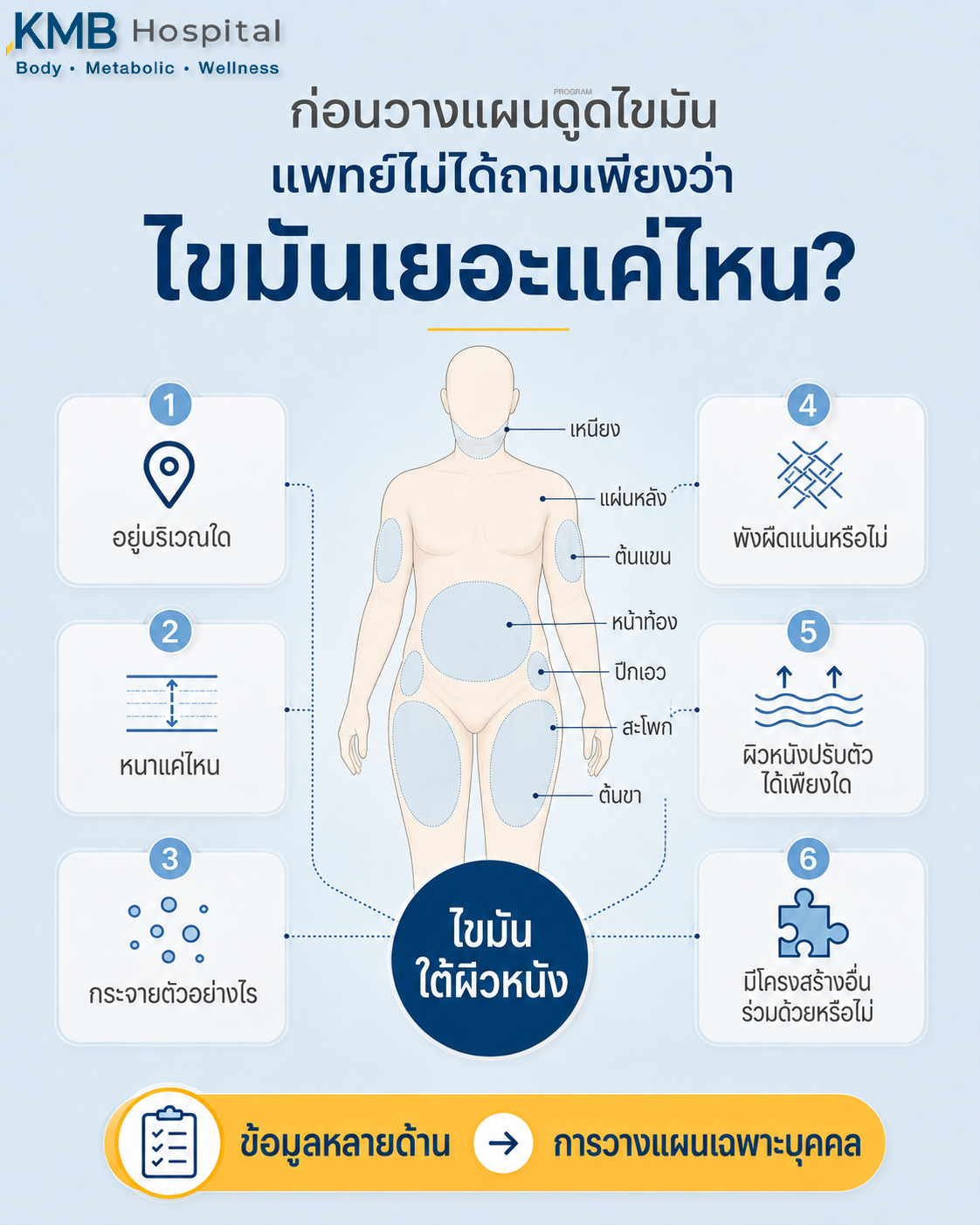
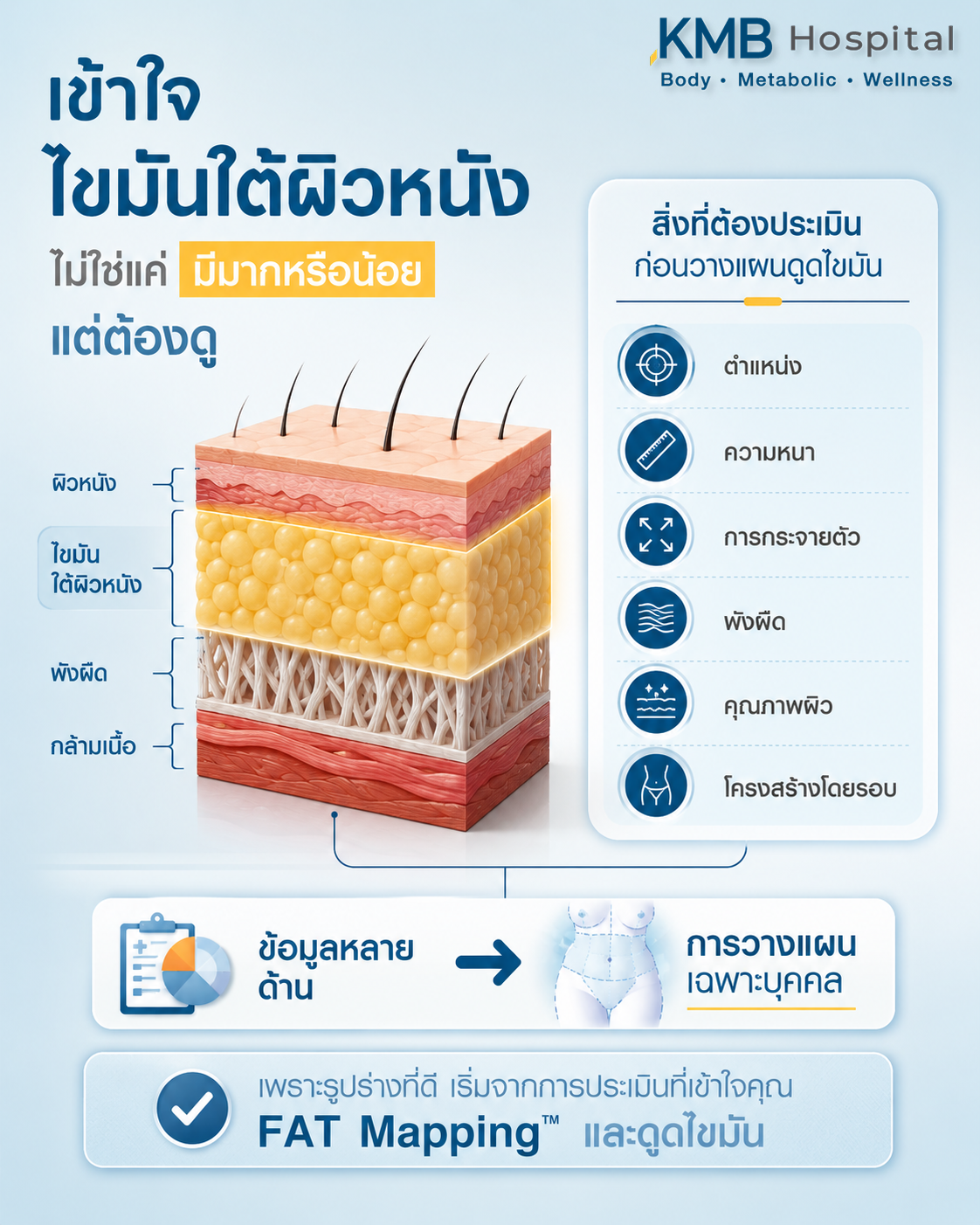
Before performing FAT Mapping™ and planning a liposuction program, doctors do not merely assess whether there is an abundance or lack of subcutaneous fat. They evaluate position, distribution, thickness, relationship with fascia, skin quality, and body composition together to ensure appropriate planning for each individual.
Even though it is called "Subcutaneous Fat," the fat in different body areas may differ anatomically, meaning a uniform evaluation approach cannot be applied to all locations.
What is Subcutaneous Fat?
Subcutaneous fat, or Subcutaneous Fat, is fatty tissue located just beneath the skin layer and above the muscle layer.
This is fat that can be felt or pinched from the outside, such as in the abdomen, upper arms, hips, thighs, love handles, or double chin.
Many people understand subcutaneous fat as "all body fat," but in reality, the body has fat in other locations, including visceral fat within the abdominal cavity, which has different roles and limitations compared to subcutaneous fat.
Previous articles explained the overview of all fat layers. This article focuses specifically on subcutaneous fat, which is a key component involved in pre-liposuction program assessment.
What Are the Functions of Subcutaneous Fat?
Many people view subcutaneous fat merely as a cause for body shape changes, but in reality, subcutaneous fat plays a crucial role in many aspects of body function.

1. Stores Body Energy Reserves
The primary function of subcutaneous fat is to store excess energy in the form of triglycerides. When the body receives more energy than it uses, a portion of that energy is stored within fat cells and can be retrieved for use during periods when the body needs energy. Therefore, having subcutaneous fat is a normal bodily mechanism, not an abnormality.
2. Provides Shock Absorption
Subcutaneous fat functions similarly to cushioning, absorbing pressure and impacts, especially in weight-bearing or high-friction areas like the soles of the feet, hips, buttocks, elbows, and knees. It reduces forces transmitted to muscles, bones, and underlying organs.
3. Helps Maintain Body Temperature
Subcutaneous fat helps reduce heat loss to the environment, playing a role similar to natural insulation that helps maintain body temperature at an appropriate level.
4. Influences Shape and Proportions
Subcutaneous fat affects the curvature of the torso, abdominal thickness, upper arm width, hip prominence, waist circumference, and overall body balance. However, body shape also involves skin, fascia, muscles, bone structure, and visceral fat working together.
Where Can Subcutaneous Fat Be Found?
Subcutaneous fat can be found in almost every part of the body, but the amount and characteristics of fat vary by area.
Even though it is the same subcutaneous fat, each location differs in thickness, firmness, distribution, relationship with fascia, and skin quality.
This is why doctors do not apply a single approach to every body region.
Are All Subcutaneous Fat Areas the Same?
Although fat beneath the skin throughout the body is collectively called "subcutaneous fat," the fatty tissue in each area does not have identical structure and function.
- Fat layer thickness
- Tissue firmness or softness
- Distribution pattern
- Layering or subdivision
- Relationship with fascia
- Blood circulation
- Response to hormones and metabolism
Research in adipose tissue biology has shown that upper and lower body subcutaneous fat stores and releases fatty acids differently, explaining why some body positions change more easily than others during weight loss.
Therefore, doctors should not view subcutaneous fat as a single tissue type that can be evaluated and planned uniformly across all areas.
What Are the Characteristics of Subcutaneous Fat in the Abdomen?
The abdomen has a complex structure with multiple layers stacked, ranging from skin, subcutaneous fat, fascia, abdominal muscles, to visceral fat inside the abdominal cavity.
Abdominal subcutaneous fat may vary in thickness in different spots, such as the upper abdomen, lower abdomen, around the navel, flanks, and suprapubic area.
Some clients may have prominent fat accumulation in the lower abdomen, while others have fat distributed around the trunk or flanks instead.
The visible abdominal shape depends not only on total fat volume but also on where the fat is distributed, and how much skin, fascia, muscle, or visceral fat is present.
How Does Fat in Upper Arms and Back Differ from the Abdomen?
Fat in the upper arms and back often relates to fascia and skin adhesion patterns that differ from the abdomen.
For some, large upper arms may be primarily due to subcutaneous fat, while others may have loose skin, or structural muscles making the limbs appear thicker.
Back regions and bra-line areas may have relatively firm tissue divided into layers or folds, supported by fascial lines attaching the surface to deeper structures.
- Degree of tissue firmness or mobility
- Presence of folds from fat or skin
- Continuity of fat spread to adjacent areas
- Symmetry of both sides' shapes
These details influence the determination of treatment zones and boundaries for liposuction planning.
What Are the Characteristics of Fat in the Face and Chin Area?
Fat in the face and under the chin is not entirely continuous tissue. It can be divided into fat compartments or groups related to facial structures and fascial planes at various levels.
Full or thick-looking chin areas may relate to subcutaneous fat position, chin shape and size, neck muscles, skin laxity, submental structure, and deeper than superficial fat.
Thus, even if two clients have similar chins, causes and assessment approaches may differ.
Planning must consider the overall structure of the face and neck, not just the palpable fat volume alone.
Why Is Subcutaneous Fat in Some Areas Harder to Reduce?
When the body is in an energy deficit state, fat cells release stored energy for use, causing fat cell shrinkage.
However, the body cannot precisely select which area to draw fat from first.
Fat in each location differs in hormonal responsiveness, blood circulation, and fat dissolution rates. Research shows that hip and thigh fat may have lower fat dissolution rates than abdominal subcutaneous fat under certain conditions, while upper and lower body regions have different fatty acid release patterns.
Consequently, some clients may see their face or certain body parts slim down first during weight loss, while fat remains in the lower abdomen, thighs, hips, or upper arms.
This does not mean diet control or exercise is ineffective, but reflects that fat in different locations responds differently to energy changes.
Is All Palpable Subcutaneous Fat Suitable for Liposuction Programs?
Not Always
Even though liposuction programs work on subcutaneous fat, being able to pinch tissue from the outside does not mean all fat in that area should be removed.
- Layer depth and fat thickness
- Skin quality and elasticity
- Fascia tightness
- Body shape balance
- Position of blood vessels, nerves, and key structures
- Client's overall health
- Expectations regarding results
Liposuction aims to adjust proportions in suitable areas, not to remove all subcutaneous fat.
Furthermore, liposuction carries risks and limitations, such as skin irregularity, asymmetry, fluid accumulation, sensation changes, infection, and other complications, requiring proper medical assessment and care.
How Do Doctors Evaluate Subcutaneous Fat?
Subcutaneous fat evaluation should use multiple sources of information together, not rely on just one tool or method.
1. Visual Body Shape Assessment
Doctors examine body shape from multiple angles—front, side, back, and oblique—to view accumulation position, line continuity, uneven bulging points, asymmetry, skin folds, and relationships with surrounding areas.
2. Palpation and Pinching Assessment
This helps evaluate subcutaneous layer thickness, softness or firmness, tissue mobility, skin adhesion, differences between neighboring areas, and potential for old adhesions or scars, though it cannot accurately distinguish all deep structures.
3. Skin Quality Evaluation
Doctors consider the skin's ability to adapt after fat volume reduction, taking into account age, elasticity, stretch marks, weight changes, pregnancy history, existing laxity, and past treatments or surgeries.
4. Fascia and History of Prior Treatments
Fascia affects firmness, movement, and smoothness. Doctors inquire about liposuction programs, surgery, injections or procedures, inflammation or infection, scars, adhesions, and injuries in the target area.
5. Overall Body Composition Assessment
Doctors consider muscle mass, visceral fat, weight and weight fluctuations, body proportions, health status, and client goals together.
Subcutaneous fat should not be evaluated in isolation from the body's overall picture.
How Does Subcutaneous Fat Relate to FAT Mapping™?
Subcutaneous fat is one of the key components of body shape that doctors must evaluate before planning a liposuction program, but merely saying "having subcutaneous fat" is insufficient to determine care guidance.
Two clients may have fat in the same general area but with different details, such as:
- One has relatively thick and evenly distributed fat layers
- One has fat accumulating only in specific spots
- One has dense fascia
- One has accompanying loose skin
- One has had prior liposuction or surgery
- One has significant visceral fat or muscle influencing body shape
FAT Mapping™ helps gather information on position, distribution, and multi-dimensional body composition for doctors to consider alongside patient history, physical exam, skin quality, fascia, health, and client goals.
Data from FAT Mapping™ is not used to judge treatment plans in isolation, but helps doctors visualize the overall picture systematically and clarify:
- Which parts involve subcutaneous fat
- Which parts may stem from other structures
- Which parts liposuction may help change
- Which parts may not respond to liposuction alone
- What limitations should be understood before planning
A systematic evaluation ensures liposuction program goals are based on actual body structure and are more appropriate for each client.
Article Summary
Subcutaneous fat is fatty tissue between the skin and muscle. It functions to store and release energy, maintain body temperature, absorb shock, and is a key component determining body thickness, curves, and proportions. Fat tissue contains cells, blood vessels, and supporting structures, so it should not be viewed merely as featureless fat deposits without bodily function.
Although subcutaneous fat can be found nearly everywhere in the body, fat characteristics vary by region, including thickness, layering, firmness, distribution, and fascia relationships. Anatomical studies explain that shallow fascial systems can divide subcutaneous fat into superficial and deep parts in many areas, where each part may have distinct structural and functional characteristics.
Before planning a liposuction program, doctors do not simply consider "how much fat there is," but evaluate where the fat is located, how it is distributed, if there are adhesions or loose skin, and how much the observed shape stems from muscle or visceral fat.
Liposuction reduces subcutaneous fat in suitable areas to adjust shape; it is not a weight loss method and cannot remove fat deep under muscles around internal organs. Skin quality and elasticity are also important factors in evaluating suitability and predicting skin adaptation after volume changes.
Thus, FAT Mapping™ helps systematically gather information about position, distribution, and body composition to assist physical exams, health history, client goals, and physician discretion before planning liposuction programs.
Key Points to Know
Frequently Asked Questions
1. Is Subcutaneous Fat All Fatty Tissue That Can Be Pinched From Outside, and Are All Areas the Same?
Generally, tissue that can be pinched from the outside includes skin, subcutaneous fat, and fascia combined, not just fat cells. Pinching helps doctors preliminarily assess thickness, softness, firmness, and mobility, but this method alone cannot distinguish all structures accurately. Additionally, fat in the abdomen, upper arms, thighs, hips, back, and chin differs in thickness, distribution, layering, and fascial structure, requiring area-by-area evaluation.
2. Why Does Subcutaneous Fat Remain in Some Areas Even After Weight Loss?
The body cannot selectively pull fat from a specific area on demand. Each region has differences in blood flow, hormonal response, and energy release. Thus, even if overall weight drops, some positions may change slower than others. However, having stubborn fat does not automatically mean that area is suitable for liposuction. Doctors must still evaluate health, skin, fascia, and other components together.
3. Can All Subcutaneous Fat Be Removed via Liposuction?
No, it cannot, nor should all be removed. Fat tissue serves functions for energy storage, temperature regulation, shock absorption, and metabolic operation. Liposuction aims to reduce some subcutaneous fat in suitable areas and adjust proportions, maintaining body shape continuity while considering anatomy, safety, and individual limitations.
4. Does Skin Quality Affect Liposuction Planning?
Significantly. After subcutaneous fat volume decreases, skin must adapt to the new underlying shape. Those with good skin elasticity may adapt differently than those with thin, loose, or scarred skin, or significant weight fluctuation history. Skin condition assessment is vital before recommending liposuction, and severely loose skin may limit results achievable from fat reduction alone.
5. How Does FAT Mapping™ Help Assess Subcutaneous Fat?
FAT Mapping™ organizes data about position, thickness, distribution, and fat relationships with other body components to give doctors a systemic overview before planning liposuction. Such data must be used alongside patient history, physical exams, skin quality, fascia, health, and client goals. FAT Mapping™ should not be used alone to conclude suitability or guarantee treatment outcomes.
Read More from DoctorLooknuu.com
Website team connects links once the destination article is published.
References
- Richard AJ, White U, Elks CM, Stephens JM. Adipose Tissue: Physiology to Metabolic Dysfunction. In: Endotext. MDText.com, Inc.; updated 2020. Content explains the role of fat tissue in energy storage, fat cell structure, and differences between fat storage sites in the body.
- Zwick RK, Guerrero-Juarez CF, Horsley V, Plikus MV. Anatomical, Physiological, and Functional Diversity of Adipose Tissue. Cell Metabolism. 2018;27(1):68–83. Explains adipose tissue diversity and the division of subcutaneous fat into superficial and deep parts by the fascial system.
- Harvey I, Boudreau A, Stephens JM. Adipose Tissue in Health and Disease. Open Biology. 2020;10(12):200291. Reviews the role of fat tissue in normal conditions and metabolic disorders.
- Karpe F, Pinnick KE. Biology of Upper-Body and Lower-Body Adipose Tissue—Link to Whole-Body Phenotypes. Nature Reviews Endocrinology. 2015;11(2):90–100. Explains biological differences of fat according to body location.
- Pirri C, Stecco A, Fede C, et al. An Anatomical Comparison of the Fasciae of the Thigh: A Macroscopic, Microscopic and Ultrasound Imaging Study. Journal of Anatomy. 2021;238(4):999–1009. Describes fascial structure and relationships with subcutaneous tissue in the thigh area.
- American Society of Plastic Surgeons. Liposuction: 10 Things to Know and 10 Questions to Ask. Explains that liposuction reduces subcutaneous fat, not weight loss, and requires skin quality and client suitability assessment before treatment.
About KMB Hospital
KMB Hospital provides body contouring, weight loss, and liposuction programs, emphasizing systematic pre-treatment assessment to help doctors understand fat position and characteristics, skin quality, fascia, body composition, and related health factors.
The FAT Mapping™ approach is used to gather data for personalized planning. Decisions regarding suitability, scope, and treatment methods rely on physical examination, health history, client goals, and physician judgment together.
Article Production Information
Written By
Medical Content Team, KMB Hospital
Medically Reviewed By
Dr. Mathanun Pirapattanchai
Molooknu
Medical Practice License No. V.37626
Article Review Information
First Published: July 31, 2026
Last Updated: July 31, 2026
Next Review Cycle: July 2027
Version: 1.0
Status: Publication Ready
Medical Disclaimer
This article is created to provide knowledge about subcutaneous fat, FAT Mapping™, and pre-liposuction assessment. Information in this article cannot replace physical examination, diagnosis, or specific medical advice from a doctor. Suitability, treatment scope, risks, limitations, and outcomes vary by individual. Interested parties should consult a doctor for evaluation and disclose complete health information before making decisions.
Understand Fat Layers Before Planning Body Care
Subcutaneous fat evaluation requires considering position, distribution, fascia, skin quality, and body composition together to ensure planning suits each individual.